
Custer State Park’s granite needles and roaming bison
Published on 09/17/2026 at 10:27 | Editorial responsibility: Rafael Müller, Editor-in-Chief AD HOC NEWS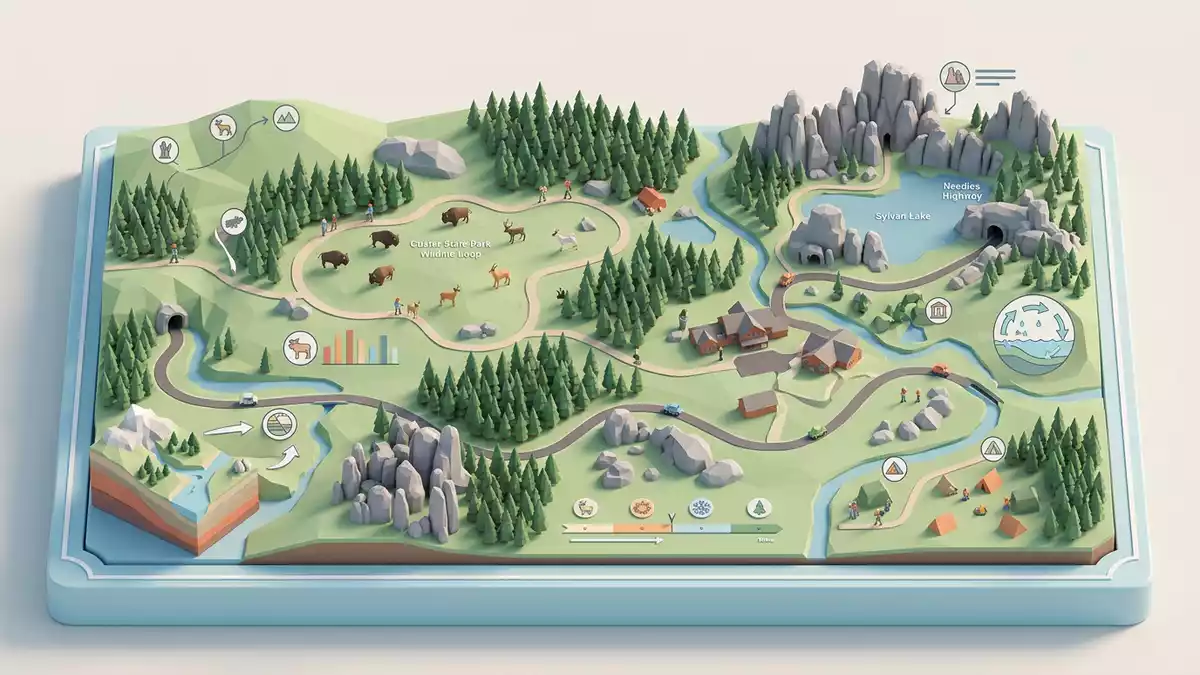
Custer State Park in the Black Hills of South Dakota is a landscape where slender granite spires, still lakes and free-roaming bison share the same wide basin. Established as a state park in the early twentieth century, it covers tens of thousands of acres of mixed prairie and forest within reach of the small town of Custer.
Granite needles and the high country of the Black Hills
The most striking feature of Custer State Park is the band of granite outcrops known as the Needles, a cluster of narrow pinnacles and fins that stand above the forest and grassland of the central Black Hills. These formations give their name to the Needles Highway, a scenic road that threads through pine and spruce woodland, open meadows and rugged stone, and forms part of the Peter Norbeck National Scenic BywayNeedles Highway. Along the route the rock rises in slender pillars that appear to pierce the skyline, creating a skyline of pale granite against the darker trees.
The road carries traffic through tunnels cut directly into the granite, some narrow enough that larger vehicles avoid them, and past named formations such as the Needle’s Eye, where erosion has carved an opening through a tall fin of rocka distinct granite formation. From many pull-outs the view takes in forested slopes, meadows and the irregular line of the spires, showing how the park’s terrain rises towards the higher central ridge of the Black Hills.
Sylvan Lake and the park’s water and woodland
At the northern end of Needles Highway, the landscape levels into a basin around Sylvan Lake, a reservoir created in 1881 when Theodore Reder built a dam across Sunday Gulch to form a mountain lakeSylvan Lake in Custer State Park. The water surface lies at around 1,873 m (6,145 ft) above sea level, ringed by granite boulders and low cliffs that frame the shoreline in pale rock. A short shore trail circles the lake, meeting patches of forest and crossing stretches of uneven stone close to the water’s edgeSylvan Lake Shore Trail.
Beyond Sylvan Lake, the park’s elevation falls towards rolling country of mixed grassland and woodland, with streams and smaller bodies of water scattered through the valleys. The terrain combines open prairie with stands of ponderosa pine and other conifers, with pockets of birch and aspen in moister hollowswoodland along Needles Highway. This variety of habitats underlies the park’s reputation for wildlife and gives many of its viewpoints a layered look, with grass, trees, rock and water sharing the frame.
Wildlife Loop Road and the park’s roaming herds
Custer State Park is known for its large herds of American bison, which graze across open sections of the park and are frequently seen from the Wildlife Loop Road, a circuit through gently rolling prairie and scattered pine standswildlife in Custer State Park. Alongside the bison, pronghorn, mule deer, white-tailed deer, elk, wild turkeys and smaller animals such as prairie dogs inhabit the same landscape, making the drive a concentrated introduction to the fauna of the Black Hills. In some areas feral burros have become a familiar sight near the road, adding a domestic note to an otherwise largely native set of speciesWildlife Loop Road.
The park covers roughly 71,000 to 73,000 acres of land, a size that gives its wildlife room to move across hills, valleys and open plains without losing the sense of a single, continuous protected areaarea and elevation. Bison in particular are treated as a central feature of the park’s identity, with the landscape of grass and scattered trees supporting a way of life in which large herbivores and smaller animals share the same broad spaces.
Visiting Custer State Park: what travellers from Western Europe should know
- Custer State Park lies south of the town of Custer in the Black Hills of South Dakota, reached by road connections including US Highway 16A and routes such as South Dakota Highway 87location near Custer.
- The terrain combines rolling prairie and forested hills with granite outcrops; some viewpoints and lakeside paths include uneven rock sections, and certain access routes use narrow tunnels cut through stone.
- Within the United States the official language is English and the currency is the United States dollar.
- Entry requirements depend on your nationality; UK travellers can check the FCDO travel advice at gov.uk/foreign-travel-advice, Irish travellers the Department of Foreign Affairs at ireland.ie.
Searching for Custer State Park on social platforms
These links open searches for Custer State Park on each platform.
Frequently asked questions about Custer State Park
Where is Custer State Park and what landscape does it occupy?
Custer State Park lies in the Black Hills of South Dakota, south of the town of Custer, and covers a mix of prairie, forest and granite high countryterrain of Custer State Park.
What can visitors expect on a first visit to Custer State Park?
A first visit reveals narrow granite spires along Needles Highway, the mountain lake at Sylvan Lake, and broad areas of grassland where bison and other wildlife graze within sight of the road.
What makes Custer State Park distinctive among Black Hills destinations?
The combination of high-country granite formations, a dammed mountain lake dating from 1881 and extensive free-roaming bison herds gives Custer State Park a character that contrasts with nearby memorial sites and towns.


