
De Dam, where Amsterdam grew from a river crossing
Published on 09/18/2026 at 13:19 | Editorial responsibility: Rafael Müller, Editor-in-Chief AD HOC NEWS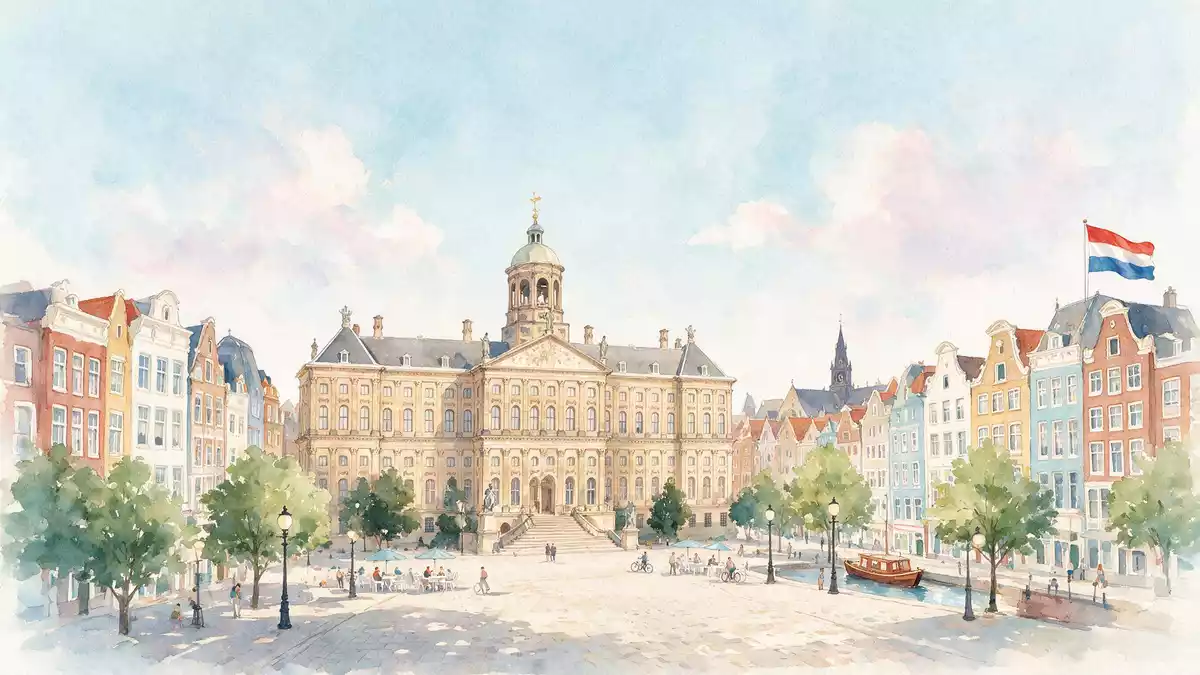
De Dam in Amsterdam is both a physical square and a historical starting point: a former dam across the Amstel River that became the civic heart of a growing trading city in the thirteenth century.
From medieval dam to city square
The story of De Dam begins with a dam built across the Amstel River in the thirteenth century, linking early settlements on either bank and protecting them from flooding.Dam Square was originally a dam As that dam was gradually widened, it ceased to be only a piece of hydraulic engineering and took on the role of a gathering space, large enough to function as a town square at the centre of the emerging Amsterdam.the dam became Amsterdam’s first market square
The original barrier across the water was known as Middeldam, while an adjoining western space called Plaetse formed with it a larger urban ensemble that corresponds to the square experienced today.Middeldam and Plaetse together formed Dam Square Traders set up a fish market on the dam, ships moored to load and unload goods and a weighing house was added, turning this stretch of former river into a compact marketplace and point of administration.
Civic architecture around De Dam
Walking onto De Dam, the most prominent building is the Royal Palace Amsterdam, a seventeenth-century structure that began life as the city hall before becoming a royal residence under Louis Napoleon in 1808.Royal Palace Amsterdam started as city hall Its dark stone façade and classical mass form a backdrop along one side of the square, marking De Dam as a seat of civic power as well as everyday activity.Amsterdam’s central square is home to the Royal Palace
Beside the palace stands the Nieuwe Kerk, a Gothic church whose history reaches back to the fifteenth century and which occupies an address directly on the square.Nieuwe Kerk stands on De Dam next to the palace Opposite this cluster of brick and stone rises the National Monument, a tall white obelisk completed in 1956 as a memorial to civilians and soldiers who died in the Second World War.the National Monument was built in 1956 as a war memorial Together these structures give De Dam a layered architectural character, combining medieval trading origins with seventeenth-century civic building and twentieth-century remembrance.
De Dam as Amsterdam’s historic centre
De Dam sits at the geographic centre of Amsterdam and at the point where the city’s name itself arose from the description of a dam on the Amstel.the city’s name refers to the dam on the Amstel Early inhabitants built dikes along the river and the dam between them created a crossing that drew merchants, fishmongers and officials, gradually transforming a piece of water management into a recognisable city square defined by stone buildings and open cobbles.Dam Square traces its origins to a thirteenth-century dam
As Amsterdam’s influence grew, De Dam served as both marketplace and symbol of government, hosting administrative buildings, memorials and ceremonies linked to the Netherlands’ wider history.De Dam has long been a place of trade and government The square’s stone paving, surrounding façades and visible monuments make it a compact summary of several centuries of Dutch urban development, all concentrated around the site where a thirteenth-century dam once held back the Amstel.
Visiting De Dam: what travellers from Western Europe should know
- De Dam lies in the historic centre of Amsterdam, reached on foot from Amsterdam Centraal railway station along Damrak and Rokin.
- The square is paved and largely level, with kerbs and steps around the Royal Palace and Nieuwe Kerk that require short climbs between street and building entrances.
- The official language is Dutch and the currency is the euro.
Searching for De Dam on social platforms
These links open searches for De Dam on each platform.
Frequently asked questions about De Dam
Where is De Dam in Amsterdam?
De Dam is the central square of Amsterdam, located in the historic core of the city between Damrak and Rokin, a short walk from Amsterdam Centraal.
What can visitors expect when they reach De Dam?
Visitors find an open paved square framed by the Royal Palace, the Gothic Nieuwe Kerk and the National Monument, with surrounding streets lined by shops and other buildings.
What makes De Dam distinctive among Amsterdam’s squares?
De Dam occupies the site of the original thirteenth-century dam on the Amstel and combines that founding role with major civic architecture and a national war memorial.


