
Denali National Park and the road into Alaska’s high wilderness
Published on 09/01/2026 at 07:08 | Editorial responsibility: Rafael Müller, Editor-in-Chief AD HOC NEWS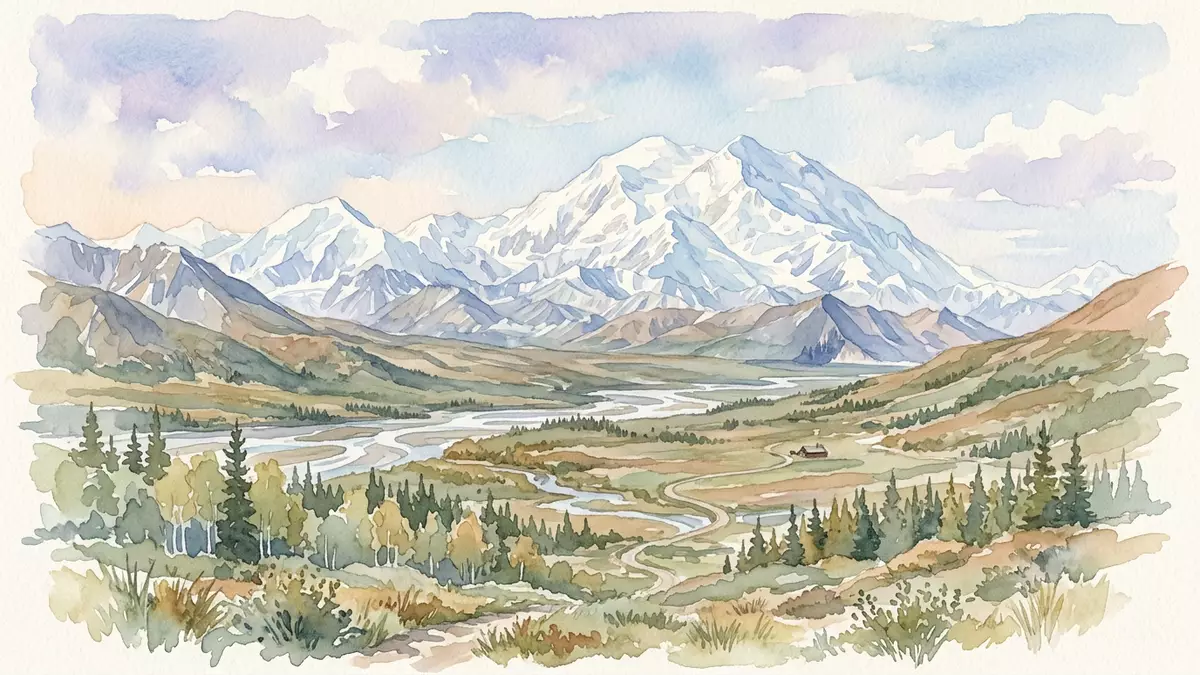
Denali National Park in Interior Alaska is built around a single road that runs from the park entrance deep into sub?arctic wilderness beneath the mountain known as Denali, North America’s highest peak at 6,190 m (20,310 ft).
A vast sub?arctic landscape shaped around one great mountain
Denali National Park and Preserve lies in Interior Alaska, roughly between Anchorage to the south and Fairbanks to the north, in the central section of the Alaska Range where the high peaks rise above broad valleys and rolling tundra.central Alaska Range location The park and its adjoining preserve together cover just over 6 million acres of protected land, an area larger than several US states and extensive enough to contain entire river systems, mountain chains and lowland forests within a single boundary.more than 6 million acres
The landscape within Denali ranges from boreal forest at lower elevations to alpine tundra higher on the slopes, with glaciers and permanent snowfields draped across the upper reaches of the Alaska Range.alpine tundra and boreal forest Denali itself rises far above this landscape, its summit at 6,190 m (20,310 ft) giving it the highest elevation of any mountain in North America and a vertical relief of more than 5,000 m from base to summit that dominates views across the park on clear days.summit elevation and vertical relief
From Mount McKinley National Park to Denali National Park and Preserve
The protected area around Denali was first established by the United States Congress in 1917 as Mount McKinley National Park, one of the earliest national parks created in Alaska and the first explicitly founded to protect wildlife such as Dall sheep in their natural mountain habitat.established as Mt. McKinley National Park in 1917 In 1980 the park was greatly enlarged and redesignated as Denali National Park and Preserve under the Alaska National Interest Lands Conservation Act, bringing surrounding wilderness into the protected area while adding the preserve category for regions where certain traditional uses continue.expansion and redesignation in 1980
The name Denali reflects Indigenous Athabaskan languages of Interior Alaska, where “Denali” is used for the high mountain that forms the centre of the park and means “the tall one” or “mountain?big” in Koyukon, a language of communities along the middle Yukon River.Athabaskan origin of the name Denali Long before the 1917 legislation, archaeological evidence shows human presence in the Denali region dating back many thousands of years, with sites near the present?day boundaries indicating that people have moved through and lived in these valleys for more than 8,000 years.
The Denali Park Road: a single route into wilderness
For travellers, the most striking practical feature of Denali National Park is that a single road threads across the landscape: the Denali Park Road, a largely gravel route of about 92 miles that runs from the park entrance near the settlement of Denali Park westwards into the interior.length of the park road The road follows a sequence of valleys and passes, climbing gradually from forest to open tundra and crossing rivers whose courses have cut deeply into the surrounding terrain, and it remains the only vehicle route that penetrates far beyond the entrance area.
A journey along the Denali Park Road reveals how varied the park’s ecosystems are, as spruce and birch forest give way to dwarf shrubs and open ground, and views expand towards glaciers and high ridges of the Alaska Range that frame Denali’s snow?covered bulk on the horizon.central region and main peak Wildlife is part of this road landscape: the park’s sub?arctic ecosystem supports large mammals including grizzly bears, wolves, moose and Dall sheep, as well as many species of birds that move with the seasons along river corridors and across the tundra.sub?arctic ecosystem with large mammals
Visiting Denali National Park: what travellers from Western Europe should know
- Denali National Park is reached via the George Parks Highway in Interior Alaska, with the park entrance near Denali Park roughly between Anchorage and Fairbanks.
- The Denali Park Road includes long gravel sections, river crossings and exposed stretches of tundra landscape, so conditions along the route vary with weather and elevation.
- The terrain around the road and viewpoints features uneven ground, changes in elevation and, on some trails, sections above the tree line where there is little shelter.
- The official language is English and the currency is the US dollar.
- Entry requirements depend on your nationality; UK travellers can check the FCDO travel advice at gov.uk/foreign-travel-advice, Irish travellers the Department of Foreign Affairs at ireland.ie.
Searching for Denali National Park on social platforms
These links open searches for Denali National Park on each platform.Frequently asked questions about Denali National Park
Where is Denali National Park located?
Denali National Park and Preserve is in Interior Alaska, in the central Alaska Range between Anchorage and Fairbanks, with its entrance near Denali Park.
What should travellers expect on a visit to Denali National Park?
A visit centres on the Denali Park Road, which leads through boreal forest, tundra and river valleys into a large sub?arctic wilderness where wildlife and high mountain scenery are central features.
What makes Denali National Park distinctive among national parks?
Denali is distinctive for combining more than 6 million acres of protected land with North America’s highest mountain and a single road that offers access deep into a largely undeveloped landscape.


