
Dendera Temple Complex and the sandstone world of Hathor
Published on 08/14/2026 at 14:03 | Editorial responsibility: Rafael Müller, Editor-in-Chief AD HOC NEWS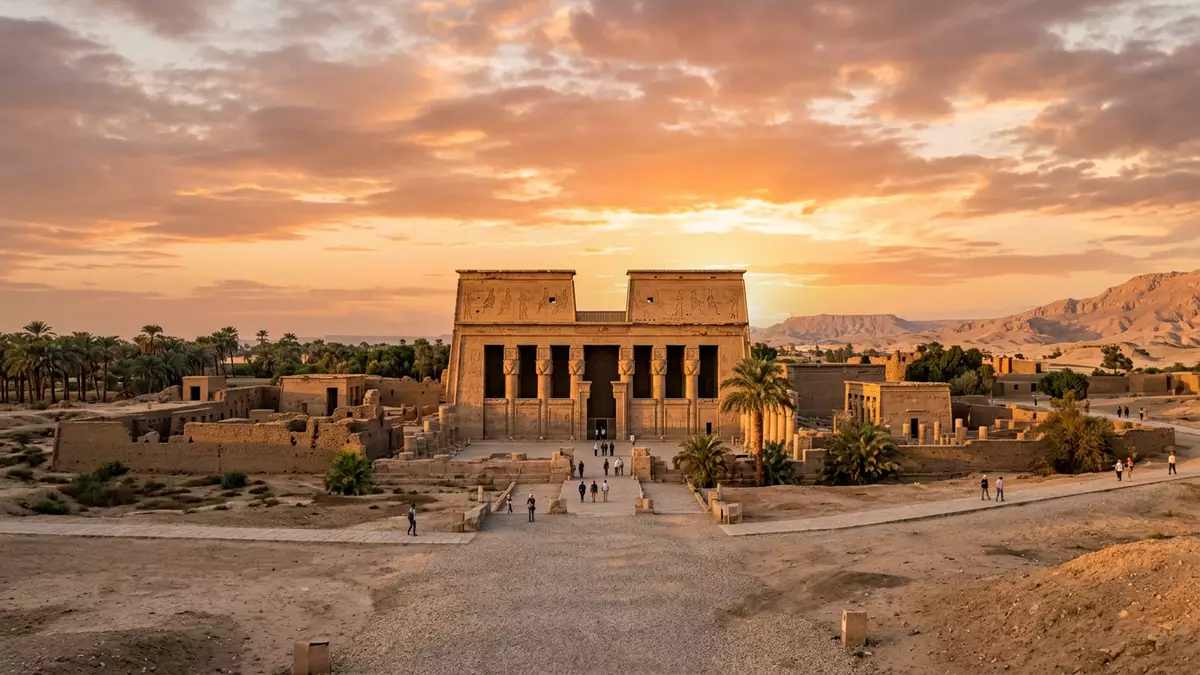
South of Qena on the west bank of the Nile, Dendera Temple Complex presents an extensive sandstone world dedicated to the goddess Hathor, laid out behind a great enclosure wall and remarkably preserved in its late Ptolemaic and Roman form.
Sandstone halls and a walled sacred city
The heart of Dendera Temple Complex is the Temple of Hathor, a sandstone building that dominates an area enclosed by a substantial mudbrick wall.The whole complex covers some 40,000 square metres and the temple stands roughly in its centre.
The enclosure wall, built of air-dried bricks, defines a rectangle whose sides extend for hundreds of metres, framing gateways built under Roman rule on its north and east sides.Roman-period portals pierce the enclosure, leading towards the temple across open ground and secondary structures.
The Ptolemaic and Roman Temple of Hathor
The present Temple of Hathor belongs to the late Ptolemaic period, with its main construction beginning under Ptolemy XII Auletes in the first century BC.Construction of the main temple began in 54 BCE under Ptolemy XII, continuing under Cleopatra VII and into the Roman era.
Decoration and additional elements of the temple carried on under Roman emperors, with the great hypostyle hall completed during the rule of Tiberius and other imperial names inscribed on entrances and façades.Inscriptions record work continuing into the first century AD, leaving a dense record of Greco-Roman patronage over an Egyptian cult building.
Older layers: mammisi, birth houses and long continuity
Beneath the dominant Ptolemaic and Roman temple lies a longer history, visible in structures such as the mammisi, or birth house, built under the reign of Nectanebo II.This birth house is the earliest surviving building in the compound, standing northwest of the main sanctuary.
Within the walls of Dendera Temple Complex lie further elements of a long-lived cult site, including a sacred lake, a basilica and additional birth houses, reflecting centuries of ritual practice focused on Hathor and associated deities.The complex includes birth houses and a sacred lake, creating a layered religious landscape where successive dynasties added to an established sacred focus.
Visiting Dendera Temple Complex: what travellers from Western Europe should know
- Dendera Temple Complex stands on the west bank of the Nile south of Qena in Upper Egypt, reached by road from Qena and by excursions from Luxor.
- Within the enclosure, access to the Temple of Hathor and its roof involves stone staircases and corridors that can be narrow and steep in places.
- The official language is Arabic and the currency is the Egyptian pound.
- Entry requirements depend on your nationality; UK travellers can check the FCDO travel advice at gov.uk/foreign-travel-advice, Irish travellers the Department of Foreign Affairs at ireland.ie.
Searching for Dendera Temple Complex on social platforms
These links open searches for Dendera Temple Complex on each platform.
Frequently asked questions about Dendera Temple Complex
Where is Dendera Temple Complex located?
Dendera Temple Complex lies on the west bank of the Nile south of Qena in Upper Egypt, within reach of road links from Qena and Luxor.
What can visitors expect inside the complex?
Visitors encounter the sandstone Temple of Hathor, its hypostyle hall and roof access, alongside birth houses, a sacred lake and other ancient structures within the walled precinct.
What makes Dendera Temple Complex distinctive among Egyptian temple sites?
Dendera Temple Complex is distinctive for its large enclosed area, late Ptolemaic and Roman Temple of Hathor, early mammisi and the combination of multiple ritual buildings within a single mudbrick-walled compound.


