
Dinh Doc Lap, Ho-Chi-Minh-Stadt’s modernist palace of power
Published on 08/25/2026 at 17:59 | Editorial responsibility: Rafael Müller, Editor-in-Chief AD HOC NEWS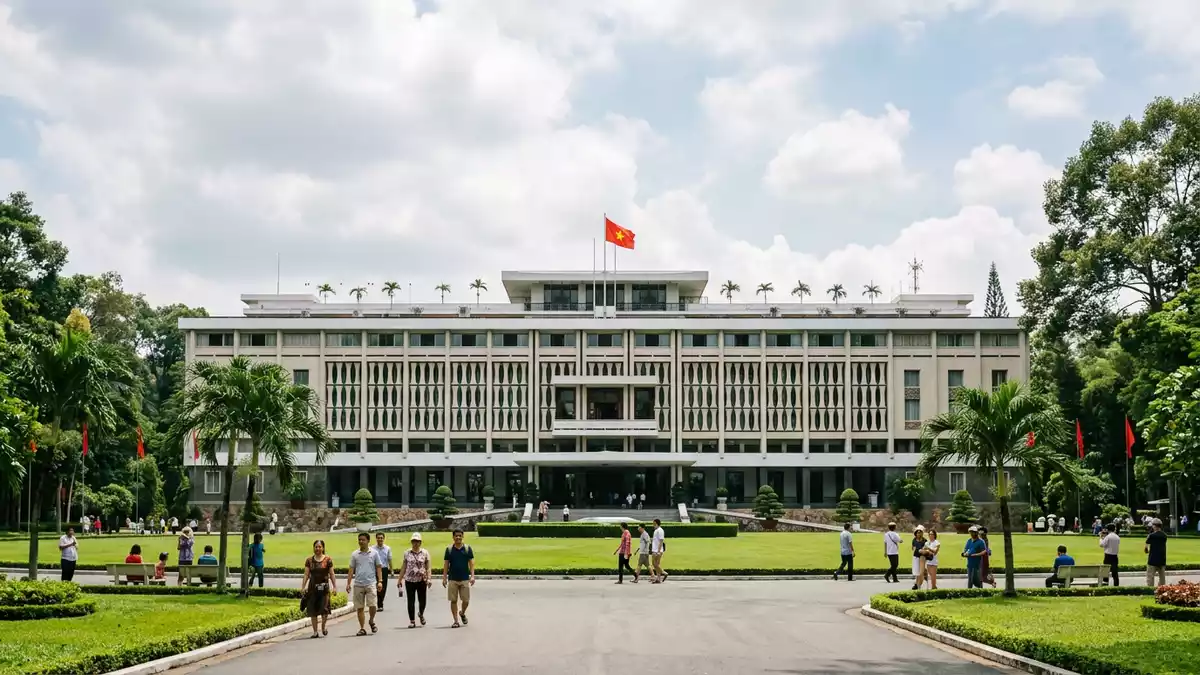
Dinh Doc Lap in Ho-Chi-Minh-Stadt, known in English as the Independence Palace or Reunification Palace, is a modernist presidential complex built in the 1960s for South Vietnam’s head of state. Its concrete grids, ceremonial halls and war rooms form a rare intact record of the Republic of Vietnam’s final years and of the moment Saigon became Ho Chi Minh City in 1975.
A 1960s palace at the heart of Ho-Chi-Minh-Stadt
The Independence Palace stands at 135 Nam Ky Khoi Nghia Street in Ben Thanh Ward, District 1, a central address surrounded by busy city streets on all sides.135 Nam Ky Khoi Nghia Street The compound covers an urban block framed by Nam Ky Khoi Nghia, Huyen Tran Cong Chua, Nguyen Thi Minh Khai and Nguyen Du, yet the main building is set back behind lawns and mature trees that give it a formal approach.bounded by four major streets
The present palace was completed in the mid-1960s to designs by architect Ngo Viet Thu, whose scheme replaced an earlier colonial residence on the same site.architect Ngo Viet Thu Built during the Vietnam War as the official residence and workplace of the president of the Republic of Vietnam, it later gained worldwide visibility in April 1975 when North Vietnamese tanks reached its forecourt and the regime collapsed.the fall of Saigon in 1975
Modernist architecture with ceremonial grandeur
The palace complex follows a largely symmetrical plan, with the main block aligned along a central axis that runs from a circular lawn and fountain through the entrance, reception rooms and out towards the rear terraces.palace complex The main building rises several storeys above a broad podium, its façades organised by concrete brise-soleil screens that shade long rows of windows and give the structure a distinctive rhythmic pattern.
Inside, the architecture combines clean-lined modern forms with decorative references to traditional Vietnamese motifs. The principal state rooms occupy the upper levels, including a reception hall, a cabinet meeting room and a panoramic formal dining space used for official banquets during the presidency of Nguyen Van Thieu.residence and office of President Nguyen Van Thieu Furnishings, carpets and artworks preserve the aesthetic of late 1960s state interiors, from low sofas and lacquer panels to map-lined walls in planning rooms.
From seat of government to national historic site
The site’s story reaches back to the nineteenth century, when the French colonial administration built Norodom Palace as its headquarters in Saigon in the late 1860s.Norodom Palace built in 1868 After the 1954 Geneva Accords and the formation of the Republic of Vietnam, Prime Minister Ngo Dinh Diem renamed the residence Independence Palace, tying it to the new South Vietnamese state.renamed the Independence Palace
A bombing in 1962 severely damaged the old structure and cleared the way for Ngo Viet Thu’s new design, which was inaugurated as the presidential palace in the second half of the decade.bombing in 1962 and new palace After 1975 the complex changed role, serving government functions under the unified Vietnamese state while also becoming a museum that presents the history of the Vietnam War and the country’s reunification.
Exploring war rooms, salons and rooftop helipad
A visit to Dinh Doc Lap leads from formal receiving rooms down to the basement command spaces that once handled military communications. The underground level contains a bunker with communication equipment, narrow corridors and operations rooms that recall the palace’s role as a wartime command centre.underground bunker level On the rooftop, a helicopter stands near the edge, marking the site’s association with dramatic helicopter landings and evacuations in the final stages of the conflict.helicopter on the roof
The gardens around the palace soften the geometry of the main block with lawns, ornamental planting and shaded paths. Within the grounds, secondary structures house exhibitions that expand on the story of the palace, including displays on earlier phases from Norodom Palace to the construction of the modern building between 1962 and 1966.history of Independence Palace Together, the preserved interiors and outdoor setting make the site both an architectural landmark and a compact introduction to Vietnam’s twentieth-century political history.
Visiting Dinh Doc Lap: what travellers from Western Europe should know
- Dinh Doc Lap stands in District 1 of Ho-Chi-Minh-Stadt at 135 Nam Ky Khoi Nghia Street, within the Ben Thanh area of central Ho Chi Minh City and surrounded by major roads.Ben Thanh Ward, District 1
- The main approach from Nam Ky Khoi Nghia Street crosses a broad lawn to the front steps, and the visit inside involves moving between storeys by staircases within the palace.
- The palace grounds include open gardens exposed to the tropical climate of southern Vietnam, while the interior areas range from large air-conditioned halls to the more enclosed bunker level beneath the main building.
- The official language is Vietnamese and the currency is the Vietnamese dong.
- Entry requirements depend on your nationality; UK travellers can check the FCDO travel advice at gov.uk/foreign-travel-advice, Irish travellers the Department of Foreign Affairs at ireland.ie.
Searching for Dinh Doc Lap on social platforms
These links open searches for Dinh Doc Lap on each platform.
Frequently asked questions about Dinh Doc Lap
Where is Dinh Doc Lap located?
Dinh Doc Lap is in District 1 of Ho Chi Minh City, at 135 Nam Ky Khoi Nghia Street within Ben Thanh Ward, surrounded by major streets on all sides.
What can visitors expect inside the palace complex?
Visitors encounter preserved 1960s state rooms, meeting halls, an underground bunker level and a rooftop with a helicopter, alongside gardens and exhibition spaces.
What makes Dinh Doc Lap distinctive among Saigon landmarks?
The palace combines modernist 1960s architecture by Ngo Viet Thu with historic interiors and war rooms that directly reflect the Vietnam War and the country’s reunification.


