
Djoudj National Bird Sanctuary and its migratory wetlands
Published on 09/16/2026 at 22:30 | Editorial responsibility: Rafael Müller, Editor-in-Chief AD HOC NEWS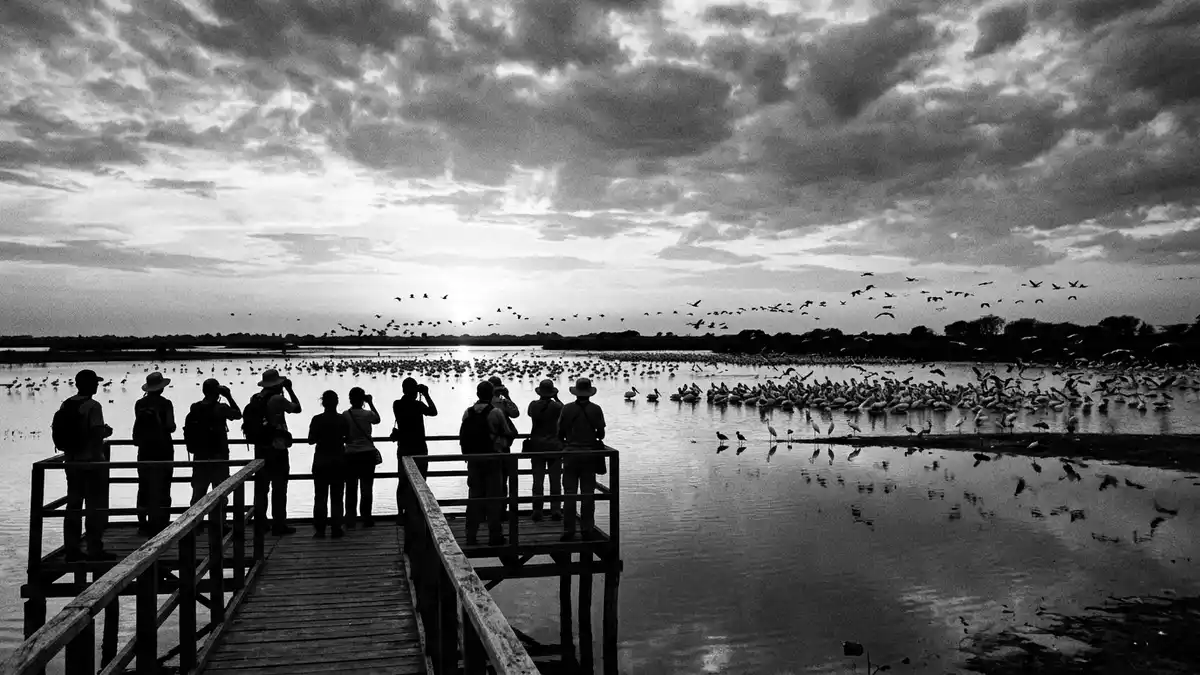
Djoudj National Bird Sanctuary in northern Senegal is a broad wetland landscape in the lower Senegal River delta where open water, reed beds and seasonally flooded plains form a crucial stopover for migratory birds moving between Europe and West Africa. Created as a protected area in 1971, it later gained international recognition as both a Ramsar Wetland of International Importance and a UNESCO World Heritage Site, placing this remote corner of the Saint-Louis Region firmly on the global conservation map.Djoudj National Bird Sanctuary
A river-delta wetland on the edge of the Sahara
Djoudj National Bird Sanctuary lies in the extreme north-west of Senegal, in the flat, low-lying valley of the Senegal River close to the border with Mauritania, north-east of the historic city of Saint-Louis.extreme northwest of the country The sanctuary occupies part of the river delta where fresh water spreads out into lakes, backwaters and floodplains, creating a mosaic of channels and shallow basins edged by marsh vegetation. Much of the protected core covers around 16,000 hectares of wetlands centred on a large lake, within a wider national park area of roughly 160 square kilometres.16,000 ha wetland ecosystemapproximately 160 square kilometers
Hydrologically, Djoudj sits where the Senegal River’s waters slow and spread after descending from the interior, just south of the Mauritanian frontier. During the wet season, wide tracts of the valley are inundated, leaving shallow sheets of water dotted with islets and traversed by natural bayous and artificial canals. As the floods recede, exposed mudflats, sedge patches and reed-lined pools remain, offering feeding grounds and roosts for waterbirds. The sanctuary adjoins Diawling National Park across the border in Mauritania, forming a cross-border wetland complex embedded in the arid Sahel belt.adjoining Diawling National Park
Migratory birds and Sahel wildlife
Djoudj’s international importance rests on the immense concentrations of birds that use the sanctuary’s waters and marshes, especially Palearctic migrants that have crossed the Sahara from Europe and North Africa. The wetland provides rest, feeding and wintering grounds for around one and a half million birds of hundreds of species, including more than 120 Palearctic migrant species.a million and a half birds Large colonies of white pelican are one of the sanctuary’s signature sights, accompanied by African spoonbill, purple heron, great egret, cormorant and pink flamingo among many other waterbirds.white pelican and African spoonbill
Beyond the birds, Djoudj supports characteristic Sahelian fauna. The marshes and lagoons contain populations of West African crocodile and West African manatee, while the surrounding drylands host antelope and other mammals adapted to the transition zone between desert and savanna.crocodiles and manatees For ornithologists and nature travellers from Western Europe, Djoudj offers a rare chance to observe species whose annual journeys link European wetlands with West African floodplains. The dense flocks on open water, mixed heron roosts in emergent vegetation and long lines of waders along exposed banks make the sanctuary a key field site for studying migration dynamics along the East Atlantic flyway.first freshwater wetlands that Palearctic migratory birds reach
From national park to international recognition
The protected area was established by presidential decree on 14 April 1971, under the official French name Parc national des oiseaux du Djoudj, securing a significant portion of the natural floodplain from agricultural conversion and uncontrolled hunting.created in 1971 In 1975 the boundaries were extended, and in 1977 the wetland core of 16,000 hectares was designated as a Ramsar Site, recognising its international importance for waterbirds.Ramsar Site in 1977
In 1981 Djoudj National Bird Sanctuary was inscribed on the UNESCO World Heritage List as a natural property under criteria vii and x, highlighting both its striking wetland landscapes and its outstanding value for biodiversity conservation.inscribed on the World Heritage List in 1981 The park has twice been placed on the List of World Heritage in Danger due to ecological pressures, including invasive aquatic vegetation linked to upstream dam construction, leading to targeted international support for management and restoration.World Heritage in Danger from 1984-1988 and from 2000-2006 Long-standing links with other wetland reserves, such as the Camargue in France and Diawling National Park in Mauritania, underline Djoudj’s place within a wider network of migratory bird sites spanning Europe and Africa.twinned with the Camargue and Diawling
Visiting Djoudj National Bird Sanctuary: what travellers from Western Europe should know
- Djoudj National Bird Sanctuary lies north-east of Saint-Louis in northern Senegal, within the lower Senegal River delta and fairly close to the border with Mauritania; most visitors approach it by road from Saint-Louis.
- The terrain inside the sanctuary includes flat floodplain tracks, embankments beside canals and boat access along river channels; during the wet season, large areas are inundated and movement concentrates on raised routes and watercraft.
- The surrounding region belongs to the semi-arid Sahel belt, with hot dry-season conditions and a distinct rainy season that floods the valley; sun exposure on open embankments and boats is strong, while mosquito presence increases near still water.
- English is not an official language in Senegal; the official language is French and the currency is the West African CFA franc.
- Entry requirements depend on your nationality; UK travellers can check the FCDO travel advice at gov.uk/foreign-travel-advice, Irish travellers the Department of Foreign Affairs at ireland.ie.
Searching for Djoudj National Bird Sanctuary on social platforms
These links open searches for Djoudj National Bird Sanctuary on each platform.
Frequently asked questions about Djoudj National Bird Sanctuary
Where is Djoudj National Bird Sanctuary located?
Djoudj National Bird Sanctuary is in the lower Senegal River delta in northern Senegal, north-east of Saint-Louis and close to the border with Mauritania.
What can visitors expect when exploring the sanctuary?
Visitors encounter open lakes, marshes, canals and floodplains used by large flocks of waterbirds, with access typically along embankments and by boat on calm river channels.
What makes Djoudj National Bird Sanctuary distinctive among African wetlands?
Djoudj stands out for the concentration of migratory waterbirds that reach its freshwater wetlands after crossing the Sahara, combined with formal recognition as both a Ramsar site and a UNESCO World Heritage wetland.


