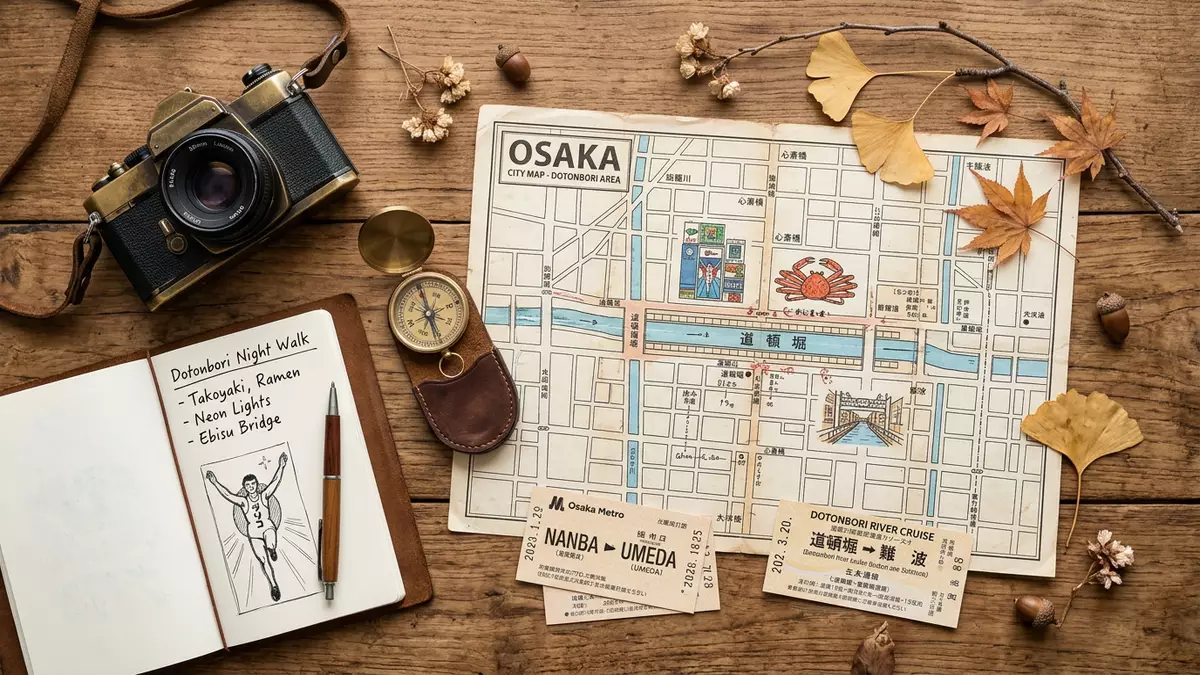
Dotonbori's neon canal and bridgefront
Published on 08/11/2026 at 15:17 | Editorial responsibility: Rafael Müller, Editor-in-Chief AD HOC NEWS
Dotonbori is one of Osaka’s most recognisable districts, stretching along the canal that gives the area its name. The scene is defined by bridgefronts, long signboards and a dense strip of restaurants and theatres.
Dotonbori’s canal edge and bridge line
The canal remains the district’s organising feature, with streets and shopfronts running close to the water. Ebisubashi is one of the best-known crossing points, and the river edge gives Dotonbori its long, narrow profile.
Much of the appeal lies in the density of surfaces: metal shutters, tiled façades, illuminated signs and projecting canopies. The district reads as a layered commercial frontage rather than a single monument.
Entertainment, food and street frontage
Dotonbori developed as a place for eating, strolling and evening entertainment, and that use still shapes its streets. Restaurants, bars and theatres sit close together, while the neon signs turn the canal side into a continuous public frontage.
The district’s most familiar symbols include the Glico running man sign and the oversized moving crab façades associated with local seafood restaurants. These features sit among smaller shop signs, ticket windows and pedestrian crossings.
A district shaped by signs and movement
What distinguishes Dotonbori is not a single building but the accumulation of signs, bridges and storefronts. The district changes from day to night as the illuminated façades become the main visual layer.
Walking here means moving between narrow pavements, bridge approaches and busy arcades that open onto the canal. The place is a compact cross-section of Osaka’s commercial and leisure culture, with water and street life placed side by side.
Visiting Dotonbori: what travellers from Western Europe should know
- Dotonbori is in central Osaka and is reached by rail, metro and on foot from the surrounding city centre.
- Admission arrangements and opening hours are set by the site's operator and change with the season; the official website is the only binding source.
- Evenings bring the strongest visual effect, when the signs and façades are lit and the canal edge is busiest.
- The area is flat, urban and easy to walk, with bridge crossings, pavements and crowded pedestrian space.
- Japanese is the main language on signage, though restaurants and shops in the district often use some English; cashless payment is widespread, but not universal.
- Entry requirements depend on your nationality. UK travellers should check the FCDO travel advice at gov.uk/foreign-travel-advice; Irish travellers the Department of Foreign Affairs at ireland.ie; EU and EEA citizens their own national foreign ministry.
Searching for Dotonbori on social platforms
These links open searches for Dotonbori on each platform.
Frequently asked questions about Dotonbori
Where is Dotonbori?
Dotonbori is a canal-side district in Osaka, close to the city centre. It sits along one of the best-known entertainment corridors in the city.
What should visitors expect?
Expect restaurants, illuminated signs, bridges and a steady flow of pedestrians. The area is compact, visually busy and centred on walking beside the canal.
What makes Dotonbori distinctive?
Its identity comes from the combination of water, commerce and signage along a single urban strip. The district’s neon façades and bridge crossings make it immediately recognisable within Osaka.