
Drottningholms slott and its layered royal landscape
Published on 09/17/2026 at 20:22 | Editorial responsibility: Rafael Müller, Editor-in-Chief AD HOC NEWS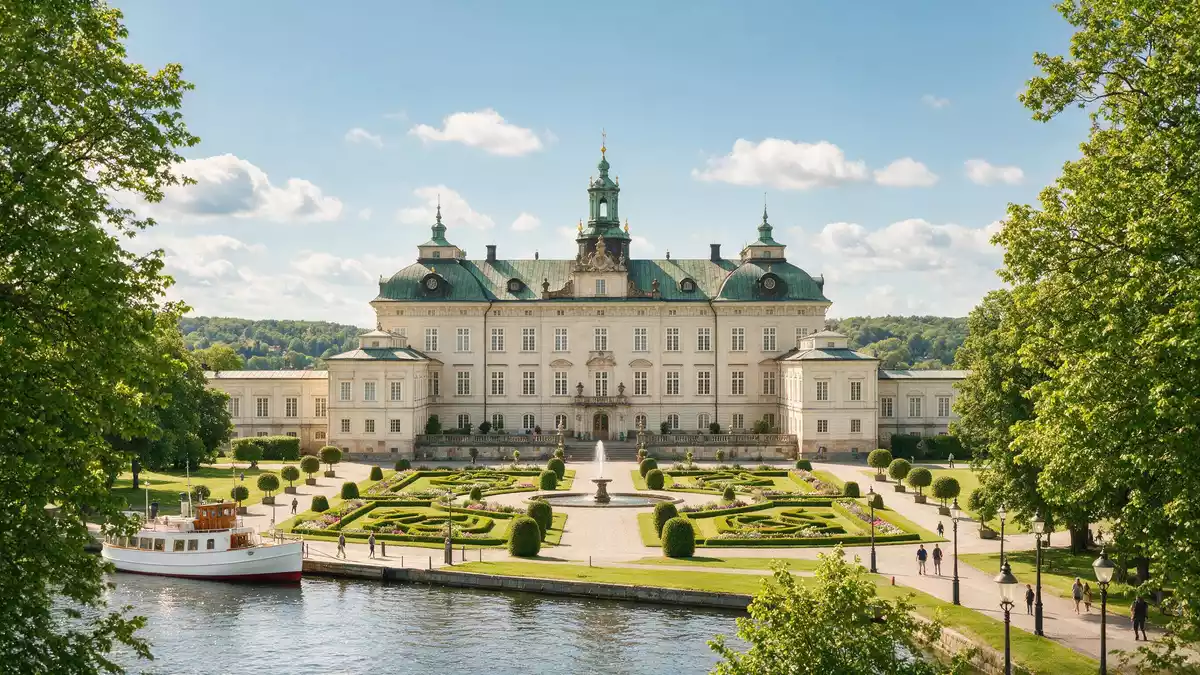
Drottningholms slott stands on Lovön west of Stockholm as a royal ensemble of palace, theatre and gardens. Its main palace dates to the later seventeenth century and carries the imprint of Nicodemus Tessin the Elder and his son, Nicodemus Tessin the Younger.
A palace shaped after fire and court ceremony
The present palace grew after the earlier building on the site was destroyed by fire in 1661. Hedvig Eleonora commissioned Nicodemus Tessin the Elder, and work began in 1662 on a Baroque residence that helped define Sweden’s court architecture.
The ensemble was later recognised as a World Heritage site in 1991. The Royal Domain of Drottningholm is presented as an exceptionally well-preserved palace landscape close to Stockholm, with original interiors and formal grounds.
The theatre and pavilion in the park
Two buildings give the estate much of its character: the Drottningholm Palace Theatre and the Chinese Pavilion. The theatre was built in 1766 for Queen Lovisa Ulrika, and the pavilion stands in the palace park at Lovön.
That combination of palace, stage and garden buildings makes the site more than a single monument. It reads as a layered royal setting from the seventeenth and eighteenth centuries, with court life visible in several forms at once.
Baroque order beside lighter eighteenth-century rooms
The palace belongs to the Baroque world of axial planning, formal rooms and disciplined façades. UNESCO describes the broader domain as representative of seventeenth- and eighteenth-century western and northern European architecture.
Inside that framework, the palace theatre and Chinese Pavilion add different voices. One carries court performance, the other a fashion for chinoiserie, and together they widen the estate beyond a single royal residence.
The park, the theatre and the pavilion are all part of the same cultural landscape. That makes Drottningholms slott read as both a residence and a sequence of connected royal spaces.
Visiting Drottningholms slott: what travellers from Western Europe should know
- Lovön lies west of Stockholm, and Drottningholms slott is reached through the road network across the island. The palace park and the theatre sit within the same royal domain.
- The estate spreads across formal grounds, parkland and separate buildings. The theatre and the Chinese Pavilion are distinct parts of the wider ensemble.
- Much of the appeal lies in moving between palace rooms, the theatre and the gardens rather than in a single object. The domain is arranged as a linked sequence of royal spaces.
- The official language is Swedish and the currency is the Swedish krona.
Searching for Drottningholms slott on social platforms
These links open searches for Drottningholms slott on each platform.
Frequently asked questions about Drottningholms slott
Where is Drottningholms slott?
It stands on Lovön in Stockholm County, west of central Stockholm. The palace belongs to the Royal Domain of Drottningholm on the island in Lake Mälaren.
What does a visit involve?
The estate combines palace interiors, the palace theatre and the Chinese Pavilion. The setting is a royal landscape rather than a single building, so the grounds are part of the experience.
What makes it distinctive?
The combination of a seventeenth-century Baroque palace, an eighteenth-century theatre and a Chinese-style pavilion gives the site its character. The World Heritage designation underlines that layered ensemble.


