
Dujiangyan and the layered logic of water
Published on 09/19/2026 at 06:34 | Editorial responsibility: Rafael Müller, Editor-in-Chief AD HOC NEWS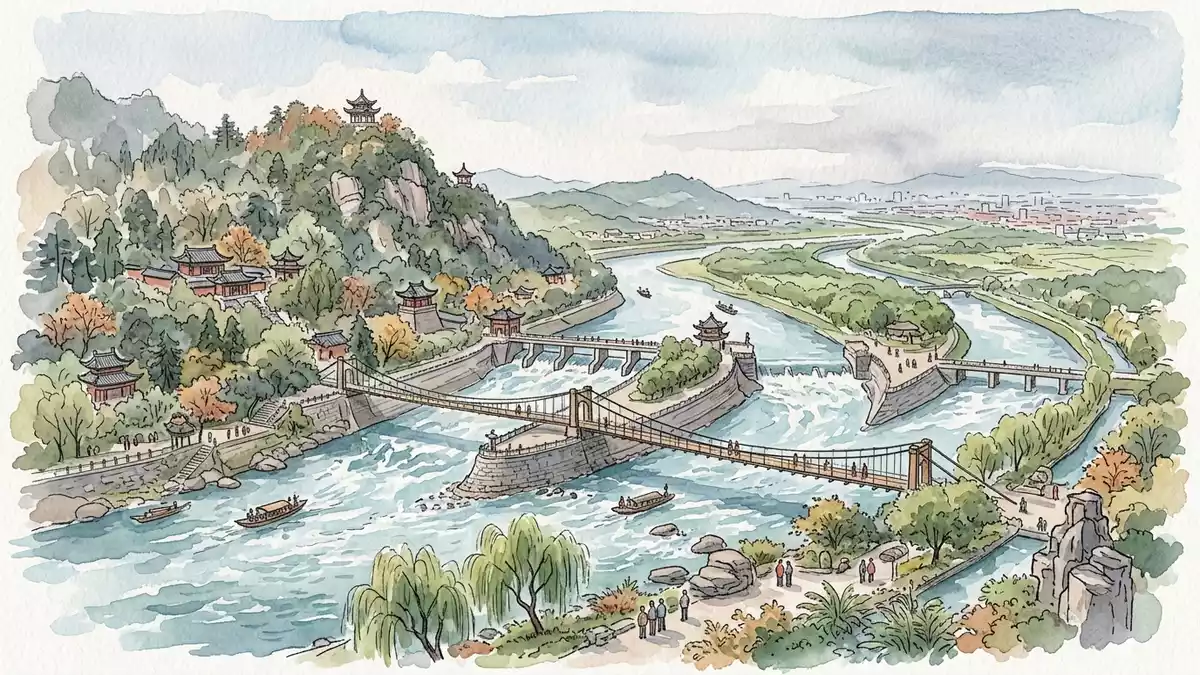
Dujiangyan is an ancient waterworks west of Chengdu, set on the Minjiang River at the edge of the Chengdu Plain. Its stone channels, dikes and intake works give the site a layered, engineered look that remains legible on foot.
Stone works on the Minjiang
The irrigation system began in the third century BC and is linked to Li Bing, a Qin official. It was inscribed on the World Heritage List in 2000, together with Mount Qingcheng, under the name Mount Qingcheng and the Dujiangyan Irrigation System.
The system centres on the Yuzui, the Feishayan and the Baopingkou. These works divide the river, shed excess water and carry flow into the irrigation channels beyond the main stream.
A heritage landscape in use
The site belongs to the wider cultural landscape of western Sichuan, where water management and landscape are closely tied. The UNESCO description places the system in the western Chengdu flatlands, at the junction between the Sichuan basin and the Qinghai-Tibet plateau, and notes that it still regulates water from the Minjiang River.
Mount Qingcheng forms part of the same heritage area and is known in Chinese history as a Taoist mountain. The mountain and the irrigation works give the place both a technical character and a religious setting, linked by the same protected landscape.
Dujiangyan as a historical engineering ensemble
The surviving layout shows an early hydraulic system that works with the river’s course rather than enclosing it in a single barrier. The World Heritage documentation describes the system as originally constructed around 256 BC and enlarged in later dynasties.
That long history is visible in the combination of river works, embankments and channels spread across the site. The result is a place where engineering, cultivation and landscape remain intertwined in a form associated with the Qin state and with Li Bing.
Visiting Dujiangyan: what travellers from Western Europe should know
- The site lies west of Chengdu in Sichuan, on the Minjiang River. Rail links and roads connect Chengdu with the wider area.
- The river works spread across an open landscape rather than a compact building. Expect bridges, embankments and water channels rather than a single enclosed monument.
- The heritage area includes Mount Qingcheng as well as the irrigation works. The setting combines river terrain with a mountain landscape.
- The official language is Chinese and the currency is the Chinese yuan.
Searching for Dujiangyan on social platforms
These links open searches for Dujiangyan on each platform.
Frequently asked questions about Dujiangyan
Where is Dujiangyan?
It lies west of Chengdu in Sichuan, on the Minjiang River and within the heritage landscape shared with Mount Qingcheng.
What should visitors expect?
Expect a spread-out river landscape with stone works, channels and embankments. The experience is shaped by open terrain rather than by a single hall or temple.
What makes Dujiangyan distinctive?
It is an early hydraulic system associated with Li Bing and the Qin state, and it remains part of the working landscape of the Chengdu Plain.


