
Duomo di Amalfi: a cliffside cathedral above Amalfi’s square
Published on 09/18/2026 at 12:33 | Editorial responsibility: Rafael Müller, Editor-in-Chief AD HOC NEWS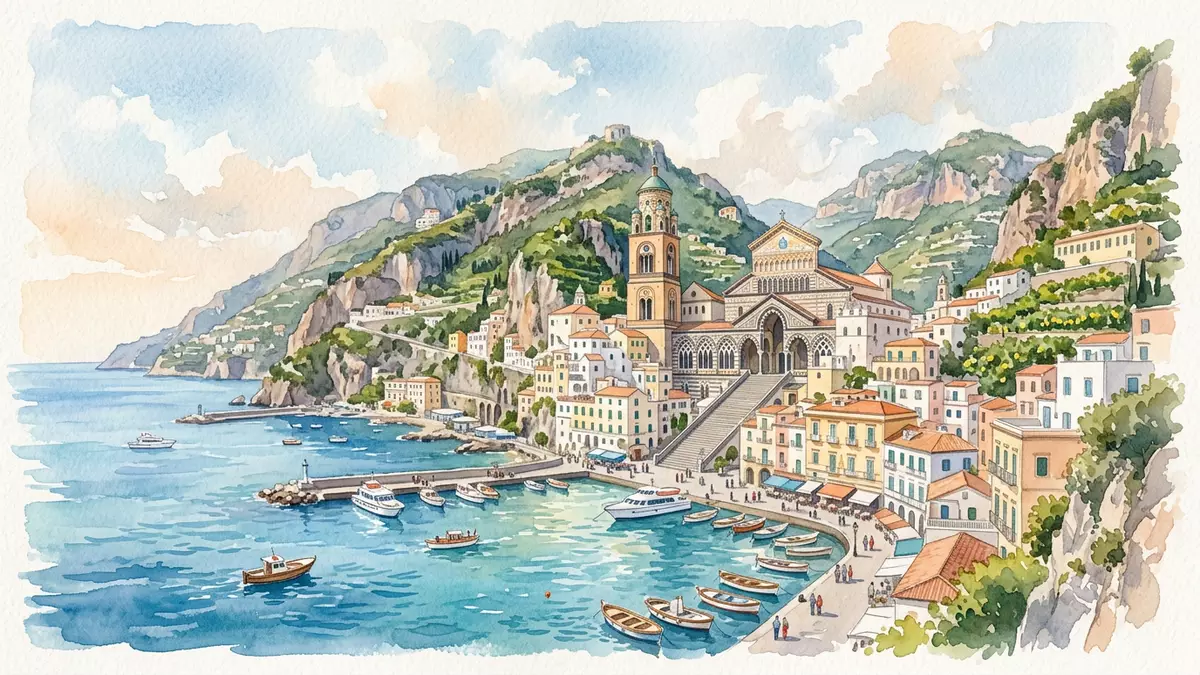
Duomo di Amalfi, the cathedral of Sant’Andrea in Amalfi on Italy’s Tyrrhenian coast, climbs above the town’s main square in a single, steep terrace of stone steps that lead to a richly patterned façade and a church whose fabric records nearly a millennium of building in stone and stucco.
A cathedral shaped by Amalfi’s maritime century
The Duomo di Amalfi stands in the centre of Amalfi, a small coastal town in Campania that grew into a maritime republic between the ninth and eleventh centuries, when its ships traded across the Mediterranean and its rulers had the means to sponsor a major cathedral dedicated to an apostle.maritime republic between the ninth and eleventh centuries The religious complex on the site developed around an early basilica and a newer church, which were gradually brought together to form a single, larger Romanesque building.
The cathedral is dedicated to Saint Andrew the Apostle, patron of Amalfi, and became a major shrine when relics associated with him were transferred from Constantinople and placed in a crypt beneath the main altar in the early thirteenth century.relics were transferred from Constantinople Construction of the new cathedral building is recorded from 987, under Duke Mansone I, beside the older Basilica of the Crucifix, and over the following centuries the two structures were unified and repeatedly remodelled.construction recorded from 987 under Duke Mansone I
Layers of architecture on the Amalfi hillside
Architecturally, Duomo di Amalfi presents a fusion of Romanesque massing with Arab-Norman, Gothic, Renaissance and Baroque elements that reflect successive campaigns of rebuilding and decoration.fusion of Romanesque massing with Arab-Norman, Gothic, Renaissance and Baroque elements The present façade, with its striped stonework and ornamental arcades, dates to a nineteenth-century reconstruction in a Norman-Arab-Byzantine style that sought to echo medieval forms while updating the front of the cathedral for the modern town.nineteenth-century Norman-Arab-Byzantine façade
Behind the façade, the cathedral interior carries Baroque and Rococo decoration over an underlying Romanesque structure, with chapels, side aisles and a raised presbytery that reflect liturgical changes across the centuries.Baroque and Rococò decoration over Romanesque structure Bronze doors cast in Constantinople in the eleventh century form a notable element of the entrance, commissioned by the Amalfitan merchant Pantaleone di Mauro, and are among the earliest bronze doors in Italy produced outside the peninsula.bronze doors cast in Constantinople in 1065
The Cloister of Paradise and the basilica complex
To one side of the cathedral lies the Chiostro del Paradiso, the Cloister of Paradise, built in the thirteenth century as a burial ground for Amalfi’s noble families, with slender columns and arcades enclosing a garden-like courtyard that contrasts with the more enclosed spaces of the church.Cloister built in the mid-thirteenth century as cemetery for Amalfi nobility Parts of the neighbouring Basilica of the Crucifix were sacrificed to create this cloister, which connects the cathedral with earlier structures on the site and offers an outdoor counterpart to the more shadowed interior.
The older Basilica of the Crucifix now functions as a museum space within the complex, preserving early Christian and medieval elements and helping visitors read how two separate basilicas from the ninth and tenth centuries were unified into a single church.two basilicas from the ninth and tenth centuries unified into a single church The whole ensemble of Duomo, cloister, crypt and museum forms a compact but intricate religious centre that rises directly from Amalfi’s urban fabric, with stone steps linking the square to the sacred spaces above.
Visiting Duomo di Amalfi: what travellers from Western Europe should know
- Duomo di Amalfi stands on Piazza Duomo in Amalfi, in the Campania region of southern Italy, above the town’s main square and a short walk from the seafront.
- The cathedral is reached by an exposed staircase of many stone steps, which forms the main approach from the square and may feel demanding for visitors unaccustomed to climbing.
- Amalfi lies on the Amalfi Coast road between other coastal towns; bus services and road traffic converge near the waterfront, from where local streets lead up towards Piazza Duomo.
- The official language is Italian and the currency is the euro.
Searching for Duomo di Amalfi on social platforms
These links open searches for Duomo di Amalfi on each platform.
Frequently asked questions about Duomo di Amalfi
Where is Duomo di Amalfi located?
Duomo di Amalfi stands on Piazza Duomo in the town of Amalfi, in the Campania region of southern Italy, a short distance inland from the Tyrrhenian Sea.
What can visitors expect when entering the cathedral?
Visitors encounter a Baroque-decorated interior set within an older Romanesque structure, with chapels, a raised high altar above the crypt of Saint Andrew and access to the attached cloister and museum spaces.
What makes Duomo di Amalfi distinctive among Italian cathedrals?
Duomo di Amalfi is distinctive for its combination of Romanesque structure and Arab-Norman, Gothic, Renaissance and Baroque layers, its thirteenth-century Cloister of Paradise and its position above the town reached by a broad staircase.


