
Duomo di Amalfi rises above a layered cathedral complex
Published on 09/22/2026 at 23:36 | Editorial responsibility: Rafael Müller, Editor-in-Chief AD HOC NEWS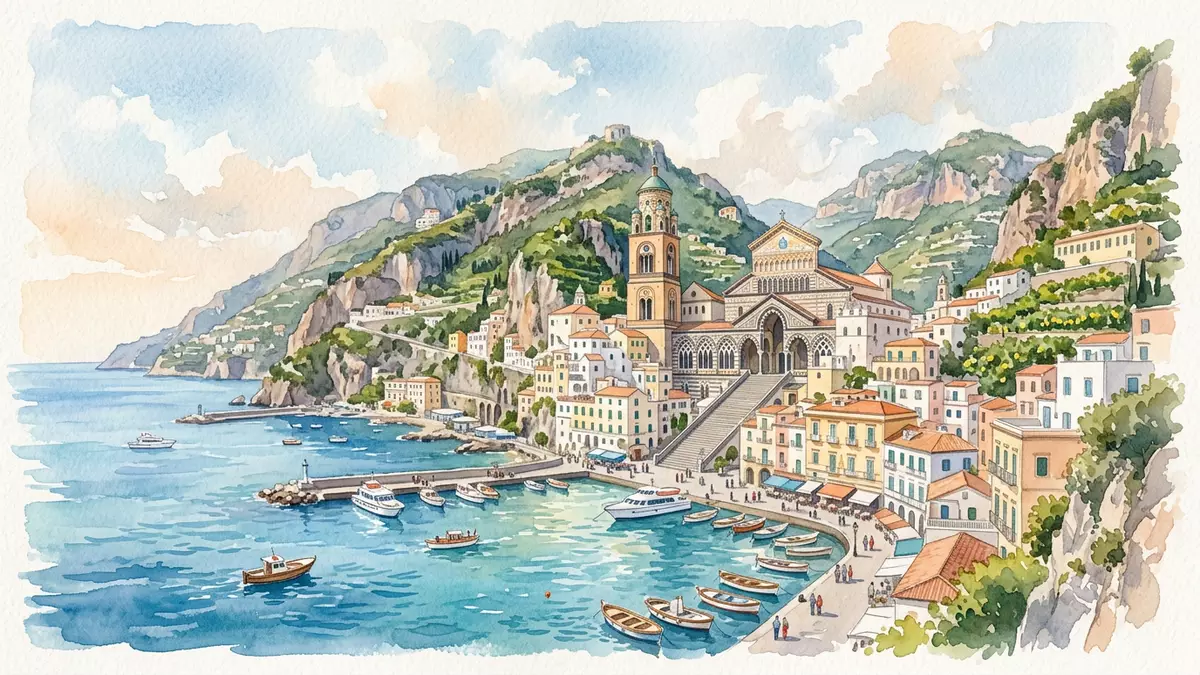
Duomo di Amalfi rises above Piazza Duomo as a layered complex of churches, chapels, a crypt and a bell tower. Its façade, staircase and striped cupola form a single architectural scene in the centre of Amalfi, while the building’s history reaches back to 987.
Duomo di Amalfi and the architecture of Piazza Duomo
The cathedral is dedicated to Saint Andrew the Apostle and occupies Piazza Duomo in Amalfi. Its present appearance combines Romanesque, Arab-Norman, Gothic, Renaissance and Baroque elements, reflecting repeated alterations across the centuries.
The façade belongs to a nineteenth-century rebuilding by Errico Alvino and Guglielmo Raimondi. Its gabled front carries interlaced arches and coloured mosaics, while the bronze central door was made in Constantinople in 1060. A broad staircase connects the square with the atrium before the church.
From Mansone I to Saint Andrew’s crypt
The cathedral’s principal church was erected in 987 during the rule of Duke Mansone I of Amalfi. It stood beside an older basilica, and the two buildings became part of a larger medieval ecclesiastical complex.
Saint Andrew’s remains are preserved in the crypt. They were brought from Constantinople to Amalfi in 1208, and the crypt built in 1203 contains marble-clad pillars, cross vaults and a bronze statue of the apostle by Michelangelo Naccherini. Saint Andrew’s crypt remains the devotional centre beneath the cathedral.
A bell tower, mosaics and Baroque interiors
The campanile began in 1180 and was completed in the thirteenth century. Its structure becomes lighter towards the top, with open arches, a circular belfry and a dome decorated with green and yellow majolica.
Inside, the cathedral has three naves divided by arches on pillars covered with marble. The flat ceiling carries golden coffers and paintings connected with Saint Andrew, while chapels contain eighteenth-century canvases and devotional sculptures. The main altar dates from 1711, and the apse includes paintings completed in 1715. the medieval bronze doorway links Amalfi’s religious setting with its maritime contacts.
The Paradise Cloister and the Basilica of the Crucifix form part of the wider cathedral complex. Columns, marble, mosaics, painted vaults and the elevated façade create distinct architectural layers within a compact urban setting. the Arab-Norman character is visible alongside later Baroque and Rococo decoration.
Visiting Duomo di Amalfi: what travellers from Western Europe should know
- Duomo di Amalfi stands in Piazza Duomo, the principal square of Amalfi. The cathedral is reached on foot through the town centre and its broad exterior staircase.
- The visit includes a staircase, an atrium, the church interior and a descent towards the crypt. Marble floors, chapels, painted vaults and a lower-level sanctuary form part of the route.
- Amalfi lies on the Tyrrhenian coast in Campania. The cathedral complex is close to the town’s waterfront, narrow lanes and the mouth of the Canneto valley.
- The official language is Italian and the currency is the euro.
Searching for Duomo di Amalfi on social platforms
These links open searches for Duomo di Amalfi on each platform.
Frequently asked questions about Duomo di Amalfi
Where is Duomo di Amalfi?
Duomo di Amalfi stands in Piazza Duomo, in the centre of Amalfi on Italy’s Campania coast. The façade faces the town’s principal square.
What can visitors expect inside?
The complex contains a richly decorated church, chapels, the Paradise Cloister, the Basilica of the Crucifix and a crypt with Saint Andrew’s remains.
What makes the cathedral distinctive?
Its identity comes from the combination of a 987 foundation, a Constantinople-made bronze door, a striped medieval bell tower and a nineteenth-century mosaic façade.


