
Duomo di Orvieto and its shimmering Gothic façade
Published on 09/24/2026 at 07:17 | Editorial responsibility: Rafael Müller, Editor-in-Chief AD HOC NEWS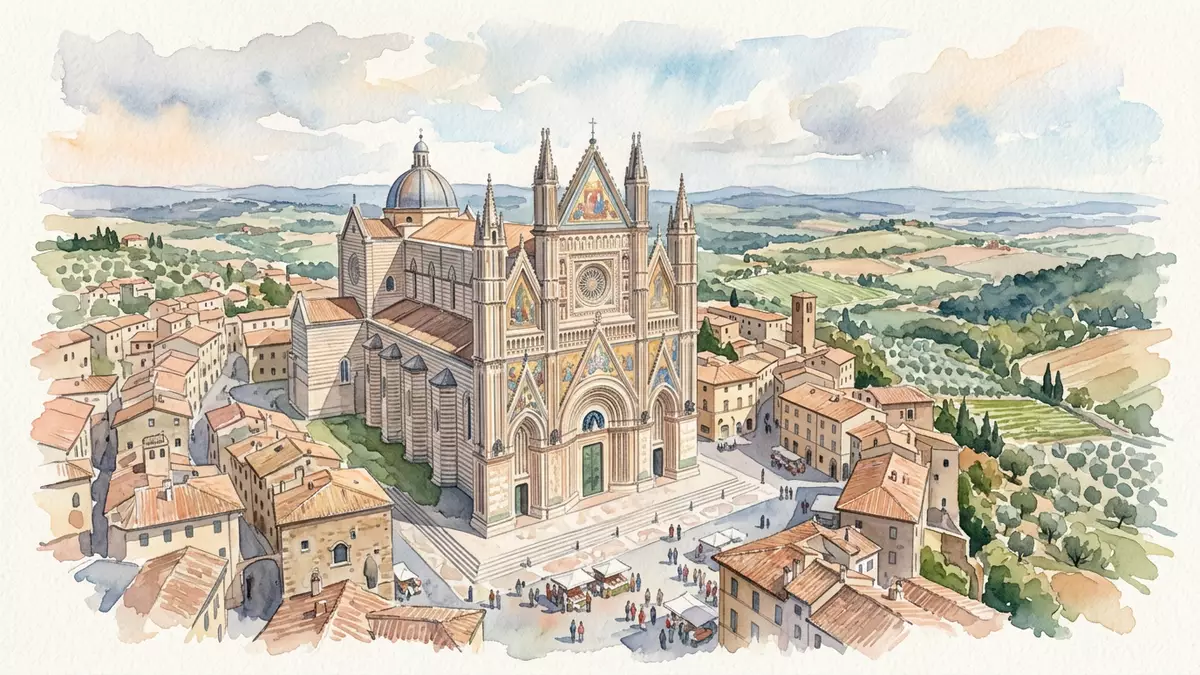
Duomo di Orvieto presents Italian Gothic architecture as a surface of colour, sculpture and gold-ground mosaics. In Orvieto, the cathedral’s façade faces Piazza del Duomo, while its interior preserves major frescoes by Luca Signorelli and Fra Angelico.
Duomo di Orvieto: a façade assembled from colour and stone
The cathedral’s exterior combines pale stone, carved reliefs, bronze sculpture, stained glass and mosaics. Its broad front is divided by vertical elements, with biblical scenes carved across the lower sections and mosaics above them.
The façade’s central rose window is associated with Andrea di Cione, known as Orcagna. The mosaic scenes present episodes from the life of the Virgin Mary, including the Annunciation, Nativity and Coronation. the cathedral façade took shape through work that began around 1310 and ended in 1532.
From 1290 into the Renaissance
The first stone was laid on 13 November 1290 in the presence of Pope Nicholas IV. The project belongs to the period when Italian Romanesque forms were developing into Gothic architecture.
Fra Bevignate di Perugia is connected with the early design, while Lorenzo Maitani shaped the cathedral’s later appearance as chief master of the building works. The long construction period brought several generations of craftsmen and artists into the project. the foundation stone links the building directly with Nicholas IV and the year 1290.
The cathedral reached its present form through work continuing into the sixteenth century. Ippolito Scalza is associated with the later completion of the side spires, while the façade remained a changing artistic project rather than the work of a single moment.
Signorelli’s visions inside the cathedral
The Chapel of San Brizio contains Luca Signorelli’s fresco cycle of the Apocalypse and Last Judgement. The paintings occupy the chapel walls and vaults with scenes of resurrection, judgement, paradise and punishment.
Fra Angelico began work in the chapel, and Signorelli continued the decoration in 1499. The paintings belong to the visual culture of late fifteenth-century Italy, when religious interiors carried extensive narrative cycles in colour and gesture.
Other areas contain architectural sculpture, chapels, stained glass and paintings connected with Orvieto’s religious history. The cathedral’s interior therefore extends the façade’s combination of stone, image and colour into a sequence of distinct spaces. the Chapel of San Brizio remains the setting for Signorelli’s best-known work in Orvieto.
Visiting Duomo di Orvieto: what travellers from Western Europe should know
- Duomo di Orvieto stands in Piazza del Duomo in Orvieto, Umbria. The historic centre is reached by rail through Orvieto station, with local connections continuing towards the hilltop town.
- Orvieto occupies a volcanic tufa plateau. Streets around the cathedral include slopes and stone paving, while the cathedral itself is approached through the medieval centre.
- The official language is Italian and the currency is the euro.
- The cathedral is close to Orvieto’s medieval streets, the Museo dell’Opera del Duomo and the well-known Pozzo di San Patrizio.
Searching for Duomo di Orvieto on social platforms
These links open searches for Duomo di Orvieto on each platform.
Frequently asked questions about Duomo di Orvieto
Where is Duomo di Orvieto?
Duomo di Orvieto stands in Piazza del Duomo in Orvieto, a hilltop town in Umbria, Italy.
What can visitors expect inside?
The interior contains chapels, sculpture, stained glass and frescoes, including Luca Signorelli’s cycle in the Chapel of San Brizio.
What makes the cathedral distinctive?
Its façade brings together carved reliefs, mosaics, bronze sculpture and a rose window, while the interior extends this visual programme through major Renaissance frescoes.


