
Edinburgh Castle and the volcanic rock that shapes it
Published on 08/13/2026 at 14:23 | Editorial responsibility: Rafael Müller, Editor-in-Chief AD HOC NEWS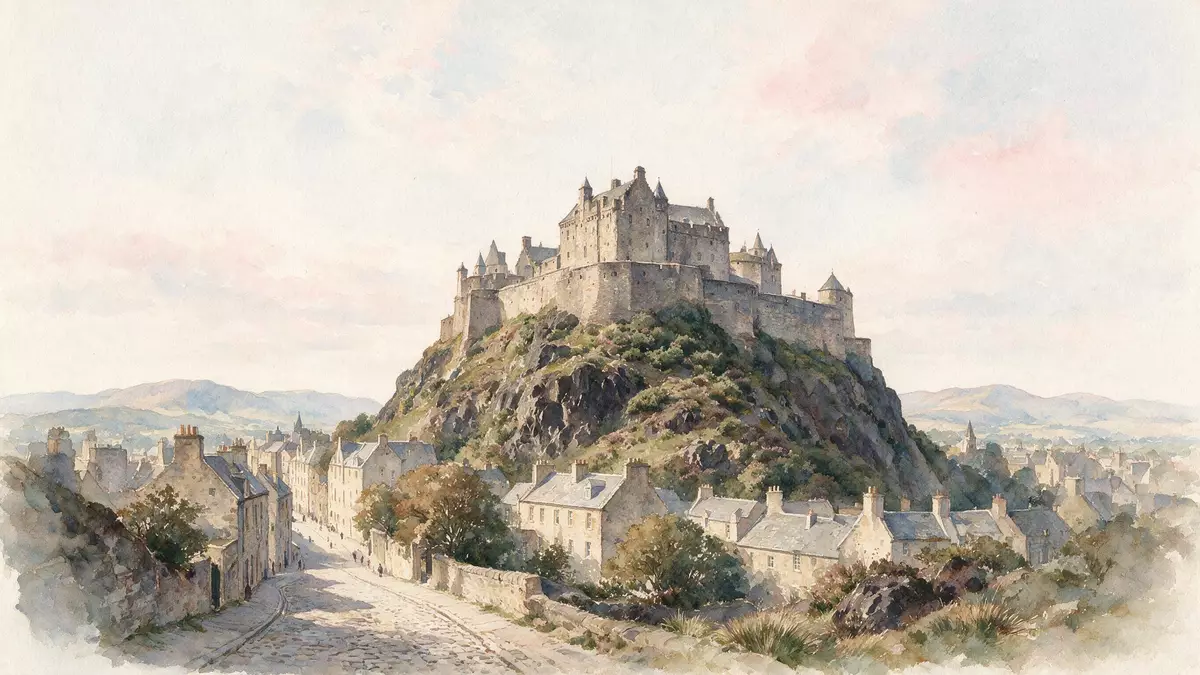
Edinburgh Castle crowns a volcanic rock above Edinburgh, its stone walls tracing a long history of royal ceremony and military defence on the same steep summit. The fortress developed through the Middle Ages and early modern period, with monarchs and soldiers leaving buildings and barracks that still define the skyline of Scotland’s capital.
The castle on Castle Rock
Edinburgh Castle stands on Castle Rock, a volcanic plug that lifts the site sharply above the surrounding streets and makes the fortress visible from much of central Edinburgh. Archaeological work has revealed traces of settlement on the rock dating back to the late Bronze Age around 900 BC, showing that people chose this crag long before stone curtain walls rose around it.Occupation of the site stretches back The rock later carried an early stronghold known as Din Eidyn, remembered in poetry as a hall where warriors gathered before marching to battle against the Angles around AD 600.The poem “Y Gododdin” preserves that name
The strategic qualities of Castle Rock shaped its medieval history. By the reign of Malcolm III Canmore in the eleventh century, a royal castle occupied the summit and served as one of the chief residences of the Scottish kings.Malcolm III made his residence here Stone buildings followed under David I in the twelfth century, gradually replacing earlier timber structures and giving the fortress the durable fabric expected of a royal stronghold.David I rebuilt parts of the castle in stone
Royal residence, armoury and prison
From the Middle Ages through the sixteenth century, Edinburgh Castle served repeatedly as a royal residence and seat of power. Monarchs including Mary, Queen of Scots lived within its walls, and in 1566 the future James VI of Scotland, later James I of England, was born in the castle, linking the site directly to the union of the crowns.James VI was born here in 1566 Great halls and chapels on the summit formed the stage for court life, while the surrounding defences sheltered royal regalia and treasuries.
The residential role of Edinburgh Castle declined during the seventeenth century as monarchs favoured other palaces, and the stronghold’s military character became more pronounced.By the seventeenth century it served mainly as a garrison Barracks, stores and gun emplacements lined the summit, and the castle functioned as an armoury and administrative centre for troops. Its position led to repeated sieges during conflicts such as the Wars of Scottish Independence and the Lang Siege of the 1570s, when artillery bombardment destroyed many medieval structures and prompted later rebuilding.A modern timeline traces these sieges
Modern heritage site on a working fortress
In the eighteenth and nineteenth centuries, parts of Edinburgh Castle were adapted as a prison, holding captives from conflicts including the Seven Years’ War, the American War of Independence and the Napoleonic Wars.Prisoner-of-war vaults beneath the castle recall these years Other buildings continued to house military units and stores, maintaining the site’s role as an active stronghold within the growing city.
From the nineteenth century onwards, restoration programmes gradually reshaped Edinburgh Castle into a heritage landmark while recognising its continuing military use. Historic Environment Scotland now cares for the historic fabric, while Scottish Ministers and the United Kingdom’s Ministry of Defence retain ownership interests in different parts of the site.Modern stewardship is shared between civil and defence authorities Visitors encounter exhibitions, memorials and preserved halls alongside functioning military spaces, all arranged around the contours of Castle Rock.
Visiting Edinburgh Castle: what travellers from Western Europe should know
- Edinburgh Castle stands above the Old Town at the top of Castlehill, reached by a steady uphill walk from the surrounding streets on the ridge.
- The approach involves cobbled surfaces and an ascent through gateways and courtyards, with further climbs on internal stairways to reach the upper battlements.
- Waverley station lies down the slope to the north-east, and the castle sits close to the western end of the Royal Mile between the city’s historic core and Princes Street Gardens.
- English is the official language and the currency is the pound sterling.
Searching for Edinburgh Castle on social platforms
These links open searches for Edinburgh Castle on each platform.
Frequently asked questions about Edinburgh Castle
Where is Edinburgh Castle located within Edinburgh?
Edinburgh Castle stands on Castle Rock above the Old Town, at the upper end of Castlehill and close to the western end of the Royal Mile.
What can visitors expect when they reach the castle?
Visitors cross defensive gateways into courtyards lined with stone buildings, chapels, halls and batteries, with further ascents to walk along the upper ramparts.
What makes Edinburgh Castle distinctive among British fortresses?
The combination of a long royal history, repeated sieges and its position on a volcanic summit gives Edinburgh Castle a layered character as palace, fortress, armoury and memorial.


