
Edinburgh Castle rises from Edinburgh’s volcanic Castle Rock
Published on 09/24/2026 at 11:14 | Editorial responsibility: Rafael Müller, Editor-in-Chief AD HOC NEWS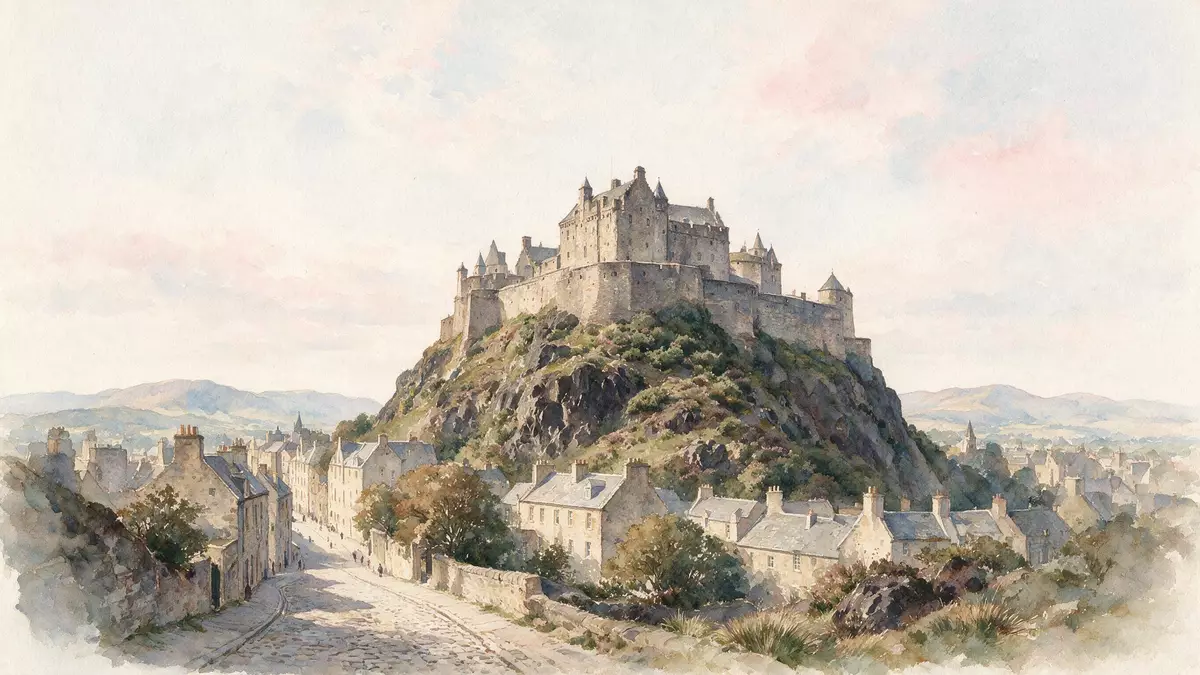
Edinburgh Castle occupies the summit of Castle Rock, a volcanic crag above Edinburgh’s Old Town. Its buildings form a compact record of Scottish history, ranging from St Margaret’s Chapel, traditionally dated to around 1130, to the New Barracks of the eighteenth century.
Castle Rock and the shape of Edinburgh Castle
The rock is the defining feature of Edinburgh Castle. The fortress sits above the Royal Mile, whose ridge descends through the Old Town towards the Palace of Holyroodhouse. The castle’s position gives its walls, gates and courtyards a strong relationship with the city below.
Human settlement on Castle Rock reaches back to the late Bronze Age, while an Iron Age hill fort occupied the summit. A royal castle existed by the medieval period, and David I is associated with the construction of St Margaret’s Chapel around 1130. The small building is named for his mother, Margaret, who died at the castle in 1093.
Royal rooms, chapel and Scottish regalia
Edinburgh Castle contains buildings from several periods rather than a single uniform architectural design. St Margaret’s Chapel is a small Romanesque structure. The Great Hall, completed for James IV in 1511, has a timber roof and displays historic weapons and armour. Its medieval buildings and stories belong to a much longer sequence of royal and military use.
The royal apartments include rooms associated with Mary, Queen of Scots, who gave birth to James VI at Edinburgh Castle in 1566. The Crown Room contains the Honours of Scotland, the crown, sceptre and sword of state used in Scottish royal ceremonies. The Stone of Destiny is also associated with the castle’s ceremonial collections.
From royal fortress to military complex
Sieges repeatedly altered Edinburgh Castle. The Lang Siege of 1573 damaged much of the medieval defences, leaving a complex where surviving medieval rooms stand beside later artillery works and barracks. Mons Meg, a large medieval cannon presented to James II in 1457, is among the best-known military objects on the site.
The castle remained a military garrison after its royal residential role diminished. The Half Moon Battery occupies part of the eastern defences, while the New Barracks date from 1796 to 1799. The One O’Clock Gun is linked to the fortress’s military identity and has marked the time since 1861. Edinburgh Castle and the surrounding Old and New Towns form part of the Edinburgh World Heritage Site.
The castle’s present appearance therefore combines a volcanic setting, medieval religious architecture, royal apartments, artillery positions and nineteenth-century military associations. The result is not a single period monument, but a fortified summit assembled across centuries.
Visiting Edinburgh Castle: what travellers from Western Europe should know
- Edinburgh Castle stands at the western end of the Royal Mile in Edinburgh’s Old Town, above Princes Street and Waverley railway station.
- The approach crosses Castlehill and enters through the Esplanade. The route includes an uphill surface and uneven historic paving.
- The complex contains exposed courtyards, steep changes in level and historic stairs. St Margaret’s Chapel and the Great Hall are reached within the fortress precinct.
- Edinburgh’s official language is English, and the currency is the pound sterling.
Searching for Edinburgh Castle on social platforms
These links open searches for Edinburgh Castle on each platform.
Frequently asked questions about Edinburgh Castle
Where is Edinburgh Castle?
Edinburgh Castle stands on Castle Rock at the western end of the Royal Mile, above Edinburgh’s Old Town.
What can visitors expect inside?
The complex includes St Margaret’s Chapel, the Great Hall, royal apartments, military batteries, barracks and collections of weapons, armour and regalia.
What makes Edinburgh Castle distinctive?
Its volcanic summit brings together a medieval chapel, royal rooms and military buildings within one fortified complex above the city.


