
El Castillo at Chichen Itza: a calendar in stone
Published on 09/18/2026 at 15:57 | Editorial responsibility: Rafael Müller, Editor-in-Chief AD HOC NEWS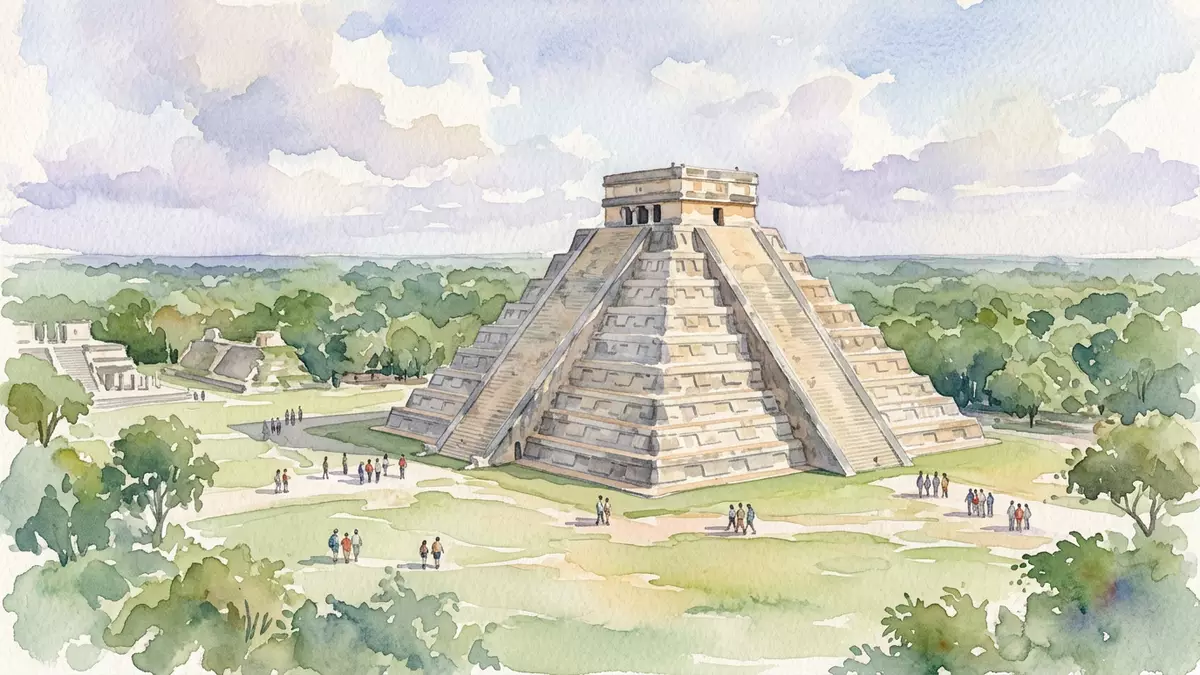
El Castillo at Chichen Itza in Mexico is a limestone step pyramid whose geometry turns the central plaza of the ancient city into a vast stone calendar. Rising in tiers above the northern part of the site, the structure known formally as the Temple of Kukulcan stands at the heart of the Pre-Hispanic City of Chichen-Itza, a UNESCO-recognised archaeological landscape on the Yucatán Peninsula.
The step pyramid that anchors Chichen Itza
El Castillo dominates the northern platform of Chichen Itza, the former Maya city in the Mexican state of Yucatán. The pyramid is built of cut limestone blocks and rises in a series of nine superimposed terraces from a square base measuring about 55 m (181 ft) on each side.square base measuring about 55 m Above these terraces, a temple stands on a high platform, giving the whole structure a height of about 30 m (98 ft) above the surrounding plaza.height of about 30 m
Four stairways climb the centre of each side of the pyramid. Each staircase has 91 steps; adding the top platform gives a total of 365, echoing the days of the solar year that structured much of Maya timekeeping.four staircases, each with 91 steps The terraces are divided by these staircases into visible segments that relate to other calendar counts in Maya practice, binding the mass of the building tightly to the cycles of the sun.
Temple of Kukulcan and its layered history
Archaeologists identify El Castillo as Structure 5B18 and as the Temple of Kukulcan, taking its name from the feathered serpent deity revered by the Yucatec Maya.Temple of Kukulcan The pyramid was built by the Toltec-Maya during the late Classic and Postclassic periods, with most sources placing its construction between about 1050 and 1300 CE.between about 1050 and 1300 CE This dating situates El Castillo within a phase when influences from central Mexico mingled with long-standing Maya traditions in architecture and religion.
Investigations have revealed that the visible pyramid envelops earlier constructions. Within El Castillo lies a smaller inner pyramid, accessed through interior passages, and archaeological work has uncovered a red jaguar throne inside this inner structure, inlaid with jade elements.red jaguar throne inside Geophysical studies carried out in the twenty-first century identified a cenote, a natural sinkhole in the limestone, beneath the pyramid, adding a layer of connection between the architecture above and the watery cavities that punctuate the Yucatán bedrock.cenote beneath the pyramid
Light, shadow and the Maya calendar in stone
The design of El Castillo incorporates alignments that make the movement of the sun visible on the stone surfaces. Around the equinoxes in March and September, the setting sun casts a series of triangular shadows along the northern staircase, creating the appearance of a serpent descending towards the carved stone heads at the base of the balustrade.triangular shadows along the northern staircase This phenomenon ties the pyramid’s form to specific points in the solar year.
The nine terraces, the four staircases and the summit platform together encode several cycles of Maya timekeeping. The total of 365 steps across all stairways and the top platform corresponds to the length of the Haab’ solar year, while the terraces and panels can be read in relation to the eighteen months and longer calendar rounds recognised by the Maya.corresponds to the length of the Haab’ solar year In this way, El Castillo is more than a temple pyramid; it operates as a monumental register of time carved in limestone.
Visiting El Castillo: what travellers from Western Europe should know
- El Castillo stands in the northern sector of the Chichen Itza archaeological site on the Yucatán Peninsula in Mexico, reached by road from regional centres such as Mérida and Valladolid.
- The pyramid rises above a broad, open plaza with level ground underfoot; viewing points are on firm surfaces, with the monument itself cordoned off.
- The wider site includes other major structures, such as the Great Ballcourt and El Caracol observatory, all set amid low vegetation on relatively flat terrain.
- Mexico’s official language is Spanish and the currency is the Mexican peso.
- Entry requirements depend on your nationality; UK travellers can check the FCDO travel advice at gov.uk/foreign-travel-advice, Irish travellers the Department of Foreign Affairs at ireland.ie.
Searching for El Castillo on social platforms
These links open searches for El Castillo on each platform.
Frequently asked questions about El Castillo
Where is El Castillo located?
El Castillo stands in the ancient Maya city of Chichen Itza in Mexico’s Yucatán Peninsula, within the archaeological zone visited by travellers from around the world.
What should visitors expect when viewing El Castillo?
Visitors walk across an open plaza to view the pyramid from ground level, with the monument itself enclosed and its stairways and summit temple viewed from outside.
What makes El Castillo distinctive among Maya monuments?
El Castillo is distinctive for its combination of nine terraces, four staircases totalling 365 steps and equinox shadow effects that together express the Maya solar calendar in architectural form.


