
El Castillo at Chichen Itza: a pyramid built around time
Published on 09/22/2026 at 13:13 | Editorial responsibility: Rafael Müller, Editor-in-Chief AD HOC NEWS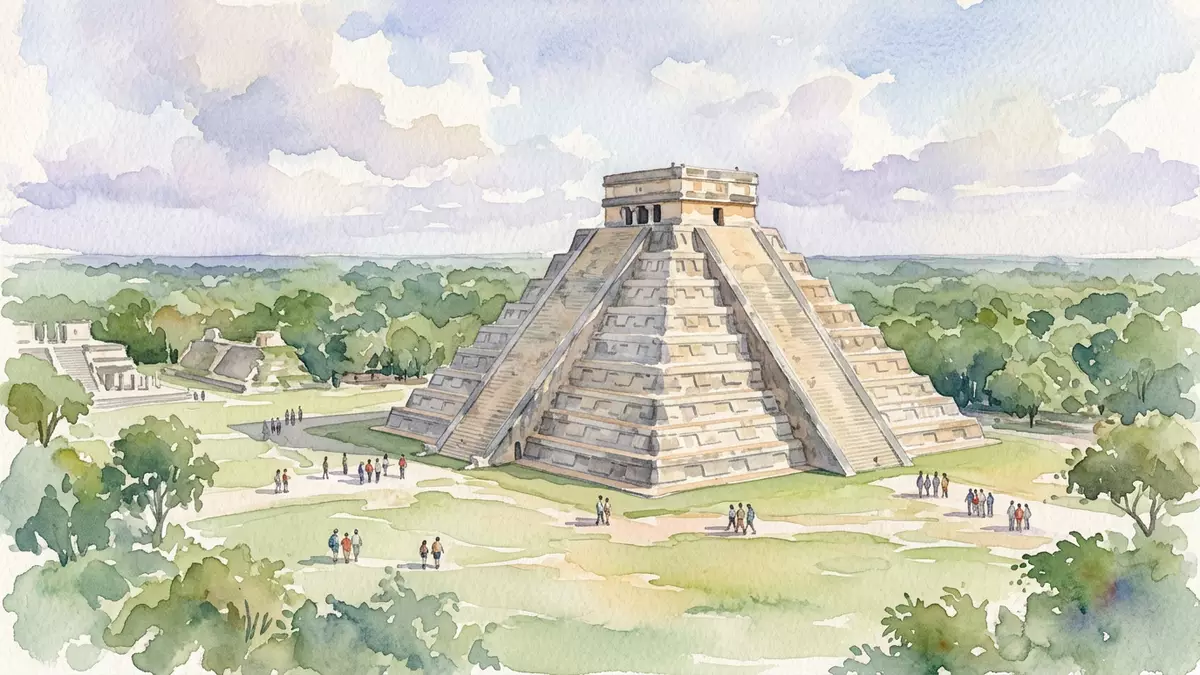
El Castillo rises above the main plaza at Chichen Itza as a stepped limestone pyramid. Also known as the Temple of Kukulcan, it combines monumental scale, four stairways and a calendar pattern that gives the building a precise numerical identity.
El Castillo and the Maya-Toltec city
Chichen Itza stands in Mexico’s Yucatan Peninsula. The settlement developed across the Classic and Postclassic periods, while its surviving monuments record the meeting of Maya building traditions with elements associated with central Mexico.
The city became a major centre in the northern Maya lowlands. El Castillo belongs to the monumental northern group, alongside the Great Ball Court, the Temple of the Warriors and the circular observatory known as El Caracol. Chichen Itza entered the UNESCO World Heritage list in 1988, placing the pyramid within a protected cultural landscape rather than treating it as an isolated monument.
Four stairways and 365 steps
El Castillo has a square plan with four broad stairways facing the cardinal directions. Each stairway has 91 steps. With the step on the summit platform, the total is 365, matching the number of days in the Maya solar year. This relationship between visible masonry and calendrical counting is among the clearest features of the monument.
The pyramid rises about 24 metres above the plaza. Its terraces narrow towards the summit temple, creating a layered profile of horizontal stone bands and sloping surfaces. The structure is built from local limestone, with carved and modelled details forming part of the wider sculptural language of Chichen Itza. El Castillo’s 365 steps connect its architecture with the solar calendar.
Kukulcan, serpents and layered architecture
The pyramid is associated with Kukulcan, the Feathered Serpent deity of Yucatec Maya tradition. The name El Castillo is Spanish, while Temple of Kukulcan identifies the building’s religious association. Serpent imagery appears beside the northern stairway, where carved forms meet the geometry of the terraces.
Light and shadow at the equinoxes create a serpent-like pattern along the northern staircase. The effect is tied to the pyramid’s alignment and stepped surfaces, although the monument remains more than a single astronomical display. Its proportions, stairways and summit temple belong to a wider architectural system shared with the surrounding ceremonial buildings.
The visible pyramid incorporates earlier masonry within its structure. Archaeological exploration has identified internal construction beneath the outer form, reflecting the layered character of Mesoamerican temple architecture. The principal visible building is associated with the Maya-Toltec period, commonly placed between the tenth and thirteenth centuries. Chichen Itza’s Maya-Toltec monuments include El Castillo, the Temple of the Warriors and El Caracol.
The pyramid’s setting makes its relationships legible. The Great Ball Court lies within the northern monumental area, while the Temple of the Warriors and the Group of the Thousand Columns extend across the same ancient urban centre. El Castillo’s terraces therefore form part of a connected stone landscape, with plazas, platforms, stairways and sculpted surfaces arranged across Chichen Itza.
Chichen Itza’s history reaches across nearly a millennium. Early buildings in the southern area display Maya forms associated with the Puuc tradition, while the northern group contains monuments that show the fusion of Maya techniques with central Mexican elements. El Castillo belongs to this later architectural language, though the exact sequence of its internal construction is more complex than its exterior suggests.
The site’s name refers to the wells or cenotes associated with the settlement. These natural cavities formed part of the environmental setting of the city and helped define its location in the Yucatan landscape. El Castillo stands within that larger cultural geography, where water, stone, ritual buildings and astronomical observation formed connected parts of an urban centre.
The pyramid’s surviving surfaces have a restrained palette of pale limestone, interrupted by carved details and the dark recesses between its steps. From the plaza, the four stairways divide the mass into strong vertical lines. The summit temple crowns the terraces and gives the building its complete profile.
El Castillo is also a monument of measurement. The number of steps is not hidden in a museum label or inscription; it is expressed through the repeated units of the stairways. The visitor sees a pyramid, but the building can also be read as a large calendrical arrangement made from stone.
Visiting El Castillo: what travellers from Western Europe should know
- El Castillo is in the archaeological zone of Chichen Itza, in Yucatan, Mexico. The site lies between Merida and Cancun and is reached by road from both cities.
- The pyramid stands in a broad ceremonial plaza. Its stairways are steep stepped surfaces, and the summit temple is viewed from ground level.
- The surrounding area includes the Great Ball Court, the Temple of the Warriors, the Group of the Thousand Columns and El Caracol.
- The official language is Spanish and the currency is the Mexican peso.
Searching for El Castillo on social platforms
These links open searches for El Castillo on each platform.
Frequently asked questions about El Castillo
Where is El Castillo?
El Castillo stands in the archaeological zone of Chichen Itza, in Mexico’s Yucatan Peninsula. It occupies the northern monumental area of the ancient Maya city.
What can visitors expect at El Castillo?
The pyramid is viewed from the surrounding plaza, with its terraces, stairways and summit temple visible from ground level. Other major monuments stand nearby within the same archaeological landscape.
What makes El Castillo distinctive?
Its four stairways contain 91 steps each, producing 365 steps with the summit platform. The pyramid also combines Kukulcan symbolism, serpent imagery and Maya-Toltec architecture.


