
El Yunque National Forest, a tropical rainforest above Rio Grande
Published on 09/18/2026 at 20:02 | Editorial responsibility: Rafael Müller, Editor-in-Chief AD HOC NEWS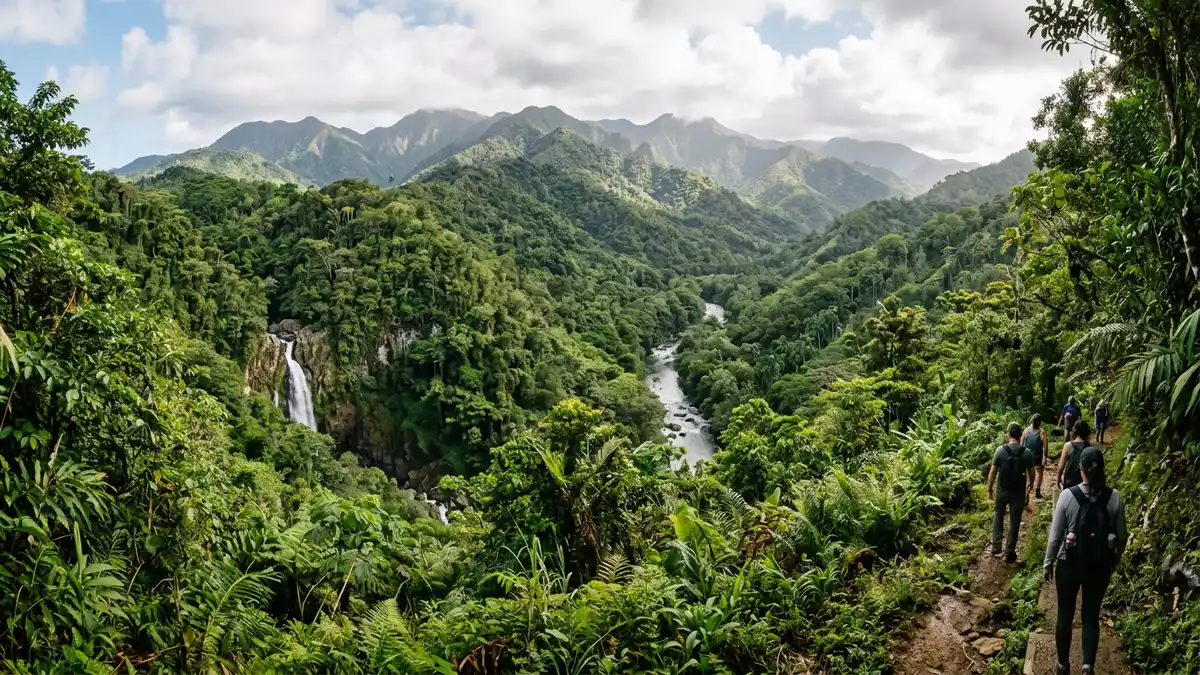
El Yunque National Forest is a tropical rainforest rising above Rio Grande on the rugged slopes of the Sierra de Luquillo mountains in northeastern Puerto Rico. It forms a compact block of protected public land with elevations ranging from low foothills to peaks such as El Toro, and it has been safeguarded as forest reserve land since the late nineteenth century.
A tropical rainforest within the U.S. National Forest System
El Yunque National Forest is managed by the United States Forest Service as part of the U.S. National Forest System, yet it differs from the mainland forests through its tropical climate and year-round lush vegetation.El Yunque is the only tropical rainforest in this system. The forest occupies around 28,000 to 29,000 acres in the Sierra de Luquillo, making it the largest continuous tract of public land on the island.Figures for the forest’s area fall in this range.
The mountains that carry El Yunque rise abruptly from the coastal plain near Las Cabezas de San Juan to high points such as El Toro, which reaches about 1,074 m (3,524 ft) above sea level.Forest assessments describe this steep rise and the elevation range. Within this compact area the terrain shows marked slopes, with significant portions exceeding gradients of 60 percent, so many paths and roads follow winding alignments that respond to the contours.
Layers of protection from the Spanish Crown to Theodore Roosevelt
The history of El Yunque National Forest reaches back to the period when Puerto Rico formed part of the Spanish Empire. In 1876 King Alfonso XII designated a forest reserve in the Luquillo Mountains, creating a protected area for soils, timber and water and establishing one of the earliest forest reserves in the Western Hemisphere.Historical studies trace the origin of the reserve to this royal decree. After the island passed to United States control at the end of the nineteenth century, the U.S. Bureau of Forestry took over supervision, and the land entered the framework that later became the U.S. Forest Service.
On 17 January 1903 President Theodore Roosevelt signed a proclamation establishing the Luquillo Forest Reserve, which was later redesignated as the Luquillo National Forest and expanded through additional land acquisitions.Accounts of El Yunque’s history describe these early U.S. forest designations. In 1935 the enlarged forest took the name Caribbean National Forest, a designation it held for several decades, before legislation in 2007 adopted the local Taíno-derived name El Yunque National Forest, aligning the official title with the mountain and regional identity.
Rain, rivers and biodiversity on the Luquillo slopes
El Yunque National Forest receives high rainfall on its steep slopes, with averages reported around 120 inches (304 cm) per year in many parts of the forest.Forest factsheets describe these rainfall levels The combination of warm temperatures and abundant moisture supports a dense cover of tropical vegetation and feeds a network of rivers that flow from the mountains towards the coastal plains. Several major rivers rise in the forest and deliver fresh water to communities across northeastern Puerto Rico, contributing a substantial share of the island’s water supply.Descriptions of El Yunque emphasise the number of rivers and their role in water provision
Botanically, the forest hosts hundreds of native plant species, including around 150 fern species and about 240 native tree species, with a group of tree species found only within the boundaries of El Yunque.Botanical surveys list these tallies for ferns and trees Fauna is equally varied, with scores of animal species recorded, some of them endemic to the forest. Different elevation bands carry distinct ecological zones, from lower montane forest to higher cloud forest, and visitors moving uphill see the vegetation change in structure and species composition.
Visiting El Yunque National Forest: what travellers from Western Europe should know
- El Yunque National Forest lies in the Sierra de Luquillo in northeastern Puerto Rico, inland from the Atlantic coast and reached on mountain roads from Rio Grande and other nearby municipalities.
- The terrain is steep and rugged, with sections of road and pathways following winding routes and some approaches involving sustained uphill gradients.
- The forest covers elevations from low foothills to peaks such as El Toro, so weather and cloud cover can differ markedly between lower and higher areas on the same day.
- The official language is Spanish and the currency is the United States dollar.
- Entry requirements depend on your nationality; UK travellers can check the FCDO travel advice at gov.uk/foreign-travel-advice, Irish travellers the Department of Foreign Affairs at ireland.ie.
Searching for El Yunque National Forest on social platforms
These links open searches for El Yunque National Forest on each platform.
Frequently asked questions about El Yunque National Forest
Where is El Yunque National Forest located?
El Yunque National Forest is in northeastern Puerto Rico on the slopes of the Sierra de Luquillo, above municipalities including Rio Grande and neighbouring towns.
What should visitors expect on a visit?
Visitors encounter steep mountain terrain, dense tropical vegetation, frequent rain showers and rivers flowing down from the Luquillo peaks, with conditions varying across elevations.
What makes El Yunque National Forest distinctive?
El Yunque National Forest stands out as a tropical rainforest within the U.S. National Forest System, combining long-standing legal protection with rich biodiversity and significant water resources.


