
El Yunque National Forest and the rainforest peaks above Rio Grande
Published on 09/17/2026 at 06:14 | Editorial responsibility: Rafael Müller, Editor-in-Chief AD HOC NEWS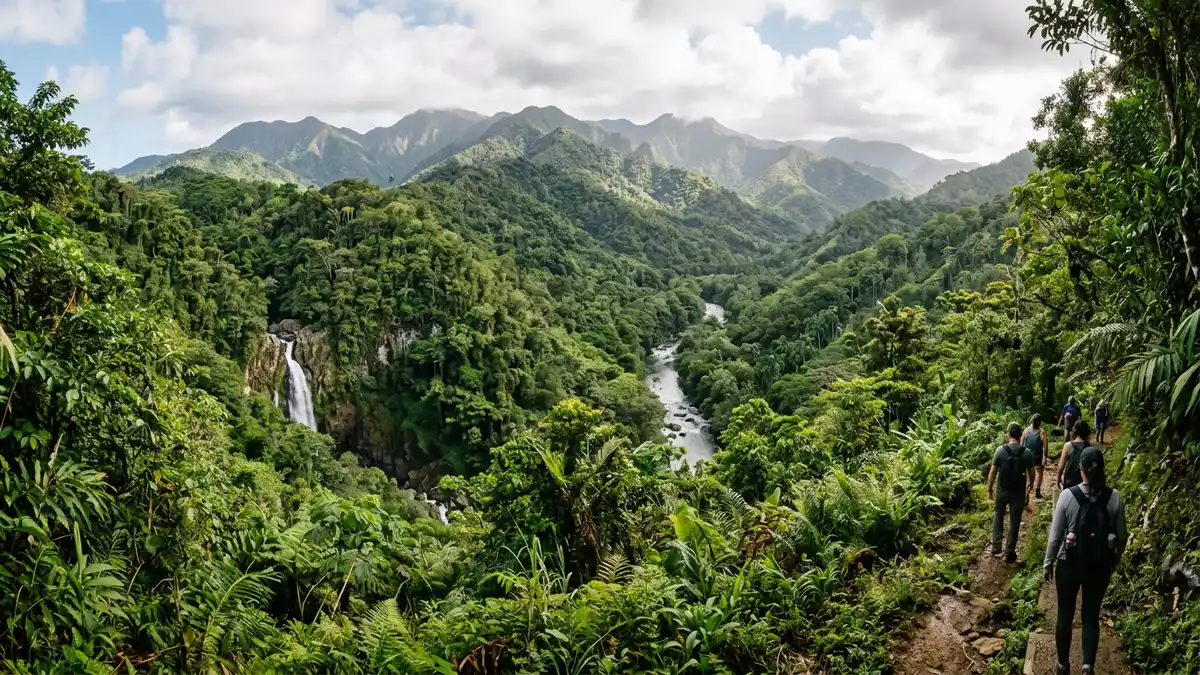
El Yunque National Forest above Rio Grande in northeastern Puerto Rico is a compact tropical rainforest landscape where steep ridges, fast rivers and cloud?wrapped peaks share a relatively small area of protected mountain terrain.
Rainforest on the Luquillo Mountains
El Yunque National Forest lies on the slopes of the Luquillo Mountains in the north?east of Puerto Rico, forming the largest continuous block of public land on the island.Luquillo Mountains The forest covers more than 28,000 acres (about 11,300 hectares) of rugged terrain, and its boundaries extend into several municipalities including Río Grande, Luquillo, Canóvanas, Fajardo, Naguabo, Ceiba, Las Piedras and Juncos.more than 28,000 acres The protected area occupies ridges and valleys that rise towards peaks in the Luquillo range, with the highest summits in the forest reaching around 1,077 m (3,533 ft) above sea level.3,533 feet above sea level
The forest is recognised as the only tropical rainforest in the United States National Forest System, a status that reflects both its climate and its vegetation.only tropical rainforest It was originally designated as a reserve by the Spanish Crown in 1876, placing a large part of the Luquillo Mountains under formal protection in the late nineteenth century.reserve by the Spanish Crown in 1876 After the Spanish–American War the protected land passed to the United States and in 1907 it was named Luquillo National Forest, later renamed Caribbean National Forest in 1935 and El Yunque National Forest in 2007 to reflect Puerto Rican culture and history.renamed El Yunque National Forest in 2007
Water, trails and habitats in a compact area
El Yunque National Forest concentrates rivers, waterfalls and a range of forest types within a relatively modest area, making it a place where changes in altitude are closely tied to changes in vegetation. The lower slopes carry lush tropical forest with tall trees, dense understorey and streams that run towards the coastal plain, while higher ridges have shorter, wind?shaped trees and cloud?forest conditions. Botanical surveys have documented hundreds of plant species in the forest, including around 150 fern species and about 240 tree species, with several endemics known only from this mountain area.150 fern species and 240 tree species
The relief of the Luquillo Mountains and the high rainfall feed numerous rivers, and visitors encounter cascades, pools, boulder?strewn channels and roadside viewpoints as they move along the main access road PR?191.Road PR 191 North in Rio Grande A network of marked trails gives access to different parts of the forest, with routes that pass through bamboo stands, across bridges and past waterfalls described in many travel accounts.25 miles of trails On clear days, openings in the canopy and high vantage points provide views towards the Atlantic coast and the surrounding lowlands.
Cultural layers and the name “El Yunque”
The mountains that form El Yunque National Forest were part of the homeland of the Taíno people long before formal reserves were declared, and the peaks carried names that reflected how they were seen from the valleys below. Taíno speakers referred to the highest peaks as Yuke, or “white lands”, describing the clouds that encircle the summits.Yuke or “white lands” The current Spanish name El Yunque is linked by many accounts to the Taíno word Yúcahu and to an image of an anvil?shaped peak, and the forest itself carries both the Spanish?language name Bosque Nacional El Yunque and the English?language designation El Yunque National Forest.Bosque Nacional El Yunque
The protected status of the forest has been reshaped across political periods, from Spanish royal reserve in 1876 to United States national forest after 1907, yet the core area of mountainous terrain above Río Grande has remained under management for conservation and timber regulation for more than a century.Luquillo National Forest and Caribbean National Forest The present?day name El Yunque National Forest, adopted in 2007, aligns the formal title with the way Puerto Ricans refer to the mountain area and its rainforest slopes.name changed again to El Yunque National Forest
Visiting El Yunque National Forest: what travellers from Western Europe should know
- El Yunque National Forest lies in the municipality of Río Grande in northeastern Puerto Rico, on the slopes of the Luquillo Mountains; drivers from San Juan follow PR?26, PR?66, PR?3 and then PR?191 towards the main forest entrance near Palmer.From San Juan, take Highway PR-26 east to PR-66
- The terrain inside the forest is mountainous, with winding paved roads, steep gradients and stairways on several trails, and visitors who leave the road network walk on uneven, often wet paths with rocks and exposed roots.
- El Yunque National Forest covers elevations that reach more than 1,000 m (3,281 ft), so some viewpoints and trailheads sit well above sea level, and cloud and mist frequently surround the upper ridges.rise to 3,533 feet above sea level
- The official language is Spanish and the currency is the United States dollar.
- Entry requirements depend on your nationality; UK travellers can check the FCDO travel advice at gov.uk/foreign-travel-advice, Irish travellers the Department of Foreign Affairs at ireland.ie.
Searching for El Yunque National Forest on social platforms
These links open searches for El Yunque National Forest on each platform.
Frequently asked questions about El Yunque National Forest
Where is El Yunque National Forest and what area does it cover?
El Yunque National Forest lies in northeastern Puerto Rico on the slopes of the Luquillo Mountains above Río Grande, covering more than 28,000 acres of mountainous rainforest terrain.
What should visitors expect on a visit to El Yunque?
Visitors encounter steep, winding roads, signed trailheads, rainforest paths, rivers and waterfalls, with viewpoints over forested ridges and, in clear conditions, towards the coastal lowlands.
What makes El Yunque National Forest distinctive among United States forests?
El Yunque National Forest is recognised as the only tropical rainforest in the United States National Forest System and concentrates diverse habitats, endemic plants and high rainfall in a compact protected mountain area.


