

Elbphilharmonie and Hamburg’s glass-topped concert hall
Published on 08/18/2026 at 13:33 | Editorial responsibility: Rafael Müller, Editor-in-Chief AD HOC NEWS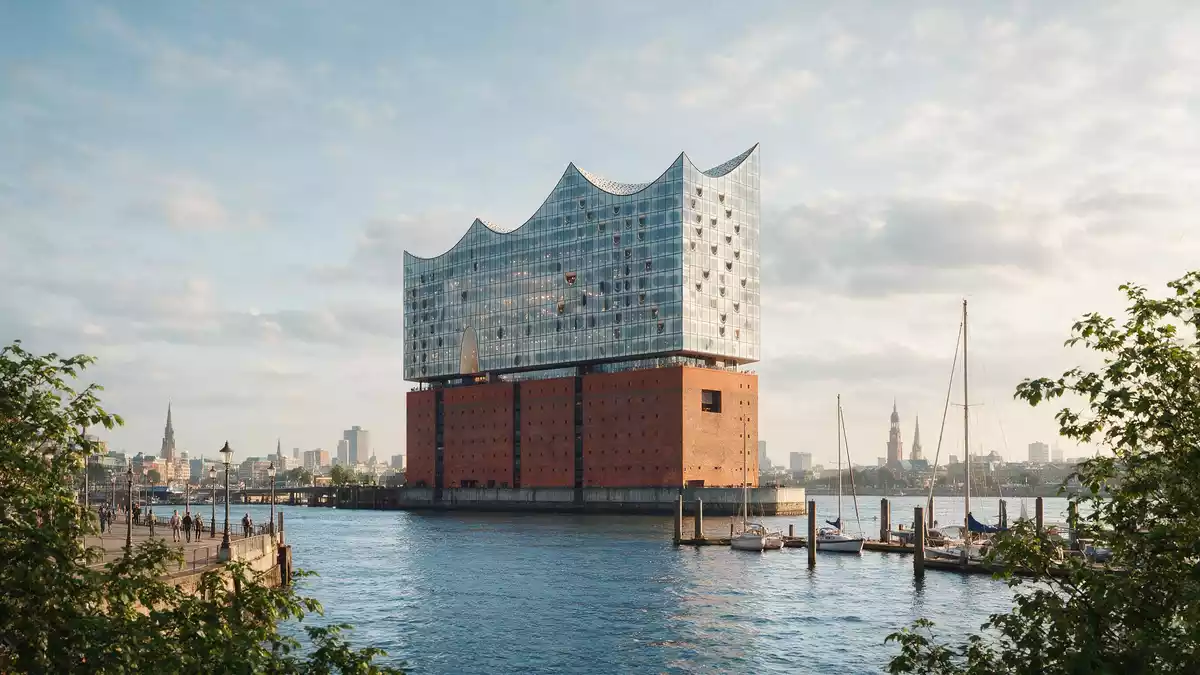
Elbphilharmonie in Hamburg pairs a glazed upper volume with a brick warehouse base, making its silhouette easy to recognise from the harbour side. Herzog & de Meuron designed the concert hall, and it opened in January 2017.
Glass above brick on the Elbe
The building stands on the western edge of HafenCity, where the Elbe bends past the inner harbour. Its lower mass is the former Kaispeicher A, a brick storehouse associated with Werner Kallmorgen and the 1960s.
Above that base rises the glass structure that gives Elbphilharmonie its profile. The contrast between red-brown masonry and pale glazing is the building’s strongest visual idea, and it is visible from several directions across the waterfront.
Herzog & de Meuron’s concert hall
Herzog & de Meuron, the Swiss practice led by Jacques Herzog and Pierre de Meuron, created the project with Ascan Mergenthaler among the listed designers. The same office has also been responsible for Tate Modern in London, the Allianz Arena in Munich and the Olympic Stadium in Beijing.
The Elbphilharmonie name now refers to a concert hall with a formal architectural setting rather than a free-standing theatre block. The layered composition links a retained industrial base with a sharply contemporary upper form, and that pairing carries much of the building’s presence.
A harbour landmark with a second life
The lower part of the complex gives the building its substance as much as its upper façade does. Brick, concrete and glazing sit together in a way that makes the old port fabric and the new concert hall read as one composition.
Its public identity rests on music, but the building also works as an urban marker in Hamburg’s waterfront district. The result is a concert venue that is read from the outside as architecture first and performance space second.
Visiting Elbphilharmonie: what travellers from Western Europe should know
- Elbphilharmonie stands in Hamburg’s HafenCity, close to the Elbe and the city centre’s harbour edge.
- The building is reached on foot across the district’s quays and bridges, and by the local U-Bahn and buses serving the area.
- The complex combines a heavy brick base with a glazed upper section, so the exterior changes character as you move around it.
- The name applies to the concert hall as well as the wider building, which also contains the older warehouse structure below.
- Hamburg is the city, Germany is the country, and the official language is German; the currency is the euro.
Searching for Elbphilharmonie on social platforms
These links open searches for Elbphilharmonie on each platform.
Frequently asked questions about Elbphilharmonie
Where is Elbphilharmonie?
It stands in Hamburg’s HafenCity beside the Elbe, on the city’s harbour edge.
What does a visit involve?
The building presents a brick base and a glazed upper level, with the concert hall housed inside the larger complex.
What makes Elbphilharmonie distinctive?
Its identity lies in the combination of the retained warehouse structure, the glass superstructure and the work of Herzog & de Meuron.


