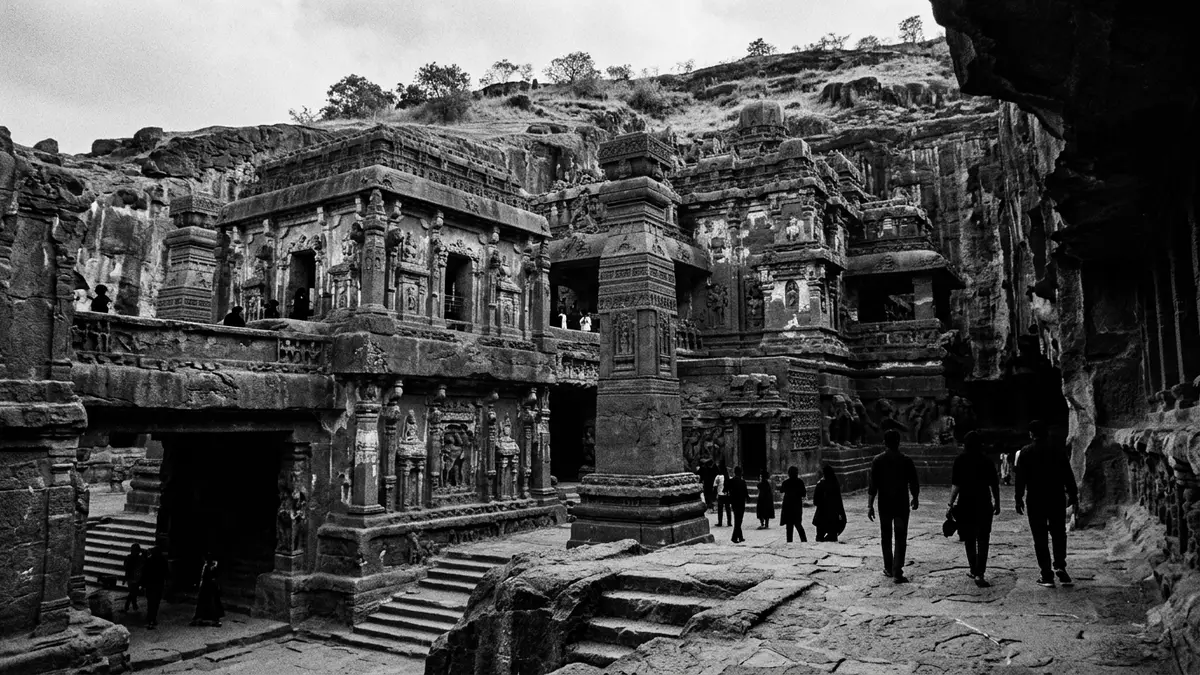
Ellora Caves and its carved Hindu, Buddhist and Jain world
Published on 08/09/2026 at 15:21 | Editorial responsibility: Rafael Müller, Editor-in-Chief AD HOC NEWS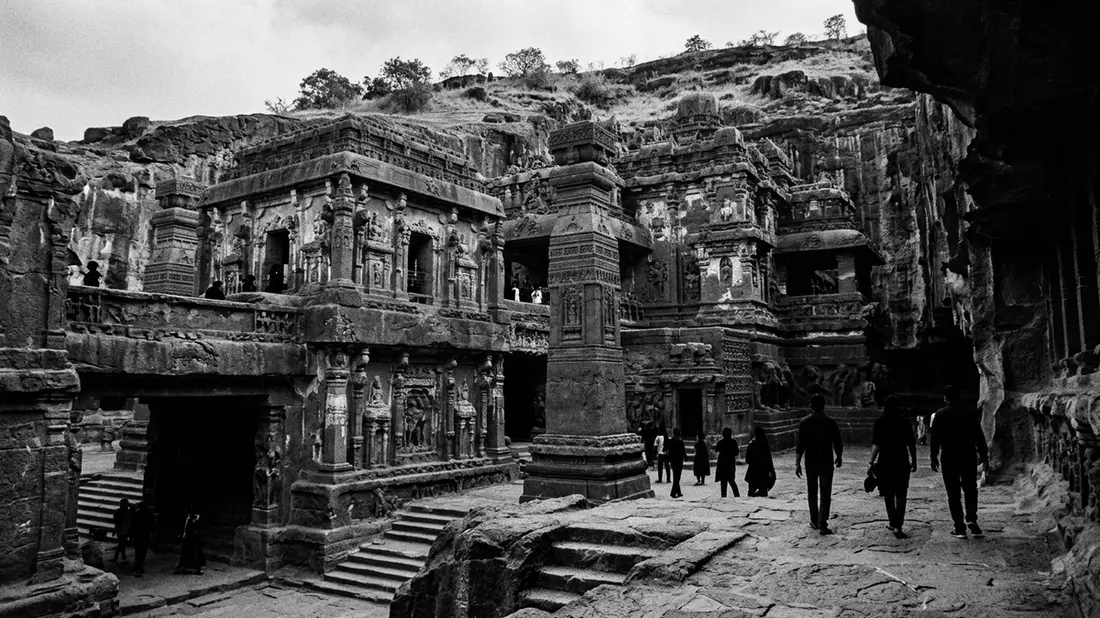
Ellora Caves near Aurangabad in India are a vast rock-cut complex carved into the Charanandri hills. The site combines Buddhist, Hindu and Jain monuments, and the scale of the cliffside work is visible from the first approach.
Three traditions cut into one basalt scarp
Ellora spans a long stretch of dark volcanic rock, with facades, pillared halls and recessed courts opening straight from the cliff. The monuments belong to different religious traditions, and that variety is part of the site’s character.
The Buddhist caves include monasteries and prayer halls. The Hindu group contains some of the most ambitious carvings, including Cave 16, the Kailasa Temple, hewn from the rock face above a broad forecourt.
Kailasa Temple and the scale of excavation
Kailasa Temple is the most striking single monument at Ellora. It is carved from one mass of basalt and presents a temple complex in relief, with gateways, columns and sculpted surfaces all cut from the same rock.
Other caves range from austere chambers to elaborately decorated sanctuaries. The Jain caves are later in date and have a more compact, refined feel, with fine carving on pillars, ceilings and doorways.
Ellora’s place in Indian religious architecture
Ellora reflects the long religious life of the Deccan, where Buddhist, Hindu and Jain communities all left monumental traces. The complex dates from the Rashtrakuta period and other phases between the 6th and 10th centuries.
The site was inscribed as a UNESCO World Heritage Site in 1983. Its importance lies in the combination of faiths, the length of its development and the sheer physical labour of carving a temple landscape into living rock.
Visiting Ellora Caves: what travellers from Western Europe should know
- Ellora Caves lies near Aurangabad in Maharashtra, India, and is reached by road from the city.
- Admission arrangements and opening hours are set by the site's operator and change with the season; the official website is the only binding source.
- The cooler part of the year is easier for walking between the caves, and late morning light is useful inside the carved courts.
- The site includes uneven rock, steps, and a fair amount of walking between excavated groups.
- Facilities are basic in the surrounding area, and local currency is useful for small purchases.
- Entry requirements depend on your nationality. UK travellers should check the FCDO travel advice at gov.uk/foreign-travel-advice; Irish travellers the Department of Foreign Affairs at ireland.ie; EU and EEA citizens their own national foreign ministry.
Searching for Ellora Caves on social platforms
These links open searches for Ellora Caves on each platform.
Frequently asked questions about Ellora Caves
Where are Ellora Caves?
They are near Aurangabad in Maharashtra, in western India, set among the basalt hills of the Deccan.
What should visitors expect?
Expect a large archaeological site with rock-cut temples, monasteries and shrines spread along the cliff. Walking surfaces can be uneven, and the site rewards time rather than haste.
What makes Ellora distinctive?
Its defining feature is the coexistence of Buddhist, Hindu and Jain monuments in one carved landscape. Kailasa Temple, cut from a single rock mass, is the most celebrated example of that ambition.