
Englischer Garten and the long line of Munich’s parkland
Published on 08/16/2026 at 13:59 | Editorial responsibility: Rafael Müller, Editor-in-Chief AD HOC NEWS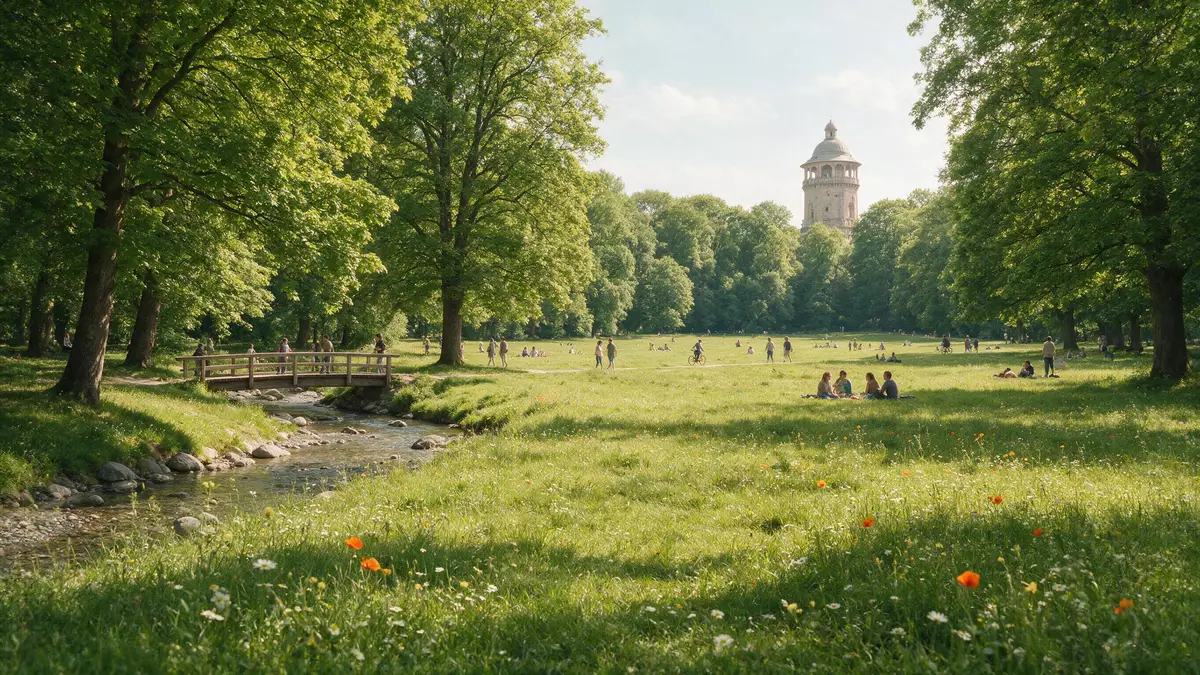
Englischer Garten in München is a broad city park where water, lawns and classical ornaments sit side by side. Its scale and 18th-century origins make the park’s layout as important as any single landmark.
From Karl Theodor to a public park
The park’s history begins in 1789, when Karl Theodor ordered the creation of an English-style garden in Munich. The project is closely tied to Sir Benjamin Thompson, later Count Rumford, and to the landscape designer Friedrich Ludwig von Sckell.
The park belongs to the late eighteenth century, when formal court gardens gave way to broader public park ideals. Its name reflects the English landscape tradition rather than a decorative theme alone.
Water, meadows and monuments
Englischer Garten is shaped by open ground, tree cover and moving water rather than by enclosed rooms or hard edges. The Eisbach and Schwabinger Bach run through the park, and the Monopteros adds a classical focal point on higher ground.
Other familiar features include the Chinese Tower, the meadows around it and the broad stretches of walking routes. The park reads as a sequence of lawns, groves, bridges and watercourses rather than a single enclosed garden room.
Munich’s parkland and its visible layers
The English Garden shows how a city park can hold several kinds of landscape at once. Formal elements, open grass and riparian corridors remain visible in different parts of the same green expanse.
The Monopteros and Chinese Tower give the park a recognisable skyline, while the streams and bridges keep the setting anchored to Munich’s river landscape. The result is a park that can be read as both designed terrain and urban open space.
Visiting Englischer Garten: what travellers from Western Europe should know
- The park lies in München and extends through the north-east side of the city. It is reached by local buses, the U-Bahn and on foot from surrounding districts.
- The ground is largely level, with paths, lawns and stream crossings. The area around the Monopteros rises above the surrounding parkland.
- The Chinese Tower stands in the southern part of the park, near the meadows and several well-known walking routes.
- The Eisbach runs through the park, and the visible watercourses give the place a strong linear character.
- The official language is German and the currency is the euro.
Searching for Englischer Garten on social platforms
These links open searches for Englischer Garten on each platform.
Frequently asked questions about Englischer Garten
Where is Englischer Garten?
Englischer Garten is a large park in München, on the west bank of the Isar in the north-east of the city. It stretches across several districts and reaches from the inner city towards the outskirts.
What does a visit involve?
The park is made for walking, lingering and crossing between lawns, streams and monuments. The Chinese Tower, the Monopteros and the Eisbach are among the most recognisable points on site.
What makes Englischer Garten distinctive?
Its combination of English landscape design, moving water and large open lawns sets its character. The park also preserves clear traces of the late eighteenth-century planning associated with Karl Theodor and Sir Benjamin Thompson.


