
Enoshima and the Sea Candle above Sagami Bay
Published on 09/22/2026 at 12:36 | Editorial responsibility: Rafael Müller, Editor-in-Chief AD HOC NEWS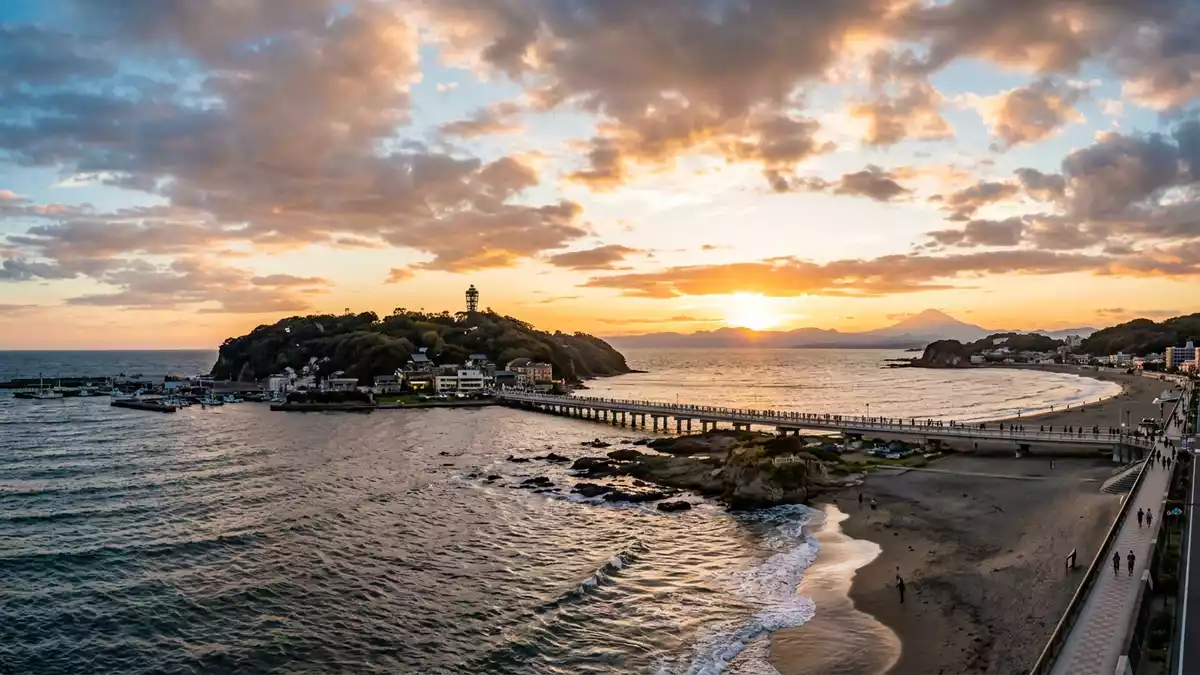
Enoshima is a small island in Sagami Bay, linked to Fujisawa on Japan’s mainland by a bridge. Its visible character comes from the meeting of a wooded shrine route, a rocky coast and the Sea Candle lighthouse above the Samuel Cocking Garden.
Enoshima rises from Sagami Bay
The island lies at the mouth of the Katase River in Kanagawa Prefecture. It measures about 4 km (2.5 mi) around, and a 389 m (1,276 ft) bridge connects it with the Katase district of Fujisawa. Enoshima’s island setting places shrines, shops, gardens and beaches within a compact coastal landscape.
The approach crosses towards a settlement of cafés, restaurants and souvenir shops. The route then climbs through the island’s central shrine area, while the south-western shore opens onto rock, sea and the Iwaya Caves. Waves formed the caves through erosion, and Buddhist monks used them as places of training.
Benzaiten, shrines and the island’s sacred route
Enoshima is dedicated to Benzaiten, a deity associated with music, entertainment and water. The island’s religious history appears in the Enoshima Engi, a chronicle written by the Buddhist monk K?kei in 1047 AD.
Enoshima Shrine occupies the central route and includes Hetsunomiya, Nakatsunomiya and Okutsunomiya. A shrine tradition on the island reaches back to the Nara period, from 710 to 794, while a temple associated with Minamoto no Yoritomo was established in 1182. Enoshima’s shrine history reflects the religious layers that shaped the island before the separation of Shinto and Buddhism in the Meiji period.
Stone steps and small shrine buildings mark the ascent. Enoshima Daishi, a Shingon Buddhist temple constructed in 1993, adds a modern religious landmark to the route. At the coast, the Iwaya Caves connect the island’s sacred geography with its exposed shoreline.
From Samuel Cocking’s garden to the Sea Candle
The upper island contains the Samuel Cocking Garden, named after the British merchant and horticulturist Samuel Cocking. He purchased land on Enoshima in 1880 and developed botanical gardens with a large greenhouse during the early Meiji period.
The original greenhouse was destroyed in the Great Kant? earthquake of 1923. The garden remains associated with Cocking’s name, while the Sea Candle rises above its planting as an observation lighthouse. The tower is 59.8 m (196 ft) high and reaches about 119.6 m (392 ft) above sea level at its upper observation areas. Sea Candle tower dimensions give the wooded summit a clear vertical landmark.
The view extends across Sagami Bay and the Sh?nan coast. Mount Fuji can appear beyond the coastline in clear conditions. The garden, the tower and the shrine route form a sequence of distinct spaces, from sacred buildings and steps to cultivated planting and an open coastal horizon.
Visiting Enoshima: what travellers from Western Europe should know
- Enoshima lies in Fujisawa, Kanagawa Prefecture, at the mouth of the Katase River. Rail access includes Katase-Enoshima on the Odaky? Enoshima Line, Enoshima Station on the Enoden and Sh?nan-Enoshima on the Shonan Monorail.
- The bridge and lower town lead to a rising shrine route. Steps continue towards the Samuel Cocking Garden and Sea Candle, while escalators provide an alternative section of the ascent.
- The island’s south-west coast contains the Iwaya Caves, reached through the shrine and upper-island route. Rocky shorelines, caves and exposed viewpoints form part of the terrain.
- The official language is Japanese and the currency is the Japanese yen.
- Entry requirements depend on your nationality; UK travellers can check the FCDO travel advice at gov.uk/foreign-travel-advice, Irish travellers the Department of Foreign Affairs at ireland.ie.
Searching for Enoshima on social platforms
These links open searches for Enoshima on each platform.
Frequently asked questions about Enoshima
Where is Enoshima?
Enoshima is an island in Sagami Bay, part of Fujisawa in Kanagawa Prefecture, Japan. A bridge connects it with the Katase district on the mainland.
What can visitors see on Enoshima?
The island contains Enoshima Shrine, the Samuel Cocking Garden, the Sea Candle, the Iwaya Caves, coastal rocks and a route of shops and restaurants.
What makes Enoshima distinctive?
Enoshima combines a Benzaiten pilgrimage tradition with a botanical garden, a 59.8 m (196 ft) lighthouse tower and a rocky shoreline above Sagami Bay.


