
Erawan Waterfall and its seven limestone tiers
Published on 09/16/2026 at 16:24 | Editorial responsibility: Rafael Müller, Editor-in-Chief AD HOC NEWS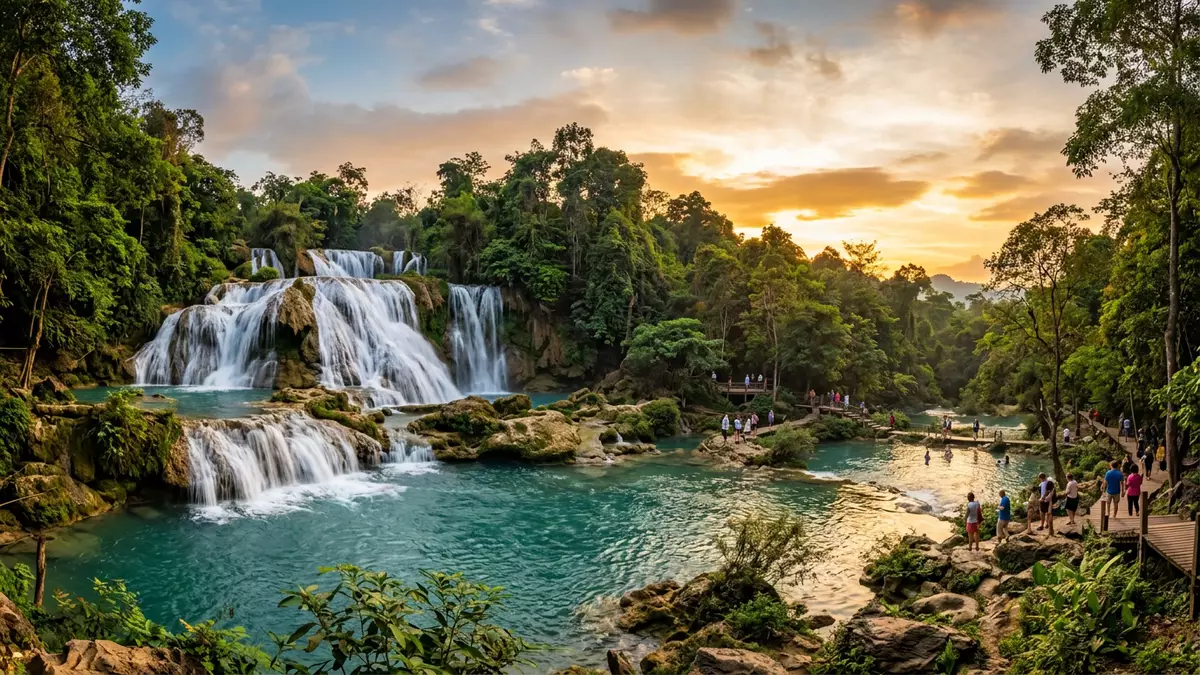
Erawan Waterfall in Kanchanaburi is a seven-tiered limestone cascade inside Erawan National Park. The name refers to Erawan, the three-headed white elephant of Hindu mythology, and that link gives the place a clear cultural identity.
The falls are defined by a stepped profile rather than a single drop. Water moves through pale rock, pools and ledges in a sequence that reads as a landscape in sections.
Seven tiers in Erawan National Park
The waterfall sits within Erawan National Park, a protected area founded in 1975 in western Thailand's Tenasserim Hillsfounded in 1975. The park setting frames the falls as part of a limestone landscape rather than an isolated water feature.
Its seven tiers are the obvious structural feature, with the lower levels grouped near the main trail and the upper levels set deeper into the parkseven tiers. Each level has its own pools, rock edges and surrounding vegetation, so the waterfall presents itself as a chain of scenes.
Rock, water and the Erawan name
Limestone shapes the colour and texture of the site. The falls run over pale rock, and the pools take on green and turquoise tones against the forest backdroplimestone.
The mythological name matters because it anchors the waterfall in Thai cultural memory as well as geology. Erawan is the white elephant associated with Indra, and the multiple streams at the upper part of the falls echo that association in name and form.
A protected landscape in western Thailand
The wider park includes forested hills, streams and limestone cliffs, giving the waterfall a broader setting of rock and vegetationprotected landscape. Kanchanaburi places it in western Thailand, within reach of the province's hill country and river valleys.
The waterfall's identity comes from the combination of tiered water, limestone and forest. That composition gives Erawan Waterfall a form that is easy to recognise and hard to confuse with a single plunge pool or a one-drop cascade.
Visiting Erawan Waterfall: what travellers from Western Europe should know
- The site is in Si Sawat district, Kanchanaburi Province. Bus services from Kanchanaburi town connect with the park, and the waterfall is reached on foot inside it.
- The approach follows a trail through limestone terrain. The route to the top tier runs for about 1.5 kilometres, so the falls are experienced as a walk through levels.
- The park contains forest, streams and caves as well as the waterfall. The falls sit at the centre of that wider protected area.
- The official language is Thai and the currency is the baht. Entry requirements depend on your nationality; UK travellers can check the FCDO travel advice at gov.uk/foreign-travel-advice, Irish travellers the Department of Foreign Affairs at ireland.ie.
Searching for Erawan Waterfall on social platforms
These links open searches for Erawan Waterfall on each platform.
Frequently asked questions about Erawan Waterfall
Where is Erawan Waterfall located?
Erawan Waterfall is in Erawan National Park in Si Sawat district, Kanchanaburi Province, western Thailand. The site lies within the Tenasserim Hills.
What does a visit involve?
It involves a walk along a limestone trail beside a stepped waterfall. Forest, streams and caves form the wider setting.
What makes Erawan Waterfall distinctive?
The seven-tiered form is its strongest characteristic. The name also links the waterfall to Erawan, the white elephant of Hindu mythology.


