
Etna and the dark architecture of Sicily
Published on 09/21/2026 at 18:31 | Editorial responsibility: Rafael Müller, Editor-in-Chief AD HOC NEWS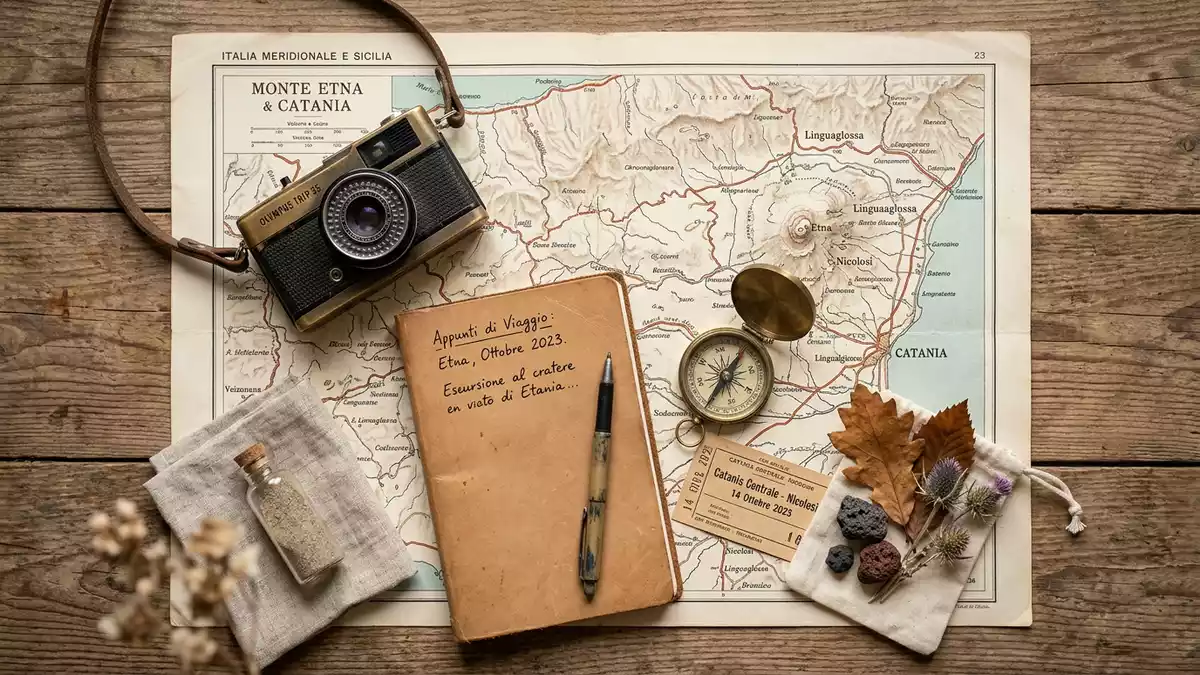
Etna rises above Catania as a broad volcanic mountain, not a neat cone. Its summit changes with eruptions, and its upper slopes hold craters, lava fields and the Valle de Bove.
Etna’s volcanic frame
Etna is a stratovolcano on Sicily’s eastern coast and a UNESCO World Heritage Site. The World Heritage inscription covers the highest part of the mountain, and the site is tied to the Parco dell’Etna regional nature park.
The mountain’s recorded eruptive history reaches back at least 2,700 years, while its geological history extends far further. UNESCO describes the volcano as the most active stratovolcano in the world, and Britannica identifies it as the highest active volcano in Europe.historical record
Craters, lava and the upper slopes
The upper mountain is not a single summit but a changing volcanic landscape. Summit craters, cinder cones, lava flows and lava caves are part of the documented terrain, along with the Valle de Bove depression.
Etna covers a large area, and its slopes carry distinct zones. Britannica describes fertile lower slopes, wooded middle slopes and upper ground covered with ash, sand and lava fragments; the mountain’s highest point is about 3,320 metres (10,900 ft).about 3,320 metres The mountain is a basaltic composite volcano, and its summit height varies with eruptions.
Etna in Sicilian culture and history
Etna has long stood inside the historical imagination of Sicily, from Greek literature to modern geology. The volcano is also known by the ancient name Aetna, and the same source notes the Latin form and the Sicilian name Mongibello.
The mountain’s long documentation includes ancient eruptions recorded in Greek and Roman writing, alongside centuries of scientific observation. That combination of physical scale and historical memory has made Etna one of Sicily’s defining landscapes, with Catania on its eastern side and the sea beyond the lower slopes.
Visiting Etna: what travellers from Western Europe should know
- Etna rises above Catania on Sicily’s eastern side. It is reached through mountain roads that lead to the higher slopes and the main visitor zones on the volcano’s flanks.
- The upper mountain is volcanic ground of ash, lava fragments and broken rock. Walks and viewpoints lie in exposed terrain, and the elevation is part of the experience.
- The volcano includes summit craters, lava caves, cinder cones and the Valle de Bove depression. These features are spread across the upper mountain rather than gathered in one compact viewpoint.
- The official language is Italian and the currency is the euro.
Searching for Etna on social platforms
These links open searches for Etna on each platform.
Frequently asked questions about Etna
Where is Etna?
Etna rises on the eastern coast of Sicily, above Catania. It is part of the landscape of eastern Sicily and stands close to the Ionian side of the island.
What can be seen on a visit?
The mountain shows craters, lava flows, lava caves and broad upper slopes of volcanic material. The terrain is open and high, with visible evidence of repeated eruptions.
What makes Etna distinctive?
Etna combines great size, active volcanism and a long written history. Its World Heritage status reflects both the mountain’s geological scale and the depth of its recorded activity.


