
Etna, the high volcanic mountain above Catania
Published on 09/01/2026 at 19:15 | Editorial responsibility: Rafael Müller, Editor-in-Chief AD HOC NEWS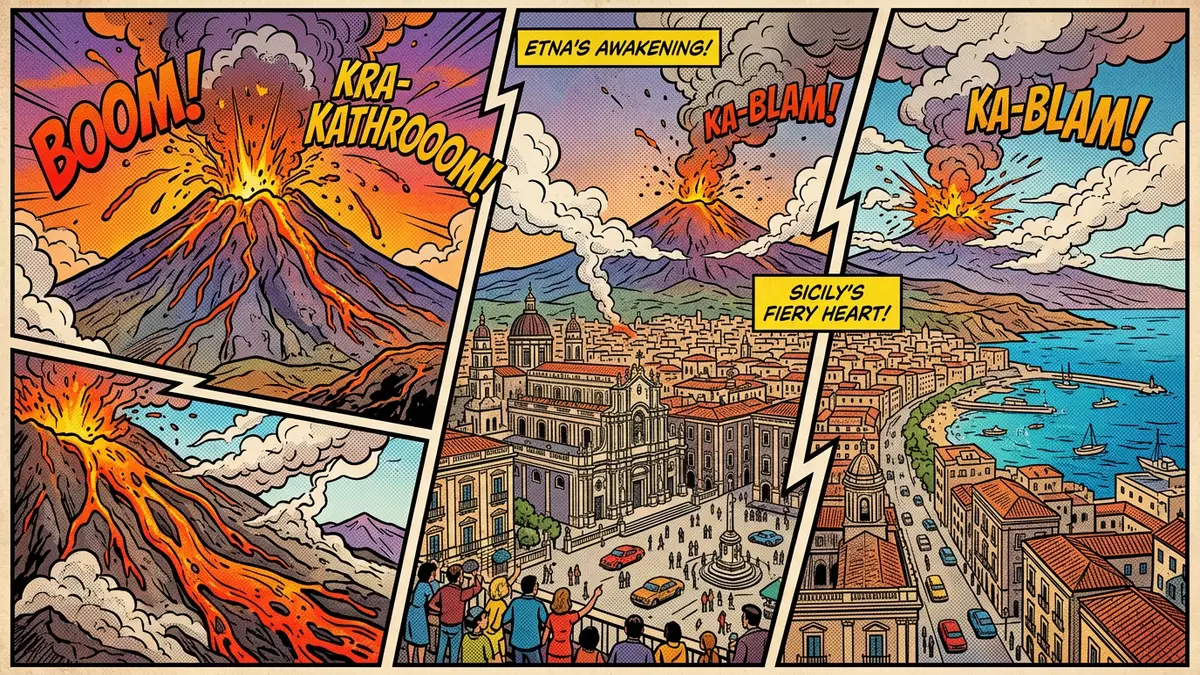
Etna on the eastern side of Sicily is a vast active stratovolcano rising above Catania and shaping the landscape that stretches from the coast to the mountain’s upper slopes. It is the highest mountain in Italy south of the Alps and a long-studied volcanic site recognised as a UNESCO World Heritage property in 2013, making it a rare case where scientific observation and everyday life meet across the same terrain.UNESCO World Heritage property
A layered mountain of lava, ash and terraces
Etna is a stratovolcano, built from successive eruptions that have left thick layers of lava flows and ash shaping the flanks into broad slopes and terraces. The mountain reaches a height of over 3,300 m (about 10,900 ft) above sea level, making it the highest Mediterranean island mountain and giving it a presence that is visible across much of eastern Sicily.highest Mediterranean island mountain The name “Etna” goes back to the Greek “Aitne”, linked to the verb “aith?”, “I burn”, underlining how long the mountain has been tied to fire in Mediterranean culture.Greek name Aitne
The broad base of the volcano covers hundreds of square kilometres and its circumference at the foot runs to well over 100 km, creating a mountain that feels more like a region in its own right than a single peak.Etna’s overall size Lower slopes carry villages, orchards and vineyards, where volcanic soils support agriculture and stone buildings rise from older lava flows. Higher slopes change first to forests and then to open volcanic ground where ash, clinker-like fragments and cooling lava fields dominate the view.
Summit craters and a long recorded eruptive history
Near the top of Etna, several summit craters cluster around the highest part of the mountain, forming an intricate volcanic landscape with overlapping cones, ridges and dark slopes. The active summit area includes the Northeast Crater, Voragine and Bocca Nuova, as well as the Southeast Crater; the latter two craters were previously grouped as the “Central Crater” in older descriptions.summit craters on Etna From these high craters and various vents on the flanks, Etna produces lava flows, ash plumes and characteristic Strombolian bursts that have been watched and documented for centuries.
The eruptive history of Etna is recorded over at least 2,700 years, with written accounts reaching back to the classical period of Greek and Roman observers and geological evidence extending much further into the past.2,700 years of documented activity One major historic eruption occurred in 1669, when lava emerging from a flank vent travelled towards Catania and submerged parts of the city, prompting early attempts to divert the flow; the episode remains a key reference point in the relationship between the volcano and nearby settlements.1669 eruption affecting Catania
Etna as a protected landscape above Catania
Etna’s upper slopes form the core of Parco dell’Etna, a regional nature park, within which the World Heritage property covers 19,237 ha around the highest third of the mountain.Etna park and World Heritage area Within this protected zone, extensive lava fields, recent and older flows, and ash-covered slopes sit alongside patches of vegetation that have taken root in cracks and shallow soils. The contrast between hardened black or reddish lava and resilient plants is one of the most striking visual features of Etna’s landscape.
From viewpoints on the mountain, Catania and the coastal plain lie far below, with the city’s streets and harbour set between the sea and the rising volcanic mass.Etna above Catania Across the middle slopes, roads and tracks thread between villages, agricultural terraces and scattered farm buildings built with local stone. Higher up, paths cross older lava flows and ash fields, where the ground underfoot shows the textures of different eruptions and the air carries fine volcanic dust in dry periods.
Visiting Etna: what travellers from Western Europe should know
- Etna rises on the eastern side of Sicily in southern Italy, north of Catania; approaches by road run from the city towards the southern and northern slopes, with car parks and viewpoints at higher elevations.
- On the mountain, terrain changes from paved roads to rough tracks and paths over volcanic ash and uneven lava, with sections of loose material and gradients that demand steady footing.
- At higher viewpoints the altitude reaches well above 1,500 m (4,921 ft), and exposed sections can leave visitors on open ground without much shelter from wind or cloud.
- Lower slopes carry settled villages and cultivated land, while upper slopes enter the protected Parco dell’Etna, where marked routes cross lava fields and ash-covered areas.
- The official language is Italian and the currency is the euro (EUR).
Searching for Etna on social platforms
These links open searches for Etna on each platform.
Frequently asked questions about Etna
Where is Etna and what kind of mountain is it?
Etna stands on the eastern coast of Sicily in southern Italy, north of Catania, and is an active stratovolcano built from successive layers of lava and ash.
What should visitors expect on a visit to Etna?
Visitors encounter a wide volcanic landscape, with roads, tracks and paths crossing lava fields, ash-covered slopes, cultivated lower areas and higher viewpoints looking down towards Catania and the sea.
What makes Etna distinctive among European mountains?
Etna combines high elevation, long-documented volcanic activity and a large protected area recognised as a UNESCO World Heritage site, all rising directly above a major coastal city.


