
Everglades National Park as a vast subtropical wilderness
Published on 09/17/2026 at 15:28 | Editorial responsibility: Rafael Müller, Editor-in-Chief AD HOC NEWS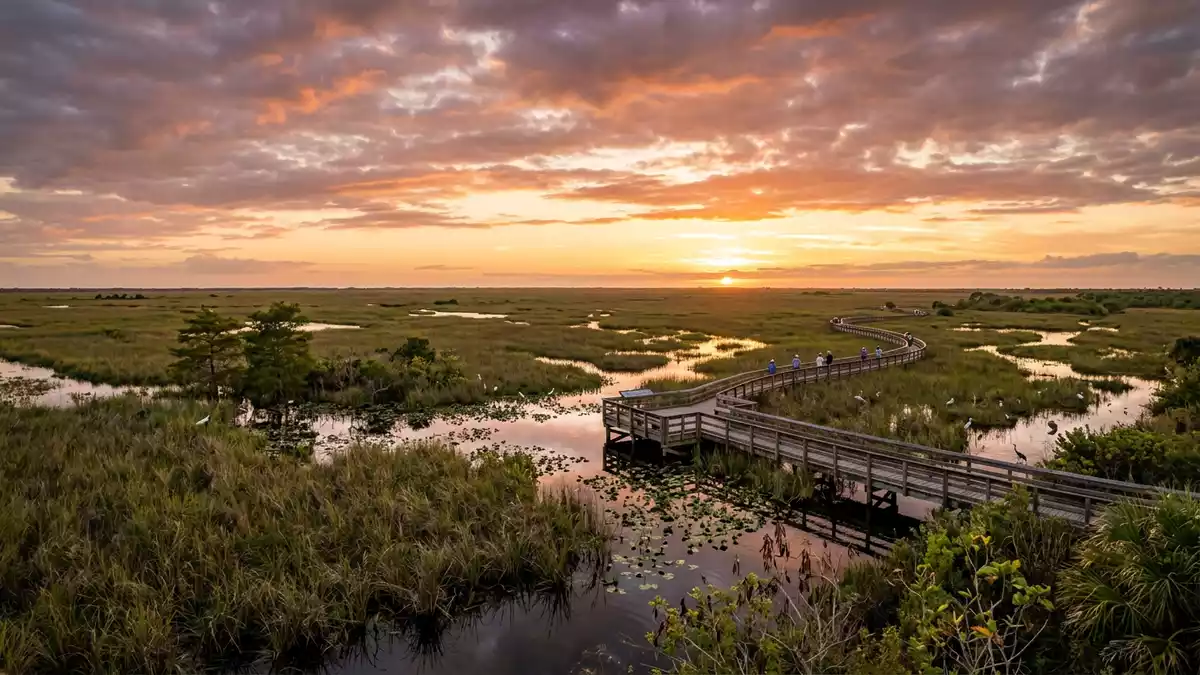
Everglades National Park spreads over the southern tip of Florida as a broad subtropical wilderness of wetlands and coastal shallows, reached on land by road from Homestead in Miami-Dade County. Designated as a national park in 1947, it protects a landscape where shallow fresh water sloughs, sawgrass prairies and mangrove estuaries form a slow-moving river system rather than a single channel. The protected area carries several international recognitions, including inscription on the UNESCO World Heritage List in 1979 and status as a Ramsar Wetland of International Importance, marking it out formally as an ecosystem of global significance.
A landscape built from water, grass and mangroves
The core character of Everglades National Park lies in its geography: a broad, flat basin where surface water drifts south-west towards Florida Bay, spreading into marshes rather than collecting in deep river valleys. At the interface between temperate and subtropical America, freshwater marshes sit beside brackish coastal bays, and shallow estuaries merge into the Gulf of Mexico, creating a continuous gradient of habitats within one protected unit.Its juncture between temperate and subtropical regions supports a notably high diversity of plant and animal communities across the wetlands and coastal shallows.
Within the park, sawgrass prairies form long, open vistas broken by tree islands and higher ground, while extensive mangrove forests line creeks and bays along the Gulf coast.The Everglades contain the largest mangrove ecosystem in the Western Hemisphere and one of the largest continuous stands of sawgrass prairie, making the park a key refuge for wading birds that nest and feed in these flooded grasslands. Tropical hardwood hammocks and pine rocklands add further texture, rising slightly above the wetlands on limestone ground and carrying tree species adapted to drier, elevated sites within the wider marsh.
Protection, designations and the wider network of reserves
Everglades National Park forms part of a broader cluster of protected areas in southern Florida, including Big Cypress National Preserve, Biscayne National Park and Dry Tortugas National Park, along with several national wildlife refuges and the Florida Keys National Marine Sanctuary.The World Heritage inscription covers hundreds of thousands of hectares within this larger protected complex, anchoring an internationally recognised biosphere reserve. Together, these areas protect a continuum from inland cypress swamps through coastal mangroves to coral reefs offshore, with Everglades National Park occupying the south-western portion of the Everglades wetland region.
Beyond the national park status granted in 1947, Everglades National Park and its surrounding waters carry several distinct international labels. It was designated as part of an International Biosphere Reserve in 1976 and recognised under the Ramsar Convention as a Wetland of International Importance in 1987, linking the site formally into global conservation frameworks.The park’s protected area today extends across more than 1,500,000 acres (over 6,000 square kilometres), making it the largest designated subtropical wilderness reserve on the North American continent. Large tracts within the park carry wilderness designation, including the Marjory Stoneman Douglas Wilderness named in 1978 under United States law.
Approaching the wetlands from Homestead and other land entrances
On land, most travellers encounter Everglades National Park through three main road entrances, each connecting to a different part of the wetland landscape. The primary eastern gateway lies west of Homestead and Florida City along State Road 9336, where the Ernest F. Coe Visitor Center marks the start of the road into the Royal Palm and Flamingo areas.The Homestead entrance links directly into the central wetland and coastal zones of the park and serves as the main access point from the metropolitan area around Miami.
The northern land entrance at Shark Valley sits along U.S. Highway 41, the Tamiami Trail, on the park’s northern border, reached by driving west from the Miami area or east from the direction of Naples.This Shark Valley gateway connects visitors to a broad sawgrass basin crossed by a road and trail system, offering views over the wet prairie. A third entrance at Gulf Coast near Everglades City provides access to the maze of tidal channels and mangrove islands on the north-western side, where the wetlands meet the Gulf of Mexico and the coastal ecosystem comes to the fore.
Visiting Everglades National Park: what travellers from Western Europe should know
- Everglades National Park lies across Miami-Dade, Monroe and Collier counties in southern Florida, with a main eastern road entrance west of Homestead reached along State Road 9336.
- Much of the park consists of low-lying wetlands and flat marsh, and access routes often include boardwalks, unpaved paths and modest elevation changes rather than steep climbs.
- Shark Valley on U.S. Highway 41 (Tamiami Trail) forms a northern land entrance, while the Gulf Coast access near Everglades City opens towards tidal channels and mangrove-fringed bays.
- The terrain can be humid and exposed, with long stretches of open sawgrass prairie and coastal waterways where shade is limited on elevated viewpoints and along some trails.
- The official language is English and the currency is the United States dollar.
Searching for Everglades National Park on social platforms
These links open searches for Everglades National Park on each platform.
Frequently asked questions about Everglades National Park
Where is Everglades National Park located?
Everglades National Park lies in southern Florida in the United States, extending across Miami-Dade, Monroe and Collier counties, with a main entrance reached from Homestead.
What kind of landscape can visitors expect?
Visitors encounter a broad mosaic of shallow wetlands, sawgrass prairies, mangrove estuaries, tropical hardwood hammocks and pine rocklands, forming a slow-flowing river of grass rather than a single channel.
What makes Everglades National Park distinctive among world nature reserves?
The park combines vast subtropical wetlands, extensive mangrove forests, international designations as a World Heritage site, biosphere reserve and Ramsar wetland, and a protected area of more than 1,500,000 acres.


