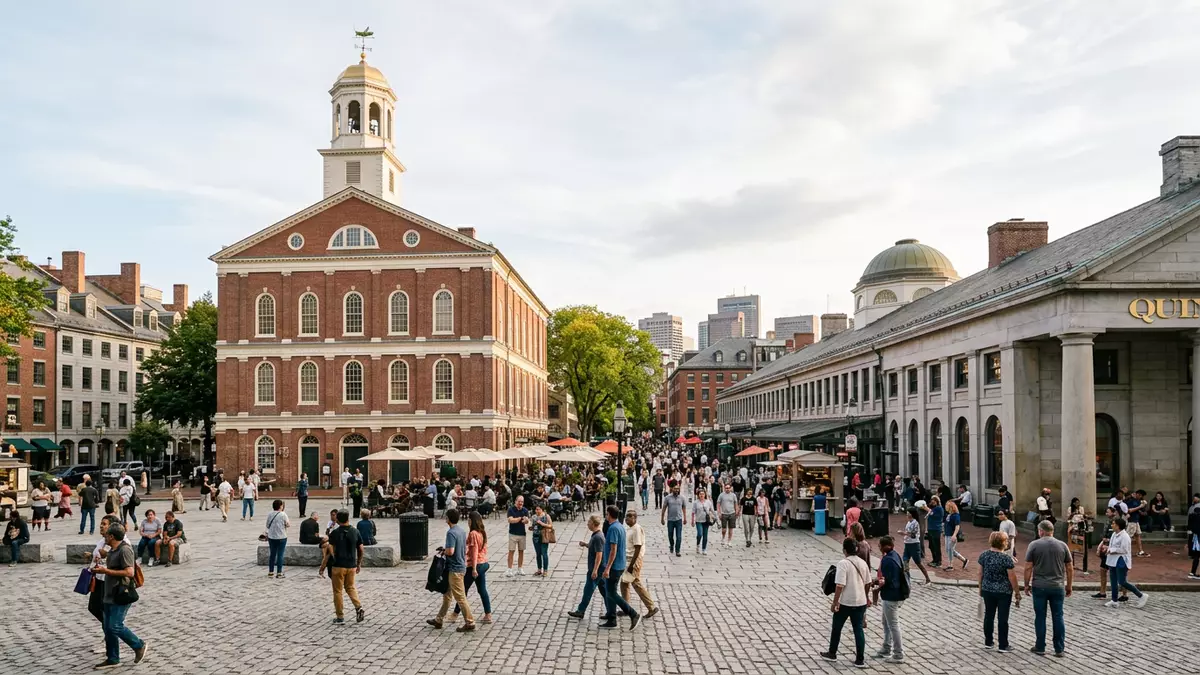
Faneuil Hall and its brick market hall in Boston
Published on 08/09/2026 at 15:19 | Editorial responsibility: Rafael Müller, Editor-in-Chief AD HOC NEWS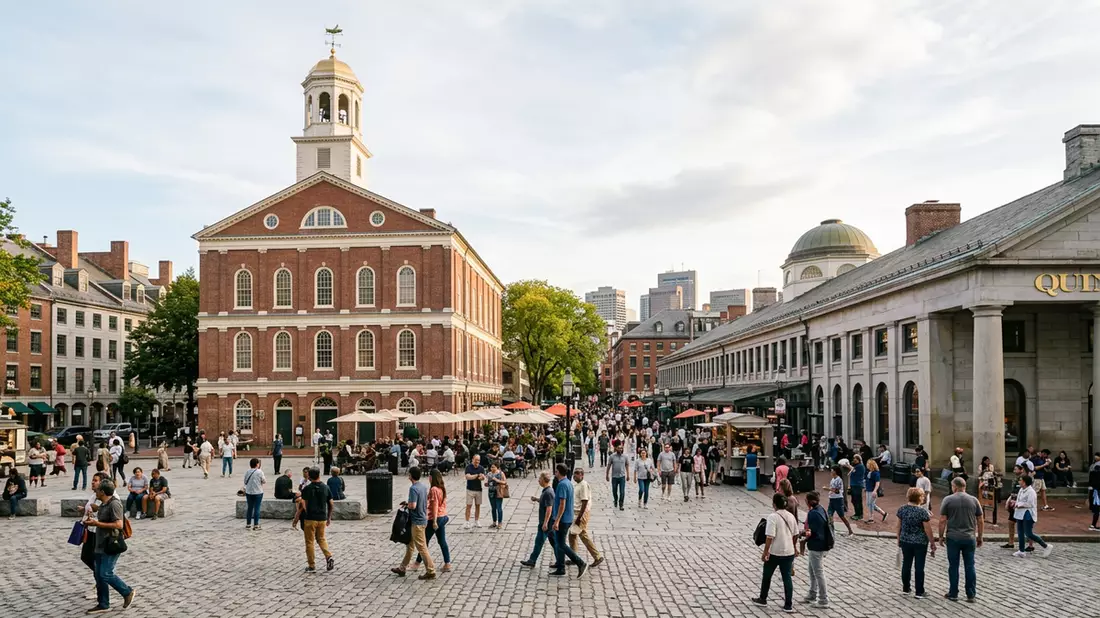
Faneuil Hall in Boston is a red-brick Georgian building with a long civic life behind its market-facing ground floor. It is most closely associated with Peter Faneuil, who commissioned it in the 1740s, and with the city’s Revolutionary-era public debate. The hall’s plain exterior and central cupola give it a measured presence on the edge of the old market district.
Boston’s colonial meeting house and market hall
The building opened in 1742 and has served both public and commercial purposes across the centuries. Its brick walls, sash windows and timber interior belong to the architecture of colonial Massachusetts, while the surrounding marketplace gives it a different rhythm from a church or courthouse.
The hall’s upper spaces were used for meetings and speeches, and the ground level has long linked it to trade. That mixed use is part of its identity: one building, two public functions, both deeply tied to Boston’s civic life.
Revolutionary debate in a Georgian shell
Faneuil Hall became associated with speeches, meetings and arguments over imperial policy in the decades before American independence. Samuel Adams and other political figures used the hall as a place for public expression, and its assembly room earned a reputation as a forum for dissent.
The building itself remains more restrained than the history attached to it. Its proportions are modest, its brickwork formal, and its cupola marks the roofline without extravagant decoration.
What survives inside the hall
Inside, the principal public rooms retain the character of an eighteenth-century civic building. Timber finishes, large open spaces and portraits related to Boston’s history give the interior a ceremonial atmosphere without turning it into a palace.
The building has also been adapted for later civic use, including museum functions and public events. That layered life is visible in the way the hall sits between memory, administration and tourism, while remaining recognisable as a working part of downtown Boston.
Visiting Faneuil Hall: what travellers from Western Europe should know
- Faneuil Hall stands in downtown Boston, close to the waterfront and the old market area, and is reached on foot and by public transport.
- Admission arrangements and opening hours are set by the site's operator and change with the season; the official website is the only binding source.
- Spring and autumn suit a visit best, when walking around the historic district is easier than in midsummer heat or winter cold.
- The building sits in a busy urban area with pavements, steps and mixed pedestrian traffic, so comfortable footwear helps.
- English is the working language, and card payments are widely accepted in the surrounding area.
- Entry requirements depend on your nationality. UK travellers should check the FCDO travel advice at gov.uk/foreign-travel-advice; Irish travellers the Department of Foreign Affairs at ireland.ie; EU and EEA citizens their own national foreign ministry.
Searching for Faneuil Hall on social platforms
These links open searches for Faneuil Hall on each platform.
Frequently asked questions about Faneuil Hall
Where is Faneuil Hall?
It stands in downtown Boston, near the historic market area and within reach of the harbourfront.
What should visitors expect?
A compact historic building with brick exterior walls, public rooms and a setting tied to the city’s old commercial core.
What makes it distinctive?
Its unusual combination of meeting hall and market hall, along with its role in Boston’s Revolutionary political life, gives it a layered identity.