
Fasil Ghebbi, Gondar’s stone-walled royal city
Published on 09/19/2026 at 20:35 | Editorial responsibility: Rafael Müller, Editor-in-Chief AD HOC NEWS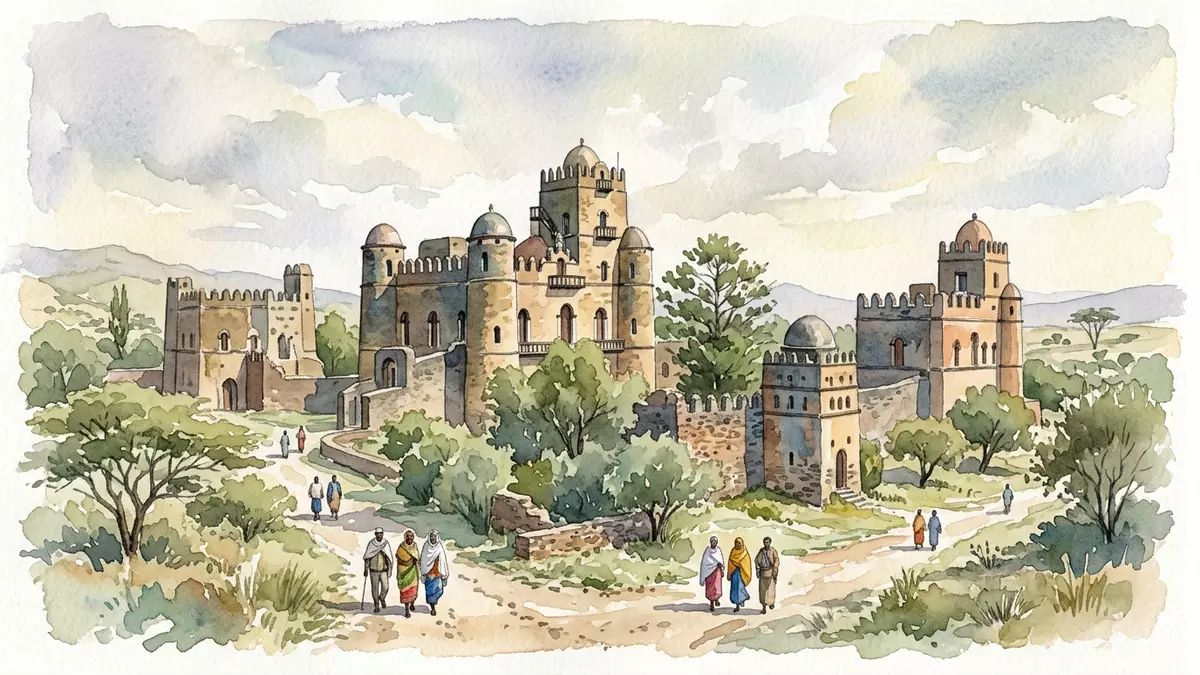
Fasil Ghebbi in Gondar is a fortress-city where stone castles, churches and courtyards stand inside high walls on Ethiopia’s northern highlands, marking the rise of a fixed imperial capital in the seventeenth century. Founded under Emperor Fasilides in the 1630s, this enclosed royal compound became the seat of Ethiopia’s rulers for generations and is now recognised as a cultural World Heritage Site.
Stone castles inside the royal enclosure
At the centre of Fasil Ghebbi stands the principal castle attributed to Emperor Fasilides, a multi-storey stone structure that anchors the ensemble of royal buildings around it.Emperor Fasil’s castle from the 1630s rises above the surrounding compound and displays Gondarine architecture that blends influences from Portuguese, Indian and older Ethiopian building traditions.Gondarine style with mixed influences
Scattered around this main towered residence are further palaces and halls built by Fasilides’ successors, including structures associated with Emperors Iyasu, Dawit and Bekaffa and with Empress Mentewab.Castles of Iyasu, Dawit and Mentewab Many walls and interiors are in partial ruin, yet the range of surviving buildings still conveys how successive members of the Solomonic dynasty added their own residences, banqueting halls and service structures within the same enclosure.
Walls, gates and the layout of a fortress-city
Fasil Ghebbi is defined as much by its perimeter as by its castles: a long curtain wall encloses the compound and is pierced by a series of gates and bridges that once controlled movement between the royal city and Gondar outside.Curtain wall with twelve gates Within this enclosure lie palaces, churches, monasteries and administrative buildings arranged across roughly 70,000 square metres, forming an internal landscape of open lawns, courtyards and stone structures.Fortress-city with palaces and churches
The compound sits on a high plateau within Gondar, in Ethiopia’s Amhara region, and forms the city’s architectural centrepiece.Royal compound in central Gondar The castles are built mainly from rough-hewn local stone, with towers, battlements and external stairways that give them a fortified profile against the skyline; inside the walls, churches and ancillary buildings occupy their own sectors, reinforcing the sense of a self-contained royal town.
Imperial history and World Heritage recognition
Emperor Fasilides, who reigned from 1632 to 1667, established Gondar as a permanent capital and began the construction of Fasil Ghebbi during the seventeenth century.Founded by Emperor Fasilides in the seventeenth century His successors continued to build within the enclosure, and the fortress-city served as the centre of Ethiopian government into the nineteenth century.Centre of Ethiopian government until 1864
Because of its architectural significance and its role in Ethiopian imperial history, Fasil Ghebbi was inscribed as a UNESCO World Heritage Site in 1979 as part of a group of related monuments in and around Gondar.UNESCO inscription in 1979 The listing highlights the way Nubian, Hindu and Arab influences, later reshaped by Baroque forms introduced by Jesuit missionaries, came together in the stone architecture of this highland fortress-city and influenced Ethiopian building traditions in the region.Mixed influences and Baroque forms
Visiting Fasil Ghebbi: what travellers from Western Europe should know
- Fasil Ghebbi lies within Gondar in northern Ethiopia’s Amhara region and is reached by road from Gondar Airport and bus stations through the city streets.
- Inside the enclosure, movement between the castles and churches involves walking over uneven ground and stone surfaces, with steps and external stairways within some of the towers.
- The official language in Gondar is Amharic and the currency is the Ethiopian birr.
- Entry requirements depend on your nationality; UK travellers can check the FCDO travel advice at gov.uk/foreign-travel-advice, Irish travellers the Department of Foreign Affairs at ireland.ie.
Searching for Fasil Ghebbi on social platforms
These links open searches for Fasil Ghebbi on each platform.
Frequently asked questions about Fasil Ghebbi
Where is Fasil Ghebbi located?
Fasil Ghebbi stands within the city of Gondar in Ethiopia’s Amhara region, on a highland plateau in the country’s north-west.
What can visitors expect inside the enclosure?
Visitors encounter a walled compound of stone castles, churches, monasteries and open courtyards connected by paths over uneven ground and historic masonry.
What makes Fasil Ghebbi distinctive among historical sites?
Fasil Ghebbi combines multiple seventeenth- and eighteenth-century castles within one walled royal city, built under Emperor Fasilides and his successors in a distinctive Gondarine style.


