
Federation Square: Melbourne’s fractured civic landscape
Published on 09/08/2026 at 12:49 | Editorial responsibility: Rafael Müller, Editor-in-Chief AD HOC NEWS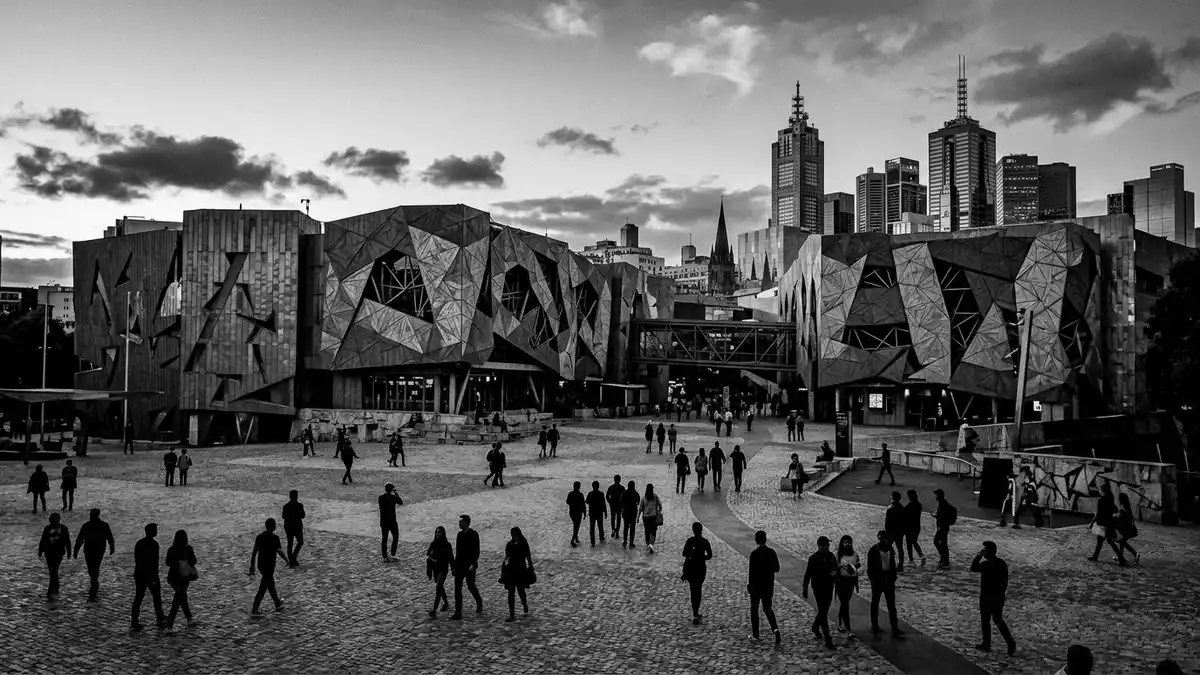
Federation Square in Melbourne is a civic precinct where angular architecture, cultural institutions and a broad plaza sit on a deck above busy railway lines. Conceived in the 1990s and opened in 2002, it has become a central gathering place for Australias largest southern city, framed by Flinders Street Station, St Paul’s Cathedral and the Yarra River.
A civic square suspended above the rails
Federation Square occupies a prominent city block at the junction of Swanston Street and Flinders Street, directly opposite the historic Flinders Street Station and across from St Paul’s Cathedral.this central intersection marks the southern edge of Melbourne’s Hoddle Grid, where the city centre meets the Yarra River. Rather than being built on conventional foundations, the precinct rests on decking that bridges railway lines leading into the station, turning an area that once separated the river from the central business district into a continuous urban surface.decking over the Jolimont Railway Yards
The project emerged from an international design competition in the late 1990s and took shape through the work of Lab Architecture Studio with executive architects Bates Smart.Lab Architecture Studio and Bates Smart Construction began in the closing years of the twentieth century and the square opened to the public on 26 October 2002, marking the completion of a long planning and building process.opened on 26 October 2002 It stands as a memorial to the Federation of Australia in 1901, with its name inscribing that national event into the everyday geography of Melbourne.preeminent memorial to the Federation of Australia
Fractured geometry and sandstone surfaces
The most striking aspect of Federation Square is its fractured geometry. The buildings and plaza depart from a straight orthogonal grid and instead use slightly cranked lines and angular planes associated with deconstructivist architecture.deconstructivist style with cranked geometries Elevations are clad in a tessellated pattern of triangular panels combining Kimberley sandstone, zinc and glass, forming a skin that reads as a complex patchwork on each façade.fractal-patterned cladding of sandstone, zinc and glass
The plaza continues this geometric language underfoot. Its surface tilts and folds gently, and is paved with hundreds of thousands of cobblestones sourced from Western Australias Kimberley region.cobblestones from the Kimberley region Bluestone steps rise towards St Paul’s Court, with inscriptions worked into the stone, while planters and native trees provide patches of shade within the otherwise hard-edged landscape.paved plaza, inscriptions and Yellow Gum trees Seen from Flinders Street, the ensemble of façades and plaza reads as a continuous, folded surface rather than a conventional square bordered by separate buildings.
Cultural institutions around an open plaza
Federation Square is not only an architectural object but also a cultural precinct. Around the central plaza sit several major institutions, including the Ian Potter Centre: NGV Australia, the branch of the National Gallery of Victoria dedicated to Australian art.Ian Potter Centre NGV Australia The Australian Centre for the Moving Image (ACMI) occupies another part of the site, focusing on film, television and digital culture, while the Koorie Heritage Trust provides space for Aboriginal cultural exhibitions and community activities.Australian Centre for the Moving Image and Koorie Heritage Trust
The plaza itself is a broad open-air amphitheatre stepping down towards the Yarra River and framed by terraces, cafés and institutional entrances.open amphitheatre within a mixed cultural and commercial precinct Sight lines connect the square to nearby landmarks, including the cathedral spire and the façades of Flinders Street Station, so that standing in the square gives a clear sense of Melbournes historic cityscape and its newer additions.sight lines to surrounding landmarks The precinct has been recognised on the Victorian Heritage Register, making its ensemble of buildings and plaza part of the states protected cultural heritage.recognised on the Victorian Heritage Register
Visiting Federation Square: what travellers from Western Europe should know
- Federation Square sits at the south-eastern corner of Melbourne’s central grid, at the junction of Swanston Street and Flinders Street opposite Flinders Street Station, with the Yarra River just beyond the decked plaza.
- The precinct is built above railway lines, and the plaza surface slopes gently with steps and terraced seating; access between levels involves staircases and ramps set among masonry and cobblestone paving.
- Nearby, the paths along the Yarra River and the lawns of Birrarung Marr extend the public space, giving visitors additional riverside walking areas reached directly from the square.
- The official language is English and the currency is the Australian dollar.
- Entry requirements depend on your nationality; UK travellers can check the FCDO travel advice at gov.uk/foreign-travel-advice, Irish travellers the Department of Foreign Affairs at ireland.ie.
Searching for Federation Square on social platforms
These links open searches for Federation Square on each platform.
Frequently asked questions about Federation Square
Where is Federation Square in Melbourne?
Federation Square stands at the meeting point of Swanston Street and Flinders Street, opposite Flinders Street Station and close to the Yarra River in central Melbourne.
What can visitors expect when they arrive at Federation Square?
Visitors encounter a broad plaza on a deck above railway lines, surrounded by cultural institutions such as the Ian Potter Centre: NGV Australia and ACMI, with terraces, steps and angular façades.
What makes Federation Square distinctive among civic spaces?
Federation Square is distinctive for its deconstructivist geometry, tessellated sandstone and metal cladding, heritage-listed status and its position bridging Melbourne’s historic core and the riverside.


