
Fernando de Noronha’s volcanic peaks and sea views
Published on 09/21/2026 at 19:02 | Editorial responsibility: Rafael Müller, Editor-in-Chief AD HOC NEWS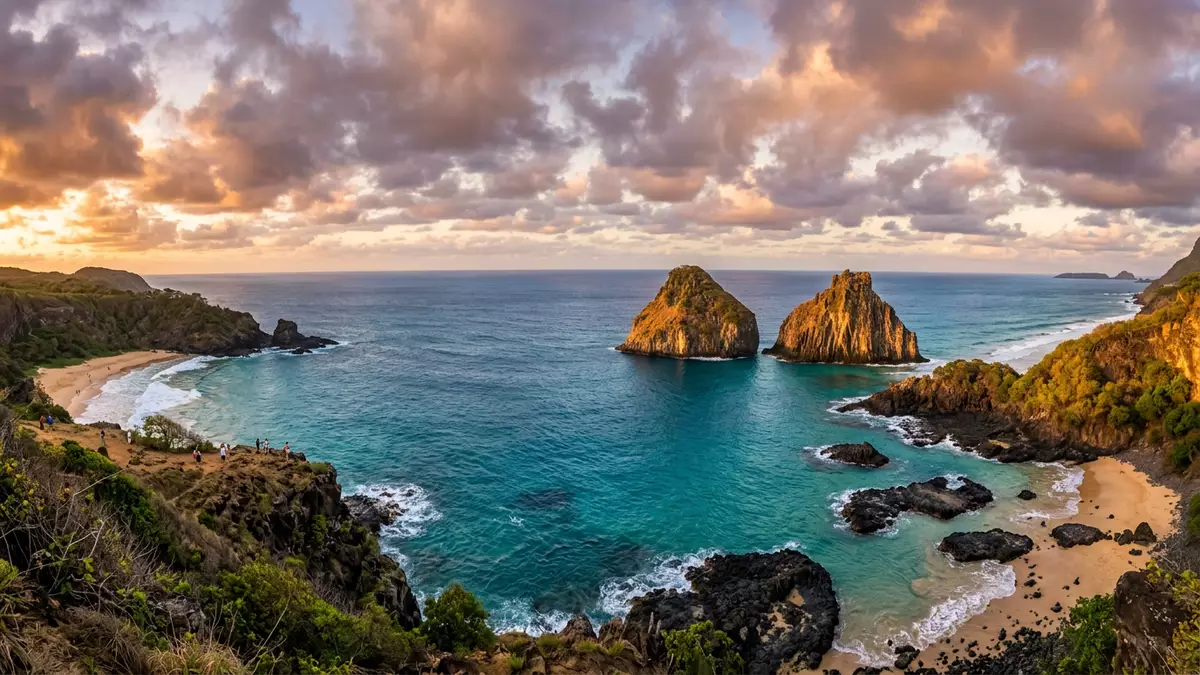
Fernando de Noronha is a Brazilian Atlantic archipelago of volcanic peaks and coves, with Morro do Pico rising above the island’s ridgeline. Its profile is tied to the volcanic chain that forms the World Heritage site inscribed in 2001.
Volcanic ridges above blue water
The island group sits in the South Atlantic and belongs to Brazil’s Pernambuco state. The wider archipelago is formed by volcanic peaks that rise from a submerged mountain chain, and the landscape is read in black rock, sandy edges and steep slopes.
That geological character gives Fernando de Noronha its strongest visual identity. The relief is broken and angular in places, with headlands, inland heights and low coastal stretches set close together. The main island also lies within a protected marine setting linked to its coastal waters and reef life.
From early maps to a named archipelago
Fernando de Noronha appears on early maps from the beginning of the sixteenth century, and the name is tied to Fernão de Noronha, the merchant who financed an expedition to Brazil. That name anchors the archipelago in the first century of European Atlantic expansion, long before the islands became known for their present-day landscape.
The site later became associated with several colonial powers, but its lasting identity is still geographical: a scattered island group with a compact core and a coastline cut by coves. Its position off the Brazilian mainland and its volcanic origin make the place read more as an isolated landform than as a conventional townscape.
Fernão de Noronha and the island form
The islands take their name from Fernão de Noronha, and the archipelago remains one of the clearest place-names in Brazil’s Atlantic history. The name is linked to a maritime world of routes, landing points and control of Atlantic waters.
The strongest thing visible on the ground is the island form itself. There are ridges, slopes, bays and offshore rocks, with the volcanic surface shaping every distant view. That mix of name and landform gives Fernando de Noronha its character.
Visiting Fernando de Noronha: what travellers from Western Europe should know
- The archipelago lies off the north-east coast of Brazil, in the Atlantic Ocean. It is reached by air to Fernando de Noronha Airport, with boat activity concentrated around the island shore.
- The terrain is uneven, with volcanic slopes, rocky heights and coastal paths. Morro do Pico rises sharply above the surrounding relief.
- The official language is Portuguese and the currency is the Brazilian real.
- The place combines island scenery with protected marine surroundings. Reefs, coves and dark volcanic rock define the setting.
- Entry requirements depend on your nationality; UK travellers can check the FCDO travel advice at gov.uk/foreign-travel-advice, Irish travellers the Department of Foreign Affairs at ireland.ie.
Searching for Fernando de Noronha on social platforms
These links open searches for Fernando de Noronha on each platform.
Frequently asked questions about Fernando de Noronha
Where is Fernando de Noronha?
Fernando de Noronha is an Atlantic archipelago off the north-east coast of Brazil. It lies in Pernambuco state, far from the mainland shoreline.
What does a visit involve?
The place is defined by volcanic relief, coastal coves and marine scenery. Roads, paths and shorelines all follow an uneven island surface.
What makes Fernando de Noronha distinctive?
Its identity rests on a volcanic island form with a named historical link to Fernão de Noronha. The UNESCO-listed marine landscape and the sharp island topography make the place easy to recognise.


