
Fes el Bali, the living medieval medina of Fes
Published on 09/18/2026 at 20:29 | Editorial responsibility: Rafael Müller, Editor-in-Chief AD HOC NEWS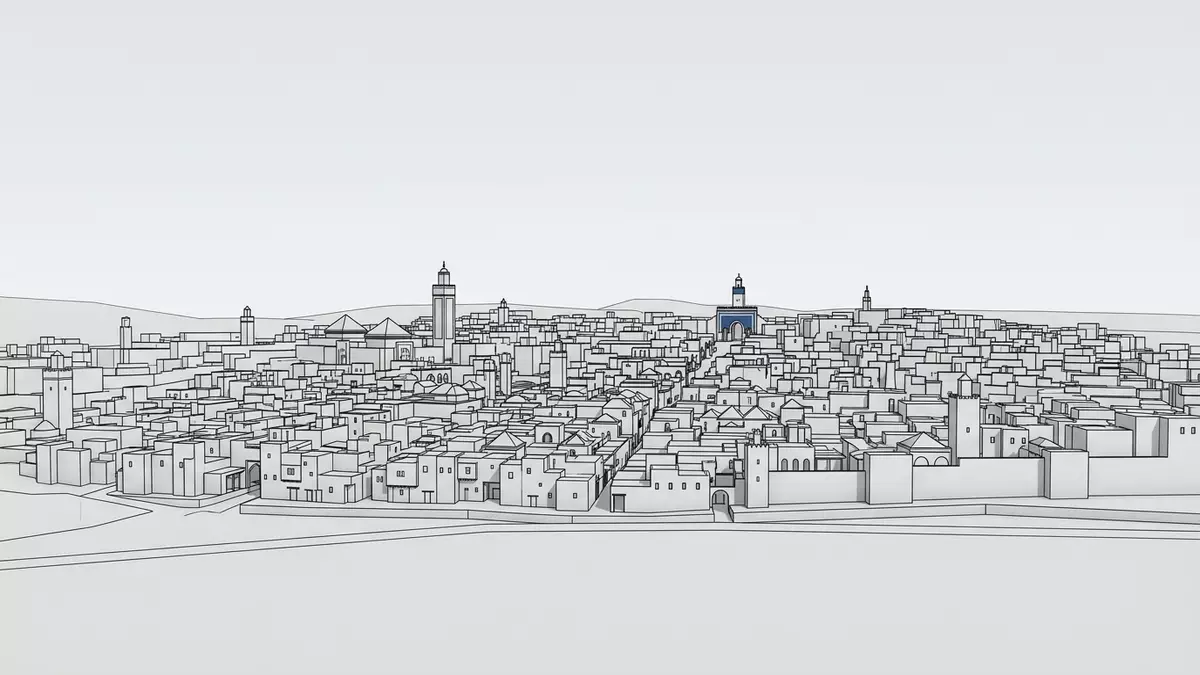
Fes el Bali is the walled historic core of Fes in northern Morocco, recognised for its dense medieval street pattern and intricate layers of religious and commercial life. Founded under the Idrisid dynasty in the early ninth century, it developed into a major city of learning and trade in the wider Islamic world.
A hillside city of walls, rivers and lanes
Fes el Bali occupies a hollow and surrounding slopes on both banks of the Oued Fes, the river that once supplied the city’s neighbourhoods and fountains. The district is enclosed by substantial city walls, whose line still marks the separation between the compact historic medina and the more open newer quarters beyond.The oldest part of Fez is commonly distinguished from Fes Jdid and the later Ville Nouvelle, which together frame it to the west.
The urban fabric inside the walls is tightly packed, with houses and religious buildings rising directly from narrow streets and passages. The medina covers several hundred hectares and contains thousands of lanes and alleyways, many of them stepped or covered and accessible only on foot.The Medina of Fez inscription notes the preservation of this pre-modern layout as a central reason for its recognition.
From Idrisid foundation to UNESCO World Heritage
The origins of Fes el Bali lie in the Idrisid period, when Idris II established a new settlement on the banks of the Oued Fes in 809.The Idrisid foundation under Idris II in 809 formed the nucleus of later development, and subsequent dynasties added mosques, madrasas and neighbourhoods as the city’s importance grew. In the eleventh century the Almoravids unified earlier settlements within a single circuit of walls, while the Almohads in the twelfth and thirteenth centuries extended the built-up area towards the form known today.The UNESCO World Heritage Centre describes this process of consolidation in its summary of the site’s history.
The Medina of Fez, encompassing Fes el Bali along with Fes Jdid, was inscribed as a UNESCO World Heritage Site in 1981. The listing cites its urban fabric, traditional institutions and ensemble of religious, educational and residential buildings as outstanding examples of a historic Islamic city.The 1981 inscription recognises criteria that include both the interchange of human values and the preservation of traditional settlement patterns.
Institutions, craftsmanship and architectural detail
Within Fes el Bali, religious and educational institutions structure the cityscape. The Qarawiyyin Mosque and University, founded in the ninth century, is one of the principal centres of Islamic learning in Morocco and has operated continuously for many centuries.The University of al-Qarawiyyin, established in 859 stands among madrasas whose ornamented interiors, carved plaster and tilework reflect periods such as the Marinid era. The Zawiya of Moulay Idris II, a major religious complex, marks the resting place of the city’s Idrisid founder and remains a focal point within the medina.The Zawiya of Moulay Idris II is noted as one of Fez’s most important religious sites.
Commercial life is concentrated in souks and specialised quarters, where workshops and shops occupy ground floors beneath residential upper levels. Tanneries, where animal hides are processed and dyed, function alongside markets for textiles, metalwork, pottery and other crafts. Many of the buildings incorporate timber screens, stucco decoration and glazed ceramic tiles, forming a visual record of successive dynasties and styles within Morocco.
Visiting Fes el Bali: what travellers from Western Europe should know
- Fes el Bali lies in northern Morocco, forming the historic medina of the city of Fes. It is reached from newer districts and from Fes–Saïss Airport by road and rail connections that link Fes with other major Moroccan cities.
- The terrain inside the medina consists of narrow, often stepped streets and passageways, with frequent changes of level and cobbled surfaces that require sure footing.
- The official language is Arabic and the currency is the Moroccan dirham.
- Entry requirements depend on your nationality; UK travellers can check the FCDO travel advice at gov.uk/foreign-travel-advice, Irish travellers the Department of Foreign Affairs at ireland.ie.
Searching for Fes el Bali on social platforms
These links open searches for Fes el Bali on each platform.
Frequently asked questions about Fes el Bali
Where is Fes el Bali located?
Fes el Bali forms the historic walled medina of Fes in northern Morocco, occupying a valley and slopes along the Oued Fes within the city’s wider urban area.
What should travellers expect on a visit?
Travellers encounter a dense network of pedestrian streets, traditional houses, mosques, madrasas and souks, with daily life and craft activity concentrated in specialised neighbourhoods.
What makes Fes el Bali distinctive among historic cities?
Fes el Bali stands out for the continuity of its medieval street pattern, the presence of institutions such as the Qarawiyyin Mosque and University, and its recognition as part of a UNESCO-listed medina.


