
Fo Guang Shan Fojitu Jinianguan at Kaohsiung’s Buddha Museum
Published on 09/17/2026 at 13:22 | Editorial responsibility: Rafael Müller, Editor-in-Chief AD HOC NEWS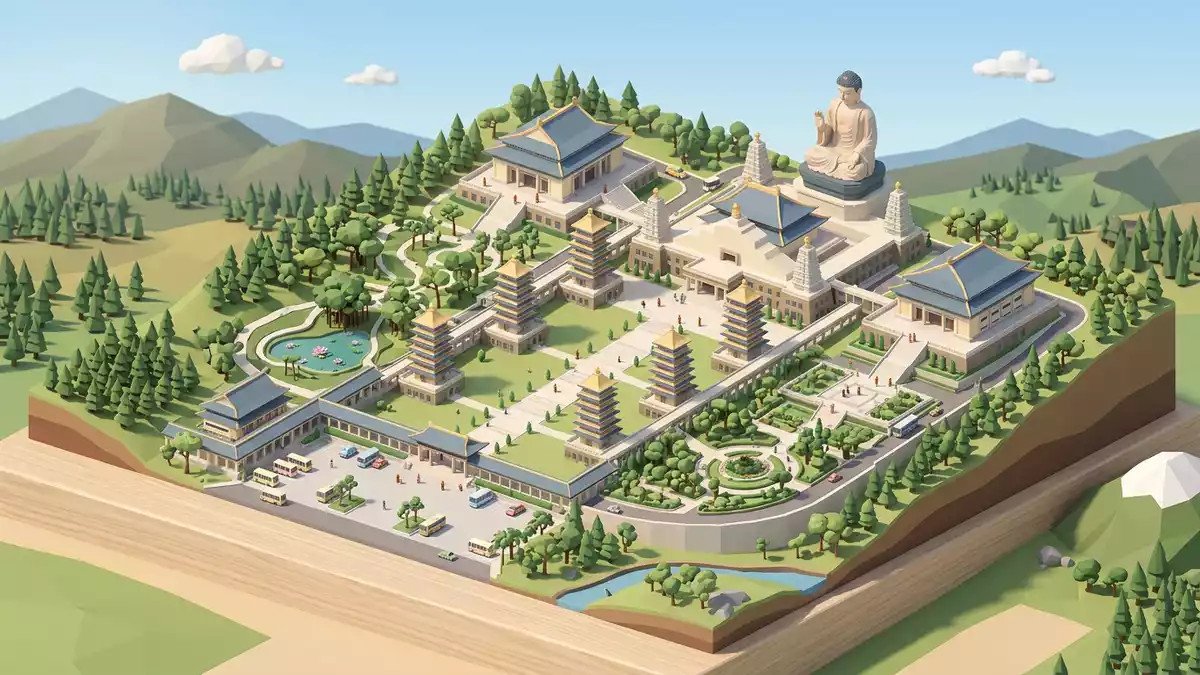
South-east of Kaohsiung’s dense urban core, Fo Guang Shan Fojitu Jinianguan forms part of the sprawling Fo Guang Shan Buddha Museum complex in Dashu District, Taiwan. The museum, completed in 2011, gathers Buddhist architecture, sculpture and relics around an immense seated Buddha that has become a landmark on the hills above the Gaoping River.
The Buddha Museum complex and its setting
Fo Guang Shan Buddha Museum stands in Dashu, a district of Kaohsiung City in southern Taiwan, on terrain that rises gently above the surrounding plains and river course.Fo Guang Shan Buddha Museum is in Kaohsiung City The complex is associated with Fo Guang Shan, one of Taiwan’s significant Buddhist organisations, and forms a bridge between the monastery itself and visitors who arrive from Kaohsiung and other parts of the island.Fo Guang Shan Buddha Museum is linked with Fo Guang Shan
The museum occupies a large site measured in hectares, aligned along a central axis that leads towards the main Buddha statue. A series of halls, courtyards and colonnaded walkways frame this axis, guiding visitors from the entrance plaza towards the heart of the complex. Beyond the buildings, the hills between Kaohsiung and Pingtung give the site a sense of distance from the city without removing it from reach, and the Gaoping River lies nearby as a geographical reference line.
Architecture, layout and the great Buddha
Fo Guang Shan Buddha Museum is described as a Mah?y?na Buddhist cultural, religious and educational museum, and its architecture reflects a blend of Indian and Chinese influences in both massing and decorative detail.Fo Guang Shan Buddha Museum is a Mah?y?na Buddhist museum The approach sequence along the main boulevard passes between symmetrical rows of pagoda-like towers and flanking buildings, leading the eye towards the Fo Guang Buddha, a monumental seated figure on a high base. Taiwan’s tourism administration describes this statue as Asia’s largest and tallest seated Buddha within such a setting, underscoring its scale in relation to the surrounding structures.Asia’s largest and tallest seated Buddha
The museum was completed in 2011, making it a relatively recent addition to Taiwan’s religious landscape while drawing on older architectural languages.Completed in 2011 Behind the main Buddha statue stands the Front Hall and Main Hall, housing exhibition spaces and the shrine that contains relics associated with the historical Buddha. The layout includes underground palaces that store further artefacts, as well as courtyards that allow visitors to move between indoor galleries and open terraces. Stone, concrete and tile dominate the material palette, giving the complex a consistent visual character even as individual halls carry distinct interior designs.
Relics, symbolism and interior spaces
A defining feature of Fo Guang Shan Buddha Museum is its role as a reliquary site. The complex houses a tooth relic attributed to Sakyamuni Buddha, the historical founder of Buddhism, which is enshrined within the Main Hall.A tooth relic of Sakyamuni Buddha is housed here Around this central relic, the museum’s galleries present Buddhist art, sculptures and textual displays that trace the spread of Mah?y?na Buddhism in East Asia, as well as its modern interpretations. Within the caisson ceiling above the Buddha relic area, a painted design evokes the emergence of great compassion, reflecting the doctrinal emphasis of the Fo Guang Shan organisation.A caisson ceiling design symbolises compassion
The museum integrates functions that range from collections and research to education, leisure and tourism, making it a hybrid of religious site and cultural institution.The complex integrates collections, research and education Inside the various exhibition halls, visitors encounter themed displays on Buddhist history, scripture, ritual practice and contemporary humanitarian work. Public spaces within the museum include auditoriums, lecture rooms and areas for quiet reflection. The long central boulevard, terraces around the great Buddha and roofed walkways together create a sequence of indoor and outdoor experiences within a single continuous composition.
Visiting Fo Guang Shan Fojitu Jinianguan: what travellers from Western Europe should know
- Fo Guang Shan Buddha Museum lies in Dashu District, north-east of central Kaohsiung, and can be reached from the city by road via National Highways 1, 8 and 3 to the Dashu exit and Provincial Highway 29, as well as by direct Kaohsiung Bus services from Kaohsiung Railway Station.
- The site extends across a broad hillside complex, and exploring the main axis and halls involves substantial walking on paved surfaces and climbing flights of steps between courtyards and interior levels.
- The official language is Chinese and the currency is the New Taiwan dollar.
- Entry requirements depend on your nationality; UK travellers can check the FCDO travel advice at gov.uk/foreign-travel-advice, Irish travellers the Department of Foreign Affairs at ireland.ie.
Searching for Fo Guang Shan Fojitu Jinianguan on social platforms
These links open searches for Fo Guang Shan Fojitu Jinianguan on each platform.
Frequently asked questions about Fo Guang Shan Fojitu Jinianguan
Where is Fo Guang Shan Fojitu Jinianguan located?
Fo Guang Shan Fojitu Jinianguan is part of Fo Guang Shan Buddha Museum in Dashu District, Kaohsiung City, in southern Taiwan, on hills near the Gaoping River.
What should visitors expect on a visit?
Visitors encounter a large Buddhist museum complex with a central axis of halls and courtyards leading to a towering seated Buddha, alongside galleries of relics and Buddhist art.
What makes Fo Guang Shan Fojitu Jinianguan distinctive?
Its combination of Mah?y?na Buddhist museum functions, a tooth relic of Sakyamuni Buddha and Asia’s tallest seated Buddha statue within a single unified architectural composition gives the site a distinctive character.


