
Fontana di Trevi: Rome’s theatrical Baroque fountain facade
Published on 09/15/2026 at 06:14 | Editorial responsibility: Rafael Müller, Editor-in-Chief AD HOC NEWS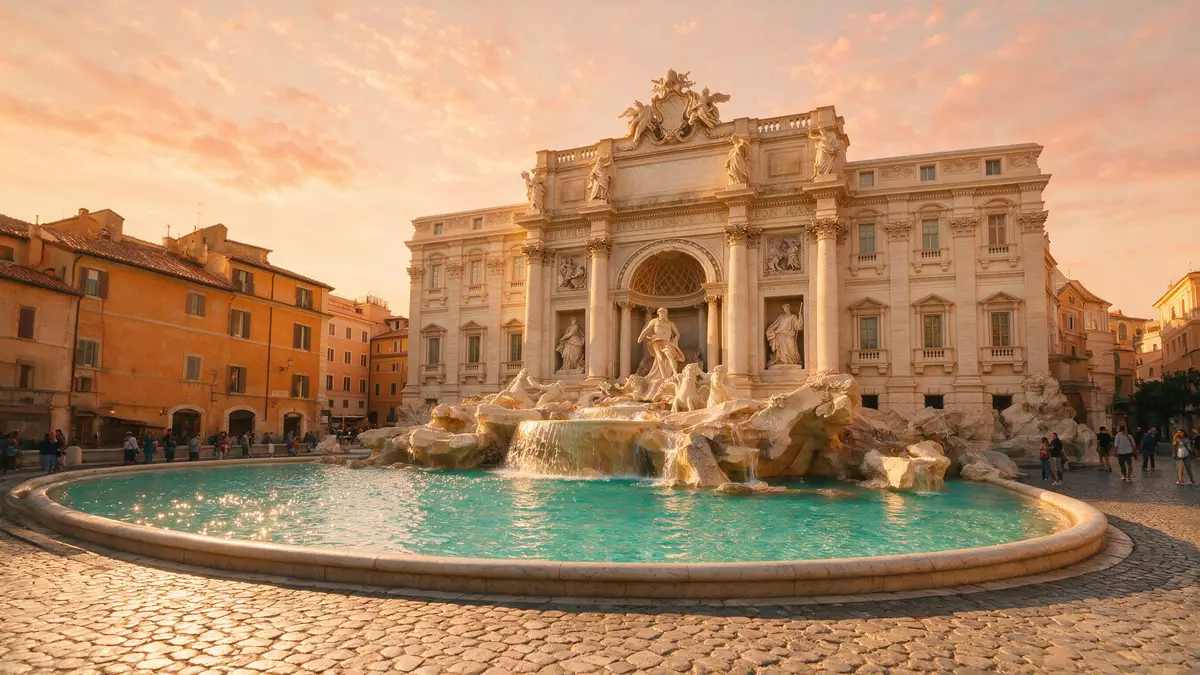
Fontana di Trevi in Rom is an 18th-century Baroque fountain that takes over the entire rear facade of Palazzo Poli, turning a palace wall into a monumental water stage. Its sculptural architecture was designed by Nicola Salvi in the 1730s and completed in 1762 under Giuseppe Pannini, at the end of a construction period that spanned three decades in the eighteenth century.
A palace turned into a fountain facade
The defining feature of Fontana di Trevi is the way it fuses a formal palace front with the drama of a fountain, using stone architecture as a backdrop for cascades of water. Salvi treated the existing Palazzo Poli facade as a broad composition with nine vertical bays, giving the central three bays attached Corinthian columns and a triumphal-arch-like arrangement that frames the main basin below.Palazzo Poli facade The fountain occupies Piazza di Trevi, wedged into the dense urban fabric of central Rome, and the water spills directly against the building, so the boundary between architecture and landscape is blurred.late Baroque masterpiece
The central vertical bay is treated as a giant niche, deeper than the surrounding wall, which becomes the stage for the principal sculpture group. Around this, the stone surface breaks into projecting ledges and broken cornices, creating a sense of movement even before the water is added. The palace windows and balconies are still present above and beside the fountain, but they are visually subordinated to the sculptural programme, so the building reads more as a theatre set than a conventional residence.
Oceanus, allegory and travertine rock
At the heart of the composition stands the figure of Oceanus, carved by Pietro Bracci, commanding the central niche above a basin edged with irregular travertine rock formations.central statue of Oceanus Oceanus is flanked by horses and tritons, which seem to emerge from the stone and water together, while side niches carry allegorical statues representing Abundance and Salubrity in high-relief poses. The rock-like lower section appears to spill forward from the architectural frame, and streams of water thread through its ledges into a large basin that fills much of the square.
The materials are typical of Roman Baroque: the main sculptural and architectural elements are carved in pale travertine, a limestone quarried near Rome and widely used for monumental works in the city.Roman Baroque in travertine Columns, pilasters and the entablature frame the composition in a classical language, while the figures, rockwork and flowing water introduce a sense of movement and theatricality associated with the late Baroque period. Beneath the main group, the basin has a broad, irregular outline, and the water surface reflects both the architecture and the sky, adding a shifting layer of light to the stone.
An 18th-century fountain at the end of an ancient aqueduct
Fontana di Trevi marks the terminal point of the Acqua Vergine, a revived ancient Roman aqueduct known originally as Aqua Virgo, which has carried water to Rome since the first century BC.Acqua Vergine aqueduct The fountain’s position in the Trevi district reflects the historical route of the aqueduct, and the name “Trevi” itself is connected with the idea of “tre vie”, the three streets that converge at the square. Water emerges from concealed outlets in the rock formations, then cascades in several levels before settling into the main basin, where the continuous flow becomes part of the square’s soundscape.
The construction history belongs firmly to the eighteenth century. A competition organised under Pope Clement XII in 1730 selected Nicola Salvi’s design, and construction began in 1732.commissioned in 1730 Salvi worked on the project until his death in 1751, by which time the architectural framework and much of the sculptural planning were in place. Giuseppe Pannini then oversaw the completion, making adjustments to the upper sections and bringing the work to inauguration in 1762, under Pope Clement XIII.completed in 1762 As a whole, the fountain complex represents a late Baroque synthesis of architecture, sculpture and hydraulic engineering anchored in Roman urban history.
Visiting Fontana di Trevi: what travellers from Western Europe should know
- Fontana di Trevi stands in Piazza di Trevi in central Rom, a short walk north-west of the Pantheon and close to major streets in the historic centre.
- The square around the basin is paved and enclosed by buildings, with steps and ledges on the fountain side where the travertine rockwork meets the water.
- The fountain is part of the Trevi district of Rom, and nearby streets connect it with other historic sites such as Piazza di Spagna and Quirinale.
- The official language is Italian and the currency is the euro.
- Entry requirements depend on your nationality; UK travellers can check the FCDO travel advice at gov.uk/foreign-travel-advice, Irish travellers the Department of Foreign Affairs at ireland.ie.
Searching for Fontana di Trevi on social platforms
These links open searches for Fontana di Trevi on each platform.
Frequently asked questions about Fontana di Trevi
Where is Fontana di Trevi located in Rom?
Fontana di Trevi stands in Piazza di Trevi in the Trevi district of Rom, attached to the rear facade of Palazzo Poli in the historic centre.
What should visitors expect when they reach the fountain?
Visitors encounter a broad travertine fountain integrated into a palace wall, with water cascading over carved rock formations into a large basin edged by paved steps.
What makes Fontana di Trevi distinctive among Roman fountains?
Fontana di Trevi is distinctive for its late Baroque design that merges an elaborate architectural facade, large-scale sculpture and continuous aqueduct-fed water into a single theatrical composition.


