
Fontana di Trevi turns water into Baroque theatre
Published on 09/22/2026 at 13:32 | Editorial responsibility: Rafael Müller, Editor-in-Chief AD HOC NEWS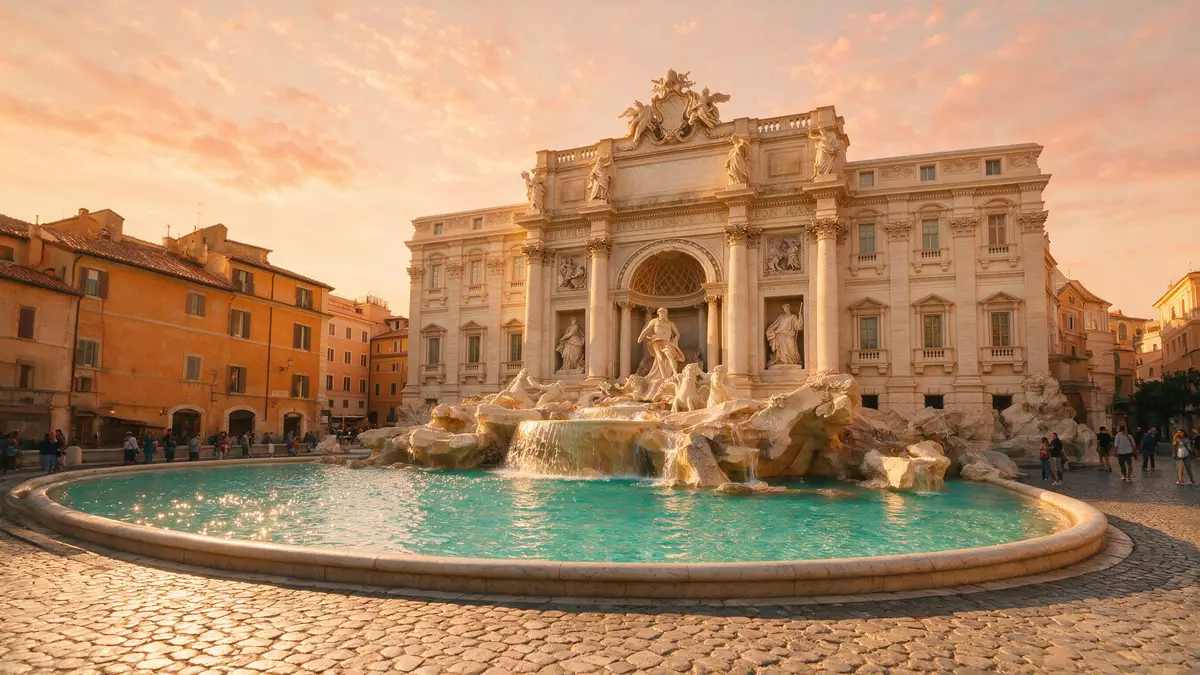
Fontana di Trevi turns a city fountain into a stage of stone, water and sculpture. Set against Palazzo Poli in Rom, the late Baroque composition rises above a broad basin, with Oceanus at its centre and water spreading across travertine rock.
Fontana di Trevi and the theatre of stone
The fountain measures about 26 metres in height and 49 metres across. Its architecture continues the façade of Palazzo Poli, joining a palace front, a triumphal central opening, sculpted figures and rocky ledges into one composition. The fountain’s dimensions give the square a strongly horizontal foreground beneath the tall central design.
Travertine forms much of the fountain, including the architectural surfaces, carved figures and rough-looking rockwork. Water gathers in the lower basin after passing through the central scene, where Oceanus stands on a shell-shaped chariot drawn by sea horses and accompanied by tritons. The figures of Abundance and Health occupy the niches beside him.
Nicola Salvi’s eighteenth-century composition
Nicola Salvi designed Fontana di Trevi after a competition held under Pope Clement XII. Construction began in 1732, and Giuseppe Pannini completed the fountain in 1762 after Salvi’s death in 1751. Nicola Salvi’s design belongs to the late Baroque, when architecture and sculpture were frequently combined in large urban works.
The finished fountain was inaugurated on 22 May 1762 under Pope Clement XIII. Its upper reliefs connect the water with Roman history, while the central figures give the façade a mythological language. The result is neither a freestanding statue nor a simple basin, but a complete architectural wall occupied by moving water.
From Aqua Virgo to Fontana di Trevi
The fountain marks the terminal point of Acqua Vergine, the aqueduct associated with the Aqua Virgo of ancient Rome. Its origins reach back to 19 BC, when Marcus Agrippa’s water system supplied the city and the Baths of Agrippa. The fountain’s long history links the eighteenth-century monument with an older network of Roman water infrastructure.
The name Trevi is connected with the Latin trivium, meaning an intersection of three streets. The setting lies in Rome’s Trevi district, where Via delle Muratte, Via Poli and Via dei Crocicchi meet around the fountain. A coin-throwing tradition adds a later layer of folklore, while films including Federico Fellini’s La Dolce Vita gave the place a lasting role in cinema.
Visiting Fontana di Trevi: what travellers from Western Europe should know
- Fontana di Trevi stands in Piazza di Trevi, in central Rom, beside Palazzo Poli. The nearest metro reference point is Barberini on Line A, with the fountain reached through the surrounding streets.
- The square is enclosed by urban streets and building façades, while the fountain occupies the lower side of the space. The basin, steps and crowded edges create a compact setting for viewing the sculpture.
- The monument is an outdoor Baroque fountain rather than an enclosed museum. Its main features can be seen from the piazza, including Oceanus, the tritons, the sea horses and the flanking allegorical figures.
- The official language is Italian and the currency is the euro.
Searching for Fontana di Trevi on social platforms
These links open searches for Fontana di Trevi on each platform.
Frequently asked questions about Fontana di Trevi
Where is Fontana di Trevi?
Fontana di Trevi is in Piazza di Trevi, in Rome’s Trevi district. Palazzo Poli forms its architectural backdrop, while several central streets meet around the square.
What can visitors expect at the fountain?
The monument presents a broad basin, travertine rockwork, moving water and sculpted figures. Oceanus occupies the central position, with sea horses, tritons, Abundance and Health around him.
What makes Fontana di Trevi distinctive?
Its design combines a palace façade, a monumental fountain and Baroque sculpture in one continuous scene. The 1762 work also marks the terminal point of the ancient Acqua Vergine water system.


