
Frauenkirche in Dresden and its great stone dome
Published on 08/29/2026 at 14:10 | Editorial responsibility: Rafael Müller, Editor-in-Chief AD HOC NEWS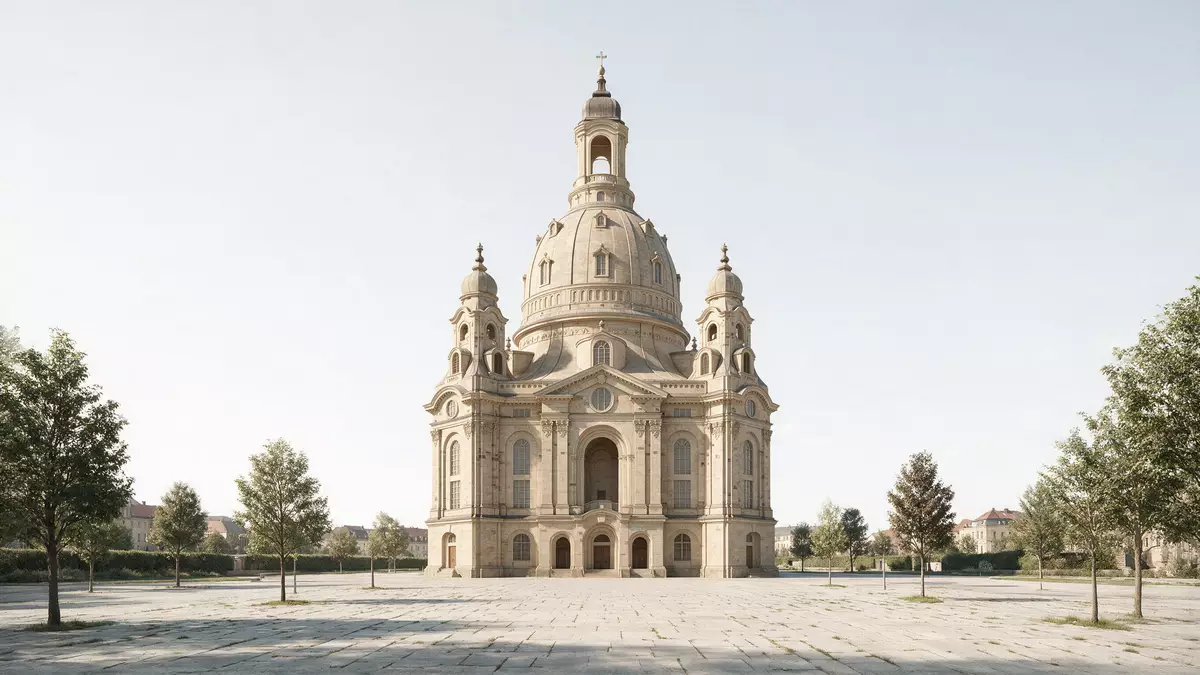
The Frauenkirche in Dresden is a Baroque Lutheran church whose vast stone dome rises above the Neumarkt and has shaped the city’s silhouette for centuries. Built in the eighteenth century under the architect George Bähr, destroyed in the Second World War and reconstructed in the late twentieth century, it stands as a sandstone central building where Protestant worship and Saxon history meet.
A Baroque Lutheran church in sandstone
Frauenkirche is a parish church of the Evangelical Lutheran tradition standing on the Neumarkt in Dresden, close to the River Elbe and the rebuilt historic centre. It belongs to a series of churches on this site dedicated to Mary as “Our Lady”, but the present building is the eighteenth-century Baroque structure conceived as a purpose-built Lutheran church.churches dedicated to Mary The sandstone walls and dome give the building a pale, finely jointed surface that changes subtly with the light and stands apart from the darker roofs and façades around the square.
Dresden’s city council commissioned the new church in 1722 and building took place between 1726 and 1743 under George Bähr, a master builder whose design combined Baroque exuberance with Protestant liturgical needs.built between 1726 and 1743 From the outside, the church rises as a centralised mass of stone with an octagonal outline and a prominent dome known locally as the “Stone Bell”, a comparison drawn from its bell-like profile and the way it swells above the drum. The Baroque façades carry pilasters, cornices and sculpted details that frame tall window openings and side entrances, while a stone lantern crowns the dome and marks the church distinctly against the sky.striking bell-formed dome
Inside the centralised space and its organ
Within Frauenkirche, George Bähr’s plan creates a centralised interior where the congregation surrounds the core elements of Lutheran worship. The layout places the altar, chancel, baptismal font and organ in direct view, with galleries stepping up around the central nave so that seating tiers wrap the space.altar and galleries The result is a hall where stone, plaster and painted ornament form a single volume rather than a long processional axis, reflecting the importance of preaching and congregational participation in Protestant practice.
The eighteenth-century Frauenkirche was equipped with a large organ built in 1736 by Gottfried Silbermann, one of Saxony’s most renowned organ builders, whose instruments still stand in several churches in the region.organ built in 1736 by Gottfried Silbermann Johann Sebastian Bach gave the organ’s first recital that same year, linking the church to the wider musical culture of Lutheran Germany. In the reconstructed church, the organ occupies a similarly prominent position above the altar, with its case and pipes forming a vertical focus under the dome. The interior surfaces combine soft colours, gilded details and carefully restored stonework, so that the rebuilt space evokes the historical arrangement while incorporating modern techniques in structural support and seating.
Destruction, ruin and reconstruction
Frauenkirche’s Baroque dome survived conflicts of the eighteenth and nineteenth centuries, but the church suffered catastrophic damage in February 1945 during the Allied bombing of Dresden. High-explosive and incendiary bombs struck the city centre on 13 February; the church resisted for a time, then its heated sandstone and supporting pillars gave way and the dome collapsed on 15 February into a pile of rubble on the Neumarkt.collapse on 15 February 1945 For decades afterwards, the broken stones remained as a ruin and a visible reminder of wartime destruction in the middle of Dresden.
After German reunification, a broad initiative gathered support and donations for a reconstruction based on historical plans, surviving documentation and the original material. Work on rebuilding the church began in the 1990s; stone blocks from the ruin were catalogued and reused where possible, creating a patchwork appearance where older darker stones sit among new lighter ones.reconstruction project The baroque cupola was rebuilt over a period that ran from 1993 to 2005, and in October 2005 the reconstructed Frauenkirche was consecrated, returning its dome to Dresden’s skyline and restoring its role as a functioning church.consecration in October 2005 The building now stands as a sandstone central church with a continuous liturgical life and a reconstructed architectural form.
Visiting Frauenkirche: what travellers from Western Europe should know
- Frauenkirche stands on the Neumarkt in central Dresden, within walking distance of the River Elbe and close to Dresden’s historic royal buildings and museums.
- The church interior is reached by steps and entrances from the surrounding square, and climbing into the dome involves narrow stairways and significant height above street level.
- Dresden is served by long-distance and regional rail services; from the main station, trams and buses run towards the Altstadt and the Neumarkt area where Frauenkirche is located.
- The official language is German and the currency is the euro; services and information at Frauenkirche reflect its role as a functioning Lutheran church.
Searching for Frauenkirche on social platforms
These links open searches for Frauenkirche on each platform.
Frequently asked questions about Frauenkirche
Where is Frauenkirche located in Dresden?
Frauenkirche stands on the Neumarkt in central Dresden, close to the River Elbe and within the area of the reconstructed historic Altstadt.
What can visitors expect inside Frauenkirche?
Visitors encounter a centralised Baroque interior with galleries, an altar and organ arranged in view of the congregation, all under the rebuilt sandstone dome.
What makes Frauenkirche distinctive among churches in Germany?
Frauenkirche is distinguished by its large bell-shaped sandstone dome, its role as a Baroque Lutheran central building and its documented reconstruction after wartime destruction.


