
French Quarter, New Orleans: a compact city of iron balconies and courtyards
Published on 09/07/2026 at 17:04 | Editorial responsibility: Rafael Müller, Editor-in-Chief AD HOC NEWS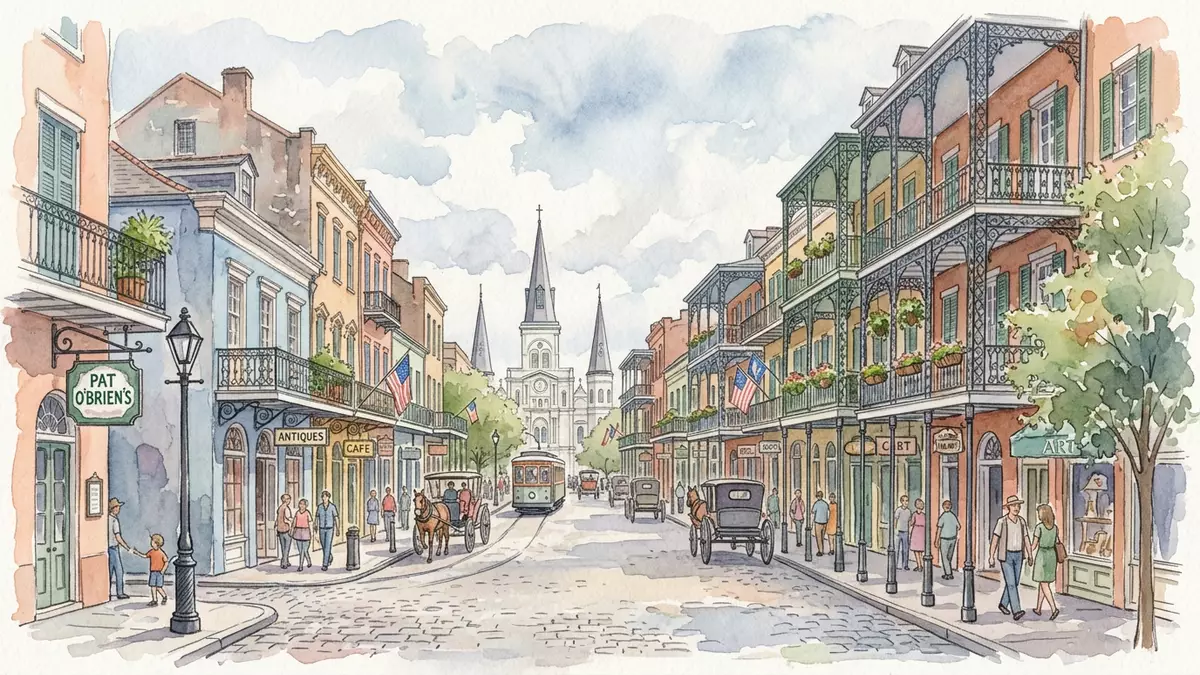
French Quarter in New Orleans is the original city footprint laid out in the early eighteenth century, a compact district where iron-laced balconies, courtyards and riverfront streets sit within a planned grid dating from 1721.the area was laid out into 80 rectilinear blocks by military engineers in 1721 Here the Vieux Carré shows how French, Spanish, Creole and American influences turned a small settlement founded in 1718 by Jean-Baptiste Le Moyne de Bienville into a historic district designated as a National Historic Landmark in 1966.New Orleans was founded in 1718 by Jean-Baptiste Le Moyne de Bienville
A planned colonial grid beside the Mississippi
French Quarter occupies the original site of New Orleans on the banks of the Mississippi River, its streets laid out as a rectilinear grid of blocks oriented towards the riverfront.Located on the banks of the Mississippi River and covering 0.66 square miles, this neighborhood is the site of the original city of New Orleans The engineer Adrien de Pauger planned this pattern in 1721, setting out a compact arrangement of streets and plots that still define the Vieux Carré.the royal engineer Adrien de Pauger designed the city's street layout in 1721
Place d’Armes, the military parade ground at the centre of this plan, is known today as Jackson Square and remains a focal point of the French Quarter, framed by buildings and opening towards the river.The original twenty blocks that formed the fledgling city of New Orleans were laid out in 1721 around the Place d’Armes, now Jackson Square From here narrow streets run inland, lined with townhouses, shops and courtyards that show the district’s long life as a mixed residential and commercial neighbourhood.The district comprises a variety of land uses and property types, including commercial, retail, hotel, entertainment, and residential
From French colony to Spanish influences and Creole architecture
The French claimed Louisiana in the late seventeenth century and Bienville founded New Orleans in 1718 as a French colonial settlement, giving the French Quarter its initial character.The French claimed Louisiana in the 1690s and Jean Baptiste Le Moyne de Bienville founded New Orleans in 1718 After the Seven Years’ War the city passed to Spanish control in 1763, and fires in 1788 and 1794 destroyed much of the earlier building fabric, so most surviving structures date from the late eighteenth century and nineteenth century.The Great New Orleans Fire of 1788 and another in 1794 destroyed 80% of the city's buildings
This history gives French Quarter architecture a layered character. Spanish colonial and Creole styles dominate many streets, with cast-iron and wrought-iron balconies projecting over pavements and enclosed courtyards set behind plastered masonry façades.From cast iron balconies and walled courtyards, to colorful Creole cottages and townhouses, the Vieux Carré is a collection of historic French, Spanish, Creole, and American architecture Creole cottages, double shotgun houses and multi-storey townhouses with an entresol level form much of the housing stock, while Greek Revival details and later American influences appear in some façades.French Quarter architecture is a mix of Spanish, French, Creole and American styles
Landmark buildings and preserved historic status
Among the individual landmarks, St. Louis Cathedral stands at the edge of Jackson Square as a dominant religious building, flanked by the Cabildo and the Presbytère, which house museum collections about Louisiana’s history and Mardi Gras.St. Louis Cathedral, flanked by the Cabildo and the Presbytère, dominates Jackson Square The Old Ursuline Convent, dating to the mid eighteenth century, is one of the earliest surviving buildings in the Mississippi River Valley and shows French colonial construction in the district.The Old Ursuline Convent, built in 1752, is the oldest building in the Mississippi River Valley
The Vieux Carré Historic District covers the full historic footprint of the French Quarter and has been protected through a local historic district established in 1936 and the later National Historic Landmark designation, keeping its street grid and building forms intact.local activists won the establishment of the Vieux Carré local historic district in 1936 Within this area the Historic New Orleans Collection occupies a group of historic buildings spread across several blocks, underscoring how whole ensembles rather than isolated monuments carry the district’s character.HNOC’s 14 historic buildings, spread over three blocks of the French Quarter
Visiting French Quarter: what travellers from Western Europe should know
- French Quarter sits beside the Mississippi River in New Orleans, east of the Garden District, and can be reached by city tram lines and road bridges across the river.
- The streets form a compact grid of pavements and carriageways, with some narrow pavements and uneven flagstones, and staircases within historic buildings such as townhouses.
- Jackson Square lies between Decatur Street and Chartres Street and opens towards the riverfront, with pedestrian paths and garden areas around the central monument to Andrew Jackson.
- The official language is English and the currency is the United States dollar.
- Entry requirements depend on your nationality; UK travellers can check the FCDO travel advice at gov.uk/foreign-travel-advice, Irish travellers the Department of Foreign Affairs at ireland.ie.
Searching for French Quarter on social platforms
These links open searches for French Quarter on each platform.Frequently asked questions about French Quarter
Where is French Quarter in New Orleans?
French Quarter occupies the original New Orleans city site beside the Mississippi River, forming the Vieux Carré historic district at the edge of the riverfront.
What can visitors expect on a walk through French Quarter?
Visitors encounter a compact grid of streets lined with Creole cottages, townhouses, iron balconies and courtyards, with Jackson Square and St. Louis Cathedral as prominent landmarks.
What makes French Quarter distinctive among New Orleans neighbourhoods?
Its eighteenth-century street plan, mix of French, Spanish, Creole and American architecture, and protected status as the Vieux Carré Historic District give it a concentrated historic character.


