
French Quarter streetlife between river and cathedral
Published on 09/03/2026 at 17:58 | Editorial responsibility: Rafael Müller, Editor-in-Chief AD HOC NEWS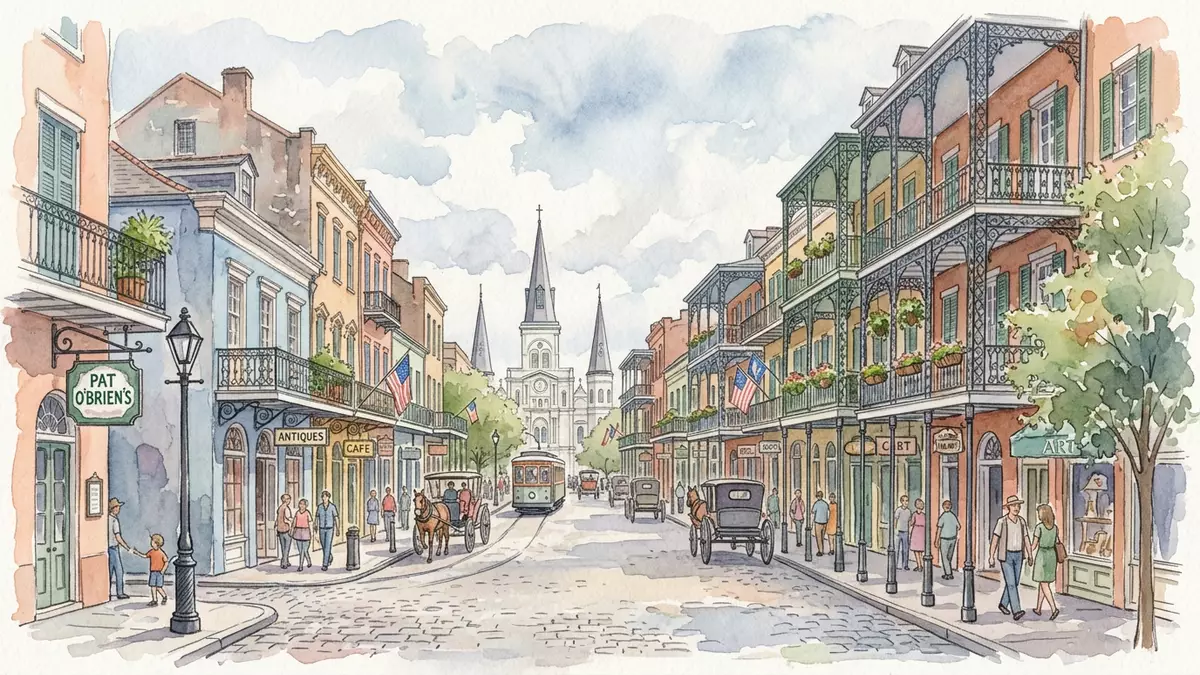
The French Quarter in New Orleans, also known as the Vieux Carré, is the city’s original riverside grid, laid out in 1718 and still densely packed with historic townhouses, courtyards and streetlife. Within this compact district, the rhythm of balconies, wrought-iron galleries and shuttered façades turns an ordinary street plan into a layered stage set of Creole urban life.
From colonial outpost to National Historic Landmark
French colonial governor Jean-Baptiste Le Moyne de Bienville founded New Orleans in 1718, setting the first streets of what became the French Quarter against a bend of the Mississippi River.Jean-Baptiste Le Moyne de Bienville founded the French colonial settlement in 1718 In the 1720s French engineers drew up an orthogonal plan with streets crossing at right angles and a central parade ground facing the river. That early Place d’Armes evolved into Jackson Square, framed by a cathedral and flanking civic buildings that still define the district’s skyline.
Political control passed from France to Spain in the eighteenth century and to the United States with the Louisiana Purchase in 1803, but the Quarter’s grid endured through each regime.The Vieux Carré was laid out as an eleven-by-six-block gridiron plan Two devastating fires in 1788 and 1794 destroyed much of the original French building stock, and most surviving structures date from the late eighteenth and nineteenth centuries rather than from the colony’s first decades.Two major fires in 1788 and 1794 reshaped the surviving building stock In 1965 the Vieux Carré Historic District was designated a National Historic Landmark, recognising the neighbourhood as the original footprint of New Orleans with a concentration of early religious, civic and residential buildings.The Vieux Carré Historic District was designated a National Historic Landmark in 1965
Creole architecture in balconies, courtyards and townhouses
The French Quarter’s architecture reflects centuries of French, Spanish, Creole and American influence layered onto the original street grid.The buildings of the Vieux Carré reflect French, Spanish, Creole and American styles Many blocks are lined with Creole townhouses, where carriage entrances open from the pavement into deep, private courtyards concealed behind masonry walls. Above, wrought-iron or cast-iron galleries project over the pavement, their railings patterned with intricate scrollwork.
Among the oldest structures in the district is the Old Ursuline Convent, dating from the mid-eighteenth century and often cited as the oldest surviving building in the Mississippi Valley.The Old Ursuline Convent is described as the oldest building in the Mississippi Valley Around Jackson Square, St. Louis Cathedral stands between the Cabildo and the Presbytère, creating a formal ensemble that anchors views along Chartres Street.Jackson Square developed from the colonial Place d’Armes as the community’s central open space Elsewhere in the Quarter, rows of American townhouses and long, narrow shotgun houses show how nineteenth-century building types were adapted to the existing colonial street pattern.
Streetlife along the Mississippi
The French Quarter occupies riverfront land between Canal Street and Esplanade Avenue, with North Rampart Street forming its inland edge and the Mississippi River running along its eastern side.The most common definition of the French Quarter runs from Canal Street to Esplanade Avenue and inland to North Rampart Street Within this area, the streets follow the early grid, but each corridor has its own character, from the restaurant-lined blocks close to Jackson Square to quieter residential stretches near Esplanade Avenue.
Many buildings conceal gardens and patios behind streetfront walls, so the district alternates between enclosed façades and sudden glimpses of greenery through open carriageways. At the river’s edge, the Moonwalk and adjoining riverfront spaces give direct views of shipping on the Mississippi and back across the rooftops. Taken together, the grid of streets, the layers of balconies and galleries, and the constant backdrop of the river create an urban landscape that is strongly tied to its eighteenth-century origins yet filled with architectural traces from later periods.The French Quarter forms New Orleans’ oldest neighbourhood along the Mississippi River
Visiting French Quarter: what travellers from Western Europe should know
- French Quarter lies beside the Mississippi River in central New Orleans, bounded broadly by Canal Street, Esplanade Avenue, North Rampart Street and the riverfront.
- The district’s streets follow an eighteenth-century grid, and many landmarks, including Jackson Square and St. Louis Cathedral, are reached on foot along narrow pavements.
- The official language is English and the currency is the United States dollar.
- Entry requirements depend on your nationality; UK travellers can check the FCDO travel advice at gov.uk/foreign-travel-advice, Irish travellers the Department of Foreign Affairs at ireland.ie.
Searching for French Quarter on social platforms
These links open searches for French Quarter on each platform.
Frequently asked questions about French Quarter
Where is French Quarter located?
French Quarter occupies the original street grid of New Orleans beside the Mississippi River, bounded broadly by Canal Street, Esplanade Avenue and North Rampart Street.
What can visitors expect in French Quarter?
Visitors encounter eighteenth- and nineteenth-century townhouses with wrought-iron galleries, hidden courtyards, prominent landmarks such as Jackson Square and St. Louis Cathedral, and a compact, walkable street plan.
What makes French Quarter distinctive?
The district’s combination of colonial-era grid, Creole and Spanish-influenced architecture, and its formal recognition as the Vieux Carré National Historic Landmark gives it a character closely tied to early New Orleans.


