
Fuji-san: Japan’s mountain of changing forms
Published on 09/22/2026 at 11:55 | Editorial responsibility: Rafael Müller, Editor-in-Chief AD HOC NEWS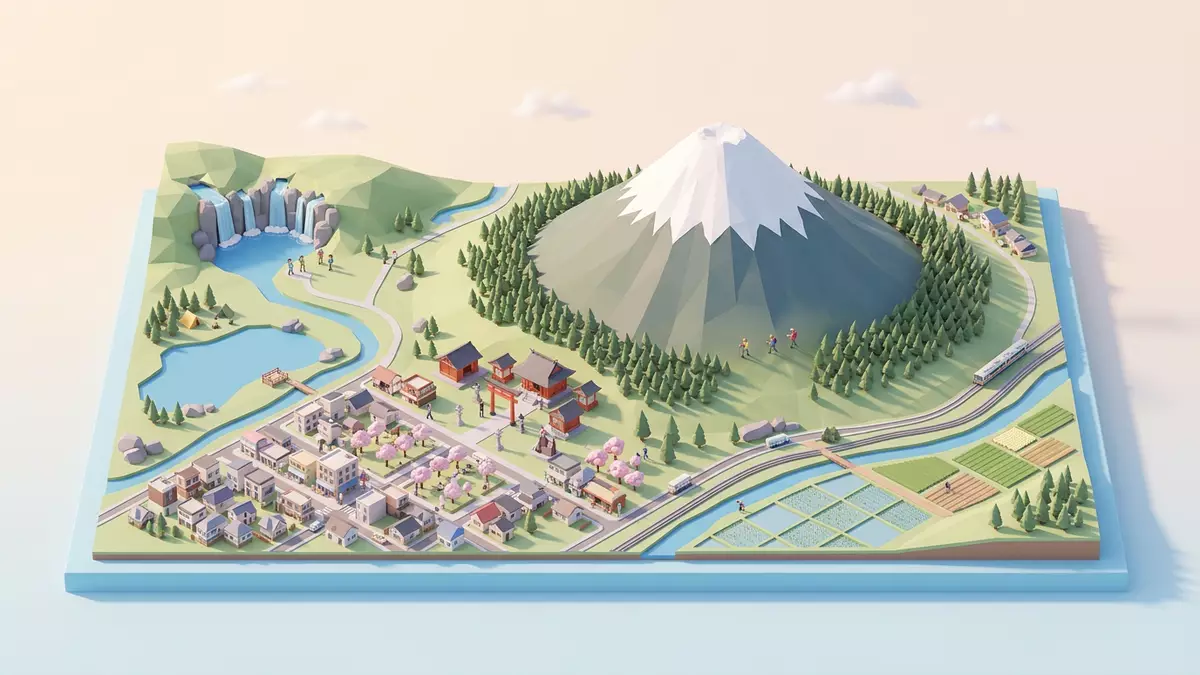
Fuji-san rises above Fujinomiya as a vast volcanic cone whose appearance changes with distance, weather and season. Its summit reaches 3,776 m (12,389 ft), while the mountain’s profile has become a lasting symbol of Japan.
Fuji-san and the shape of a volcano
Fuji-san is an active stratovolcano on Honshu, Japan’s largest island. Its broad summit is crowned by a crater, and the upper slopes form a long, clean line above the surrounding foothills.
The mountain is built from layers of lava, ash and other volcanic material. Its geological story includes older volcanic formations beneath the cone visible today. Fuji-san’s volcanic profile belongs to a landscape shaped by repeated eruptions.
At lower elevations, forests cover much of the mountain. Higher ground becomes open volcanic terrain, with rock, scree and narrow paths leading towards the crater rim. The summit is not a separate peak beside the cone; it is the upper edge of the same volcanic mass.
From sacred mountain to cultural symbol
Fuji-san has a long place in Japanese religious culture. Shinto traditions connect the mountain with the deity Konohanasakuya-hime, while Buddhist practice associated its summit with spiritual ascent.
Climbing Fuji-san became part of organised pilgrimage culture during the Edo period, which lasted from 1603 to 1868. Pilgrims travelled through settlements around the mountain before beginning the ascent. Shrines, trails and summit rituals preserve this connection between landscape and belief.
The mountain also became a central subject in Japanese art. Katsushika Hokusai’s series Thirty-six Views of Mount Fuji includes Fuji-san in different seasons and settings. Utagawa Hiroshige also placed the mountain within scenes of roads, rivers and towns.
Hokusai’s Fuji prints show how the mountain functions as both a physical landmark and a repeated artistic subject. Its outline remains recognisable even when the surrounding scene changes.
Fujinomiya on the southern approach
Fujinomiya lies on the southern side of Fuji-san in Shizuoka Prefecture. The city is associated with Fujisan Hong? Sengen Taisha, a major shrine connected with worship of the mountain.
The shrine’s red buildings, wooded grounds and sacred spring form a cultural counterpoint to the exposed volcanic slopes above. The mountain appears beyond the shrine precinct, linking the urban landscape with the summit.
Fujinomiya also gives its name to the Fujinomiya Trail, one of the recognised routes ascending Fuji-san. The trail begins at high altitude and reaches the summit through volcanic terrain. The Fujinomiya Trail forms part of the mountain’s pilgrimage and climbing geography.
Near the city, Shiraito Falls lies within the wider Fuji region. Water descends over a broad wall of volcanic rock, while the mountain’s lava fields and forests extend across the surrounding landscape.
Visiting Fuji-san: what travellers from Western Europe should know
- Fuji-san rises south-west of Tokyo and west of Yokohama. Fujinomiya lies on the southern side, with rail connections through Shin-Fuji and Mishima.
- The summit stands at 3,776 m (12,389 ft). The upper mountain has volcanic rock, exposed slopes and a crater rim, while the lower slopes contain forest.
- The Fujinomiya Trail is the shortest direct route from a high trailhead to the summit, but its steep volcanic ground remains demanding.
- The official language is Japanese and the currency is the Japanese yen.
- Entry requirements depend on your nationality; UK travellers can check the FCDO travel advice at gov.uk/foreign-travel-advice, Irish travellers the Department of Foreign Affairs at ireland.ie.
- Conditions on the mountain change with the seasons; the local cable-car operators and alpine clubs provide information.
Searching for Fuji-san on social platforms
These links open searches for Fuji-san on each platform.
Frequently asked questions about Fuji-san
Where is Fuji-san?
Fuji-san stands on Honshu, west of Tokyo, between Shizuoka and Yamanashi prefectures. Fujinomiya occupies the southern side of the mountain.
What does a visit involve?
The lower landscape includes forests, shrines, waterfalls and lava terrain. A summit ascent involves steep paths, volcanic ground and high altitude.
What makes Fuji-san distinctive?
Fuji-san combines a clearly defined volcanic cone with centuries of religious practice and artistic representation. Its summit reaches 3,776 m (12,389 ft).


