
Fujian Tulou in Yongding and the art of communal earthen living
Published on 08/29/2026 at 13:55 | Editorial responsibility: Rafael Müller, Editor-in-Chief AD HOC NEWS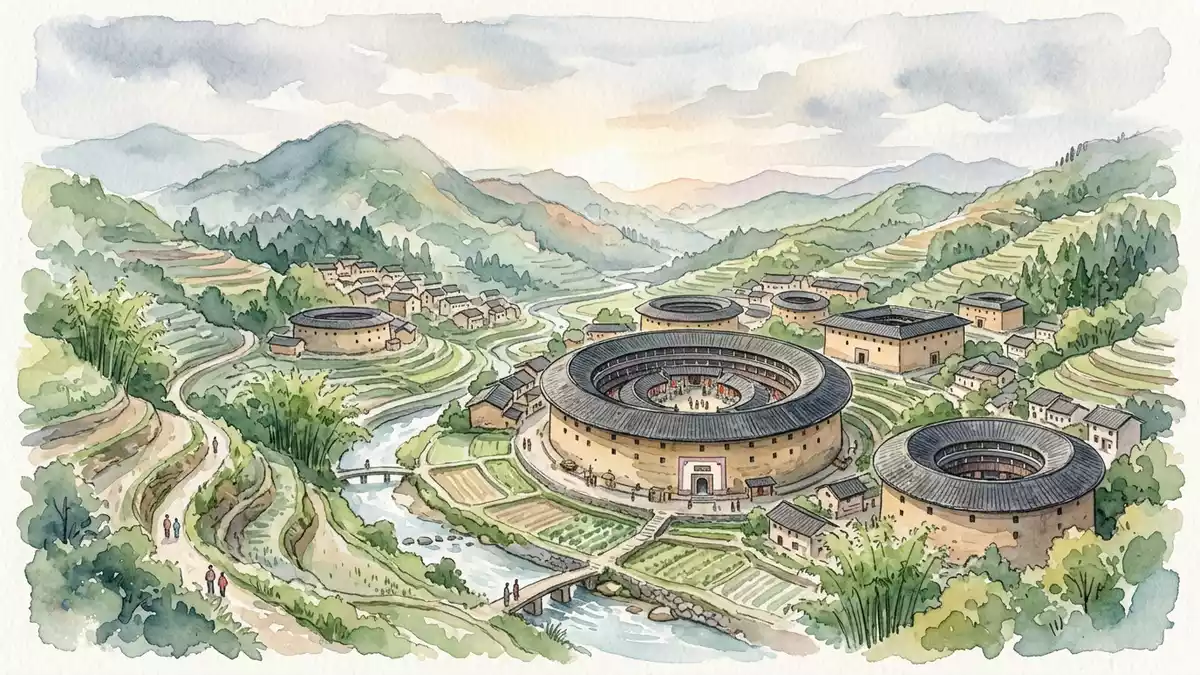
Fujian Tulou in Yongding are monumental earthen dwellings where architecture and clan life are bound into single fortified structures built across several centuries in the mountains of south-eastern China. These rammed-earth residences are recognised as a UNESCO World Heritage Site and form part of a group of tulou spread across Yongding, Nanjing and Hua'an counties in Fujian Province.
Earthen fortresses shaped for clan living
The term tulou literally means “earth building”, a name that describes both the main construction material and the multi-storey domestic purpose of these structures. Fujian Tulou in Yongding belong to a wider group of Hakka walled villages that served as communal homes for extended families in the mountain valleys of Fujian.earth building Inside a single tulou, individual housing units line the inner perimeter, typically rising through several floors and sharing a common courtyard at the centre.
The outer wall of a Fujian Tulou is built from rammed earth mixed with local materials such as clay, sand and lime, sometimes with organic additives that enhance binding. This substantial wall is paired with an internal frame of timber and bamboo that supports the floors and roof.rammed earth walls The result is a ring or block of dwellings arranged vertically, with each family space commonly including cooking, storage and sleeping rooms stacked one above the other. The courtyard between the encircling dwelling and the inner space is both a shared social area and the focus of daily activity.
From Song dynasty origins to World Heritage status
Tulou construction in Fujian began in the medieval period and continued for many generations, with examples dating from the Northern Song dynasty in the twelfth century and further building through the Ming and Qing dynasties into the twentieth century.Northern Song dynasty In Yongding and neighbouring counties, tulou formed dense clusters of fortified settlements, and thousands of such buildings remain scattered through the hills and valleys of western Fujian.more than 23,000 tulou
In 2008, a group of 46 Fujian Tulou sites, including clusters in Yongding, were inscribed on the UNESCO World Heritage List as “exceptional examples of a building tradition and function exemplifying a particular type of communal living and defensive organisation in a harmonious relationship with their environment”.UNESCO World Heritage List The inscription recognises both their architectural ingenuity and their role as enduring communal residences in mountainous rural China.built between the 15th and 20th centuries
Yongding clusters and scenic areas
Within Yongding, several tulou clusters and individually striking buildings form the core of the Fujian Tulou (Yongding) Scenic Area. Among them are groupings such as the Chuxi Tulou cluster in Xiayang township, where multiple tulou rise from the slopes around Chuxi village and together present layered rings and blocks of earthen architecture.Chuxi Tulou cluster Other parts of the scenic area highlight individual structures given local nicknames such as “king” or “prince” tulou, pointing to their size or visual presence within the landscape.Fujian Tulou (Yongding) Scenic Area
These clusters sit in narrow valleys and on gentle slopes in the mountains of Longyan, with rivers, terraced fields and smaller houses nearby. A single tulou often stands beside lower, more recent buildings of brick or concrete, underlining the scale and distinctive material of the earthen structure. The arrangement of tulou in Yongding, where several stand within walking distance of one another, lets visitors compare different plans, heights and courtyard proportions in a compact rural setting.
Visiting Fujian Tulou: what travellers from Western Europe should know
- Fujian Tulou in Yongding lie in the mountainous interior of Fujian Province in south-eastern China, south of Longyan and reached from regional cities by road and rail.
- The terrain around the tulou clusters includes slopes, stone steps and uneven village paths, with approaches on foot through courtyards and narrow lanes.
- The Fujian Tulou (Yongding) Scenic Area is set among rivers and terraced farmland, so expect rural surroundings rather than dense urban streets.
- The official language is Chinese and the currency is the renminbi (yuan).
- Entry requirements depend on your nationality; UK travellers can check the FCDO travel advice at gov.uk/foreign-travel-advice, Irish travellers the Department of Foreign Affairs at ireland.ie.
Searching for Fujian Tulou on social platforms
These links open searches for Fujian Tulou on each platform.Frequently asked questions about Fujian Tulou
Where are Fujian Tulou in Yongding located?
Fujian Tulou in Yongding are situated in the mountainous part of Longyan in Fujian Province, in south-eastern China, among valleys and terraced farmland.
What can visitors expect during a visit?
Visitors encounter large earthen-walled dwellings arranged around courtyards, with stepped approaches, village lanes, timber interiors and clusters of tulou standing close to rivers and fields.
What makes Fujian Tulou distinctive among rural dwellings?
Fujian Tulou combine thick rammed-earth outer walls, multi-storey timber living units and shared courtyards into single fortified residential buildings that housed extended clans over centuries.


