
Fuzimiao in Nanjing, where Confucian learning meets the Qinhuai River
Published on 09/18/2026 at 12:45 | Editorial responsibility: Rafael Müller, Editor-in-Chief AD HOC NEWS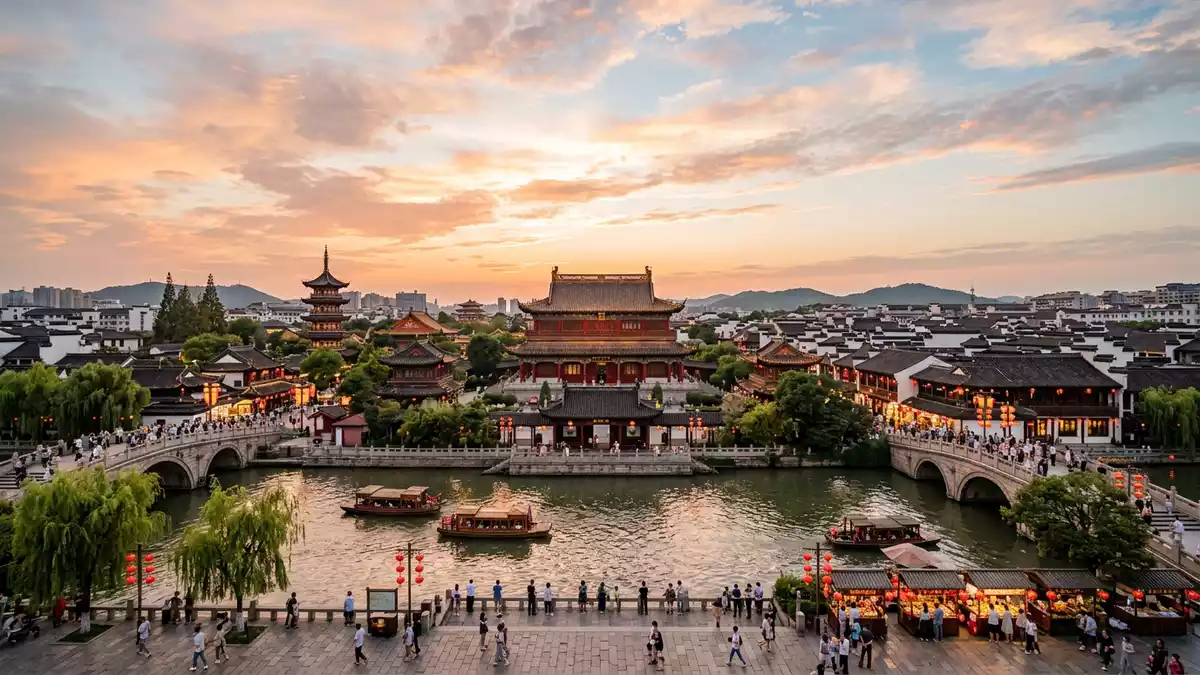
Fuzimiao in Nanjing is a Confucian temple quarter where ritual halls, academic buildings and riverside streets gather along the Qinhuai River, reflecting centuries of Chinese scholarship and urban life. The complex’s roots reach back to the Eastern Jin dynasty in the fourth century, while a major reconstruction in 1034 during the Song dynasty gave it the role of both temple and educational centre.
Temple, academy and examination hall along the river
Fuzimiao grew out of institutions of learning established during the Eastern Jin dynasty, when an imperial university campus extended across both banks of the Qinhuai River.imperial university campus In 1034, under the Song dynasty, the site was newly developed as a Confucius Temple, formalising its identity as a place of worship and scholarship by linking temple buildings with state education.built in 1034 during the Song dynasty
Over the following centuries the Fuzimiao area came to encompass three closely connected elements: the Confucius Temple itself, the Imperial Academy and the Jiangnan Examination Hall.Confucius Temple, Imperial Academy and Jiangnan Examination Hall Together they formed a complete route for scholars, from study in the academy to the civil service examinations held in Jiangnan Gongyuan, all set beside the Qinhuai River as it flows through Nanjing’s historic Qinhuai District.Confucius Temple area in Qinhuai District
Architecture shaped by Ming and Qing reconstructions
The buildings seen at Fuzimiao today reflect cycles of damage and rebuilding, with major reconstructions during the Ming and Qing dynasties shaping their timber architecture and layout.Ming and Qing style reconstructions A sequence of courtyards, gates and halls aligns along a central axis, echoing wider patterns of Chinese temple and palace design and giving visitors a clear progression from the entrance towards the main ceremonial spaces.courtyards, gates and halls on a central axis
Within the complex, Dacheng Hall stands as the principal hall where Confucius is venerated, forming the architectural focus of the sanctuary and marking the end of the main axis.Dacheng Hall as main ceremonial hall Surrounding it are further halls, side buildings and courtyards, some carrying stelae recording past scholars, others recalling the functions of the imperial academy and examination compound that once formed an integrated environment of Confucian learning along the river.
Imperial examinations and the Jiangnan Gongyuan
Fuzimiao’s significance is closely tied to the Jiangnan Examination Hall, known as Jiangnan Gongyuan, which served for centuries as a principal venue for the imperial civil service examinations.Jiangnan Examination Hall beside the temple At its height during the Qing dynasty, this examination compound contained thousands of narrow cells arranged in rows, where candidates were confined for days as they wrote essays on Confucian classics in the hope of gaining official posts.
Viewed together, the Confucius Temple, Imperial Academy and Jiangnan Gongyuan show how Fuzimiao once functioned as a complete system of ritual, study and selection for government service along a short stretch of the Qinhuai River.Confucius Temple and Jiangnan Examination Hall The present complex therefore offers a tangible view of imperial-era education, even though the buildings themselves reflect reconstructions and restorations carried out under later administrations.
Visiting Fuzimiao: what travellers from Western Europe should know
- Fuzimiao stands in Nanjing’s Qinhuai District on the banks of the Qinhuai River, with the Confucius Temple area forming a distinct quarter within the city.
- The core complex is arranged as a succession of courtyards and halls linked by gates and walkways, so a visit involves moving along this axis and crossing steps between levels.
- Within and around the temple precinct lie the Imperial Academy and the former Jiangnan Examination Hall, so exploring the area brings several connected historic institutions into a single walk.
- The official language is Chinese and the currency is the renminbi (RMB).
- Entry requirements depend on your nationality; UK travellers can check the FCDO travel advice at gov.uk/foreign-travel-advice, Irish travellers the Department of Foreign Affairs at ireland.ie.
Searching for Fuzimiao on social platforms
These links open searches for Fuzimiao on each platform.Frequently asked questions about Fuzimiao
Where is Fuzimiao located in Nanjing?
Fuzimiao is situated in Qinhuai District in Nanjing, beside the Qinhuai River, in an area long associated with the Confucius Temple and imperial education.
What can visitors expect when exploring Fuzimiao?
Visitors encounter a sequence of courtyards, halls and gates arranged along a central axis, together with adjacent academy and examination buildings that recall the site’s scholarly past.
What makes Fuzimiao distinctive among historic sites?
Fuzimiao stands out for combining a major Confucius Temple with the Imperial Academy and the Jiangnan Examination Hall, forming a dense riverside landscape of ritual and learning.


