
Gallerie degli Uffizi, a Renaissance palace of art in Florenz
Published on 08/25/2026 at 17:00 | Editorial responsibility: Rafael Müller, Editor-in-Chief AD HOC NEWS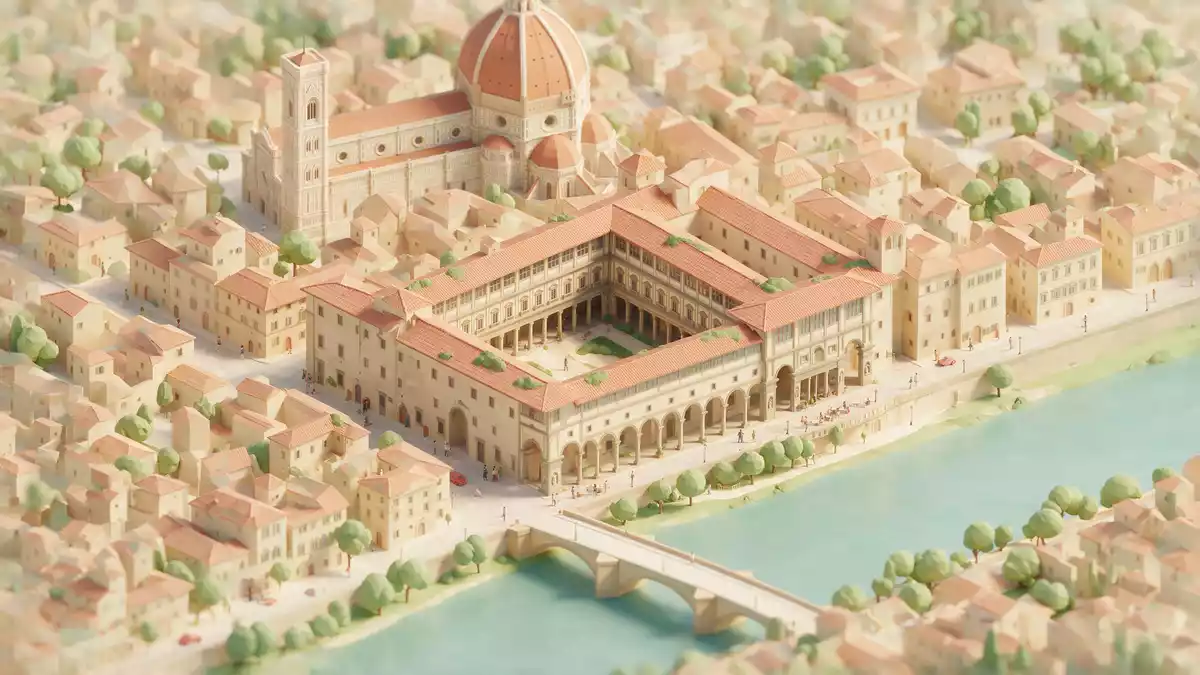
Gallerie degli Uffizi in Florenz is both a monumental sixteenth-century office palace and one of the most concentrated collections of Italian Renaissance art in Europe. Built for Cosimo I de’ Medici and later adapted as a public museum, it turns a long stone complex beside the Arno into a sequence of galleries that trace painting, sculpture and drawing from the late Middle Ages into the eighteenth century.
A Medici office block turned museum landmark
The building that houses Gallerie degli Uffizi was commissioned in 1560 by Cosimo I de’ Medici, the first Grand Duke of Tuscany, as a single complex for Florence’s magistrates and guilds.commissioned in 1560 by Cosimo I The painter and architect Giorgio Vasari laid out a U-shaped palace that runs from Piazza della Signoria towards the Arno, creating a covered urban corridor rather than a freestanding block.U-shaped palace by Giorgio Vasari Its name preserves that origin: “Uffizi” derives from the Italian word for offices, recording the site’s first role.
Work on the complex continued after Vasari’s death in 1574, with architects such as Bernardo Buontalenti and Alfonso Parigi completing the scheme along the lines he had set out.completion by later architects In the late sixteenth century, the top floor began to house the Medici family’s growing collections of sculpture, paintings and artefacts, turning administrative corridors into curated rooms. By the eighteenth century the assemblage of Florentine and wider Italian works had been opened to a wider public, making Gallerie degli Uffizi one of the earliest art museums to occupy a purpose-built government palace.
Architecture along the Arno and the city
Seen from the historic centre, Gallerie degli Uffizi forms a long, regular façade framing a narrow internal courtyard, or cortile, that leads visitors’ eyes towards the river. Vasari’s mannerist architecture uses repetitive bays, columns and pilasters to structure the palace while leaving the space between it and the Arno open as an elongated outdoor room.courtyard leading towards the Arno Stone arcades line this passage, and the Doric screen at the far end articulates the view without closing it, so the palace reads as both building and streetscape.
The complex stands directly beside Piazza della Signoria and close to Ponte Vecchio, tying civil power, commerce and culture into a compact area that is easily walked.location near Signoria and Ponte Vecchio Within the palace, corridors run parallel to the cortile and side wings, and higher levels contain long galleries lined with paintings hung in chronological order. The conversion of former office rooms into exhibition spaces preserved much of the structural rhythm: rectangular rooms follow one another with regular doorways, while ceilings, windows and floors show the Renaissance fabric underpinning the later museum layouts.
Renaissance painting and drawings under one roof
Gallerie degli Uffizi is best known for its dense array of Italian Renaissance paintings, particularly from Florence and Tuscany. Works from the late Gothic period lead into early Renaissance panels, with artists such as Giotto and Fra Angelico giving way to Botticelli, Leonardo da Vinci, Michelangelo, Raphael and their contemporaries.Renaissance paintings and artists The progression continues through the sixteenth century’s Mannerist painters and into later schools, so walking the galleries becomes a compressed journey through several centuries of Italian art.
Beyond the paintings, the museum holds large collections of classical sculptures and a print and drawing cabinet with tens of thousands of works on paper, many of them Florentine.drawings, prints and sculpture The arrangement of rooms places stone figures in halls, loggias and junctions between painting galleries, so visitors move continually between media. The palace itself contributes to the experience: stone staircases, decorated ceilings and views out towards the Arno and the tiled roofs of Florenz remind visitors that the collections sit inside a grand ducal seat rather than a neutral white-box museum.
Visiting Gallerie degli Uffizi: what travellers from Western Europe should know
- Gallerie degli Uffizi stands at Piazzale degli Uffizi on the north bank of the Arno in Florenz, a short walk from Piazza della Signoria and Ponte Vecchio.
- The palace is a multi-storey complex with long corridors and numerous staircases; visiting the galleries involves substantial walking and several flights of steps.
- The museum lies within the historic centre of Florenz, close to the main railway stations and other major sights, so it can be combined with walks through the surrounding streets and squares.
- Italy’s official language is Italian and the currency is the euro.
Searching for Gallerie degli Uffizi on social platforms
These links open searches for Gallerie degli Uffizi on each platform.
Frequently asked questions about Gallerie degli Uffizi
Where is Gallerie degli Uffizi located?
Gallerie degli Uffizi stands at Piazzale degli Uffizi in the historic centre of Florenz, beside Piazza della Signoria and close to the Arno river.
What can visitors expect inside the museum?
Visitors walk through a Renaissance palace filled with galleries of Italian paintings, classical sculptures and extensive drawing and print collections arranged largely in chronological order.
What makes Gallerie degli Uffizi distinctive compared with other museums?
The combination of a sixteenth-century Medici office complex by Giorgio Vasari and a particularly rich sequence of Florentine Renaissance works gives the museum an unusually direct link between its architecture and its collections.


