
Gamla Stan, Stockholm’s island old town of stone and story
Published on 09/18/2026 at 19:34 | Editorial responsibility: Rafael Müller, Editor-in-Chief AD HOC NEWS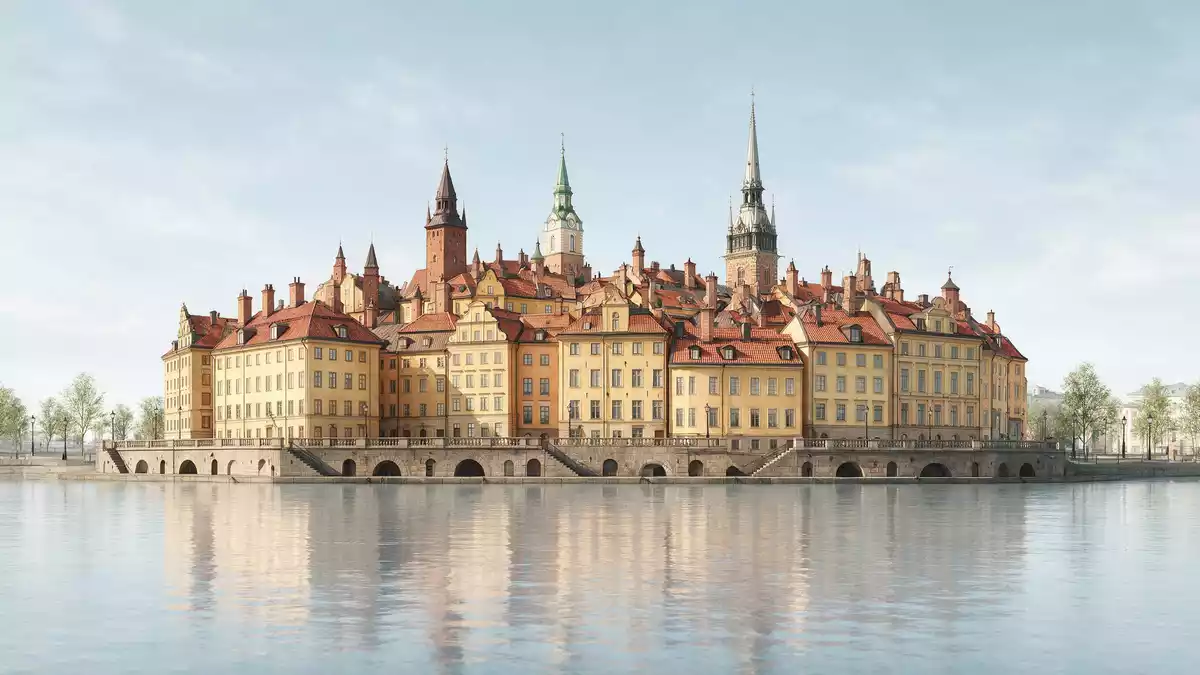
Gamla Stan is Stockholm’s historic old town, a compact island district of cobbled streets, tall narrow houses and royal institutions that grew from a medieval trading hub into the political heart of Sweden in the thirteenth century.
An island between waters and bridges
Gamla Stan occupies the island of Stadsholmen at the centre of Stockholm, surrounded by water on all sides and linked to neighbouring districts by bridges that give the area its former official name “Staden mellan broarna”, the town between the bridges.Staden mellan broarna The old town also encompasses the smaller islets of Riddarholmen, Helgeandsholmen and Strömsborg, creating a compact cluster of land where Lake Mälaren meets the Baltic Sea.Riddarholmen, Helgeandsholmen and Strömsborg
The site is the original core of Stockholm, with settlement dating back to the thirteenth century and a street plan that still reflects its medieval origins.dates back to the 13th century Narrow lanes run between timber-framed and masonry buildings whose façades in warm tones of ochre and rust form continuous frontages along the streets. The islands mark a natural division between the inland waters of Lake Mälaren to the west and the sea inlet of Saltsjön to the east, giving Gamla Stan a landscape setting where harbours, ferry quays and quayside warehouses developed around the old town’s edges.between Lake Mälaren and the Baltic inlet of Saltsjön
Royal power and parish life in stone
The northern part of Stadsholmen is dominated by the Royal Palace, a baroque residence and administrative building that stands on the site where Sweden’s monarchs have exercised power for centuries.Royal Palace Around it cluster other national institutions: the House of Lords, government offices and the Stockholm Stock Exchange, which faces the main square and houses cultural organisations.House of Lords and Stock Exchange On adjacent Helgeandsholmen stand the Parliament and the National Bank, underlining how the medieval nucleus grew into the seat of legislative and financial authority.Parliament and National Bank
Ecclesiastical buildings form a second layer of identity. Storkyrkan, also known as the Cathedral or Church of St Nicolas, rises close to the palace as the main parish church of the old town.Storkyrkan Cathedral Nearby stands the German Church, reflecting the importance of German merchants and craftsmen in Stockholm’s medieval growth and the north German influence on local building styles.North German architecture Across the water on Riddarholmen, the skyline is defined by the Riddarholm Church, a former royal burial church surrounded by noble palaces that now accommodate various public bodies.Riddarholm Church and palaces
Stortorget and the fabric of the old town
At the heart of Gamla Stan lies Stortorget, the Great Square, whose origins go back to the mid-thirteenth century as Stockholm’s oldest public square.Stortorget dates to the mid-13th century The space is enclosed by tall houses with coloured façades and regular rows of windows, some now occupied by the Nobel Prize Museum, which presents the history of the prize and its laureates inside one of the historic buildings.Nobel Museum and coloured buildings Stortorget’s layout, with narrow streets radiating from the square, illustrates how the medieval town organised its marketplace and civic life around a central open space.
The wider urban fabric features lanes such as Västerlånggatan and Österlånggatan, which follow the line of the old town’s western and eastern sides and remain busy thoroughfares lined with shops, cafés and small businesses.Västerlånggatan and Österlånggatan Buildings from the sixteenth and seventeenth centuries survive in large numbers and are legally protected from drastic alteration, preserving plastered masonry façades, steep roofs and decorative details that reflect both Swedish and Germanic traditions.16th and 17th century buildings protected Behind the main streets, passageways and minor alleys retain the intimate scale of the medieval town, with occasional particularly narrow passages often noted for their constrained width.
Visiting Gamla Stan: what travellers from Western Europe should know
- Gamla Stan sits between the mainland district of Norrmalm and the island of Södermalm, reached on foot across several bridges and directly by the metro at Gamla stan station.
- The streets and squares are largely paved with cobblestones, and many routes involve short flights of steps or gentle gradients that reflect the island’s varied levels.
- Ferry quays on the surrounding waterfront link Gamla Stan with other parts of Stockholm, and Riddarholmen and Helgeandsholmen are connected by short bridges and causeways.
- The official language is Swedish and the currency is the Swedish krona.
Searching for Gamla Stan on social platforms
These links open searches for Gamla Stan on each platform.
Frequently asked questions about Gamla Stan
Where is Gamla Stan in Stockholm?
Gamla Stan is the old town of Stockholm, centred on the island of Stadsholmen and including the nearby islets of Riddarholmen, Helgeandsholmen and Strömsborg.
What should visitors expect in Gamla Stan?
Visitors encounter cobbled streets, historic houses, major institutions such as the Royal Palace and Parliament, and churches and squares that reflect centuries of Swedish urban life.
What makes Gamla Stan distinctive among old towns?
Gamla Stan stands out for its combination of medieval street layout, seventeenth-century architecture and its continuing role as the seat of Sweden’s royal, parliamentary and ecclesiastical buildings in a single compact district.


