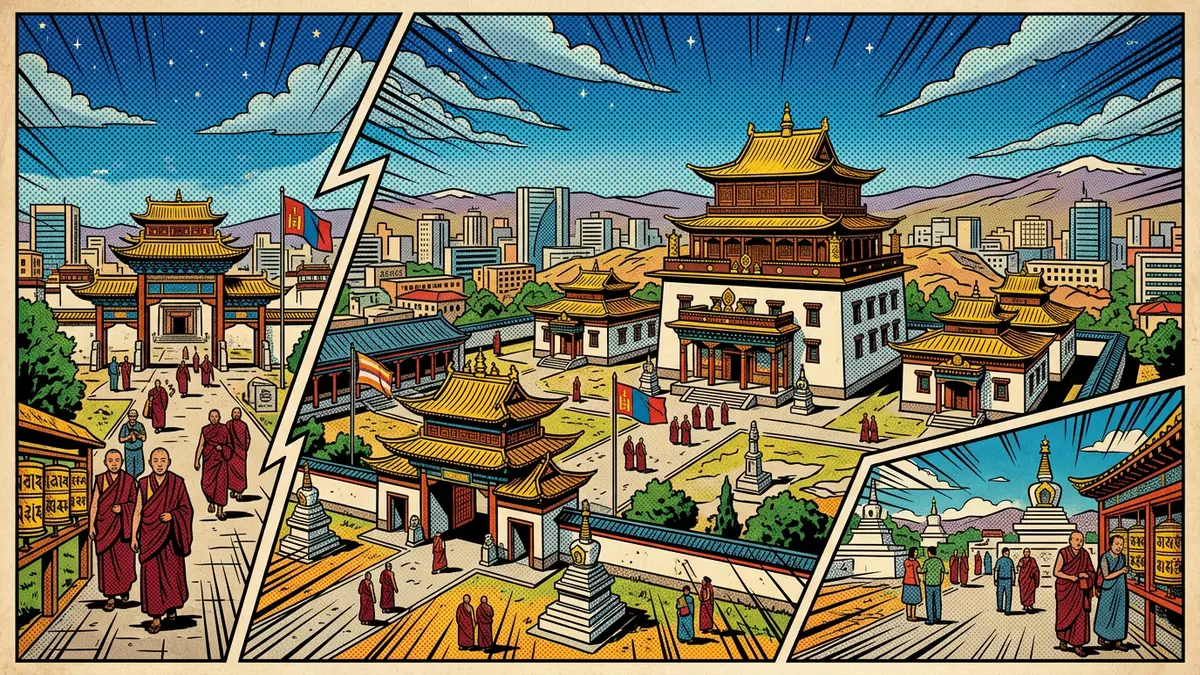
Gandantegchinlen Monastery in Ulaanbaatar’s blue-roofed complex
Published on 08/09/2026 at 15:02 | Editorial responsibility: Rafael Müller, Editor-in-Chief AD HOC NEWS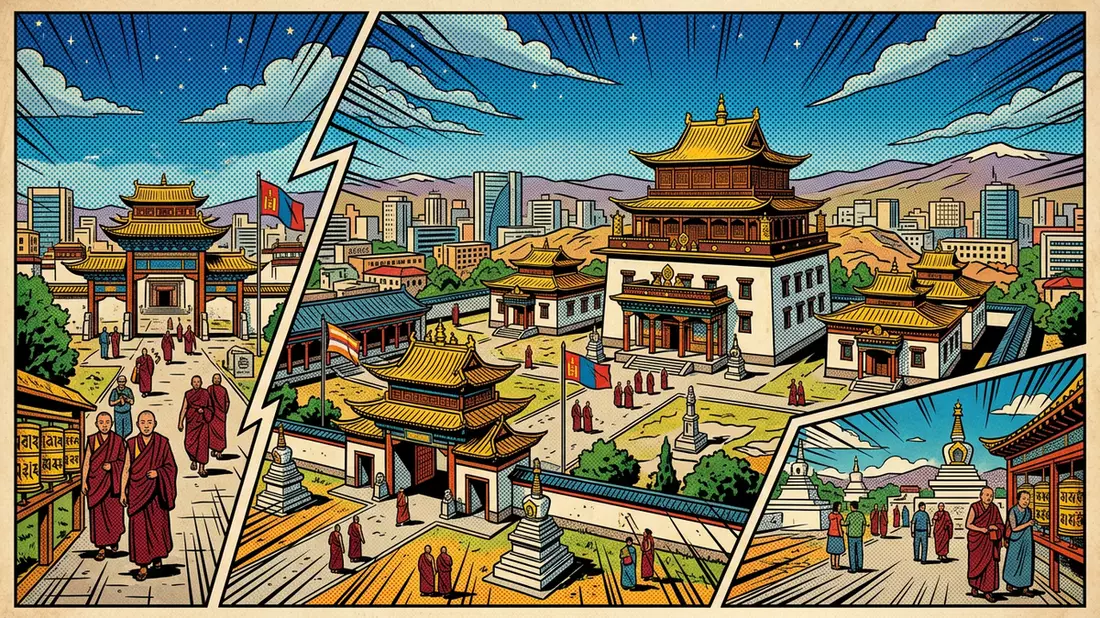
Gandantegchinlen Monastery in Ulaanbaatar is the capital’s best-known Tibetan Buddhist complex, with courtyards, prayer halls and a tall gilded statue at its centre. Founded in 1809 under the Qing Empire, it remains one of Mongolia’s most important active monasteries.
Gandantegchinlen Monastery and its layered temple courts
The monastery spreads across a group of halls and enclosed yards rather than a single block. Red walls, green and blue roofs, and painted woodwork give the place a compact, ceremonial look.
Its name is often shortened to Gandan. The monastery is associated with Tibetan Buddhist practice, and that religious identity shapes the atmosphere of the complex.
A 19th-century Buddhist centre in Ulaanbaatar
The monastery’s origins reach back to 1809, when it was established during the Qing period. That date places it among the older surviving religious sites in the city.
Over the decades, the complex became tied to Mongolia’s Buddhist heritage. The surviving temples and devotional spaces make that history visible in the fabric of the site.
The Buddha statue and the main devotional spaces
Gandantegchinlen Monastery is best known for its large standing Buddha image inside one of the main halls. The figure, with gilded surfaces and a raised platform, gives the interior its strongest focal point.
Elsewhere in the complex, smaller shrines, drums and lamps provide a quieter counterpoint. Visitors move between open courtyards and enclosed halls, with painted columns and ritual objects throughout.
Visiting Gandantegchinlen Monastery: what travellers from Western Europe should know
- The monastery is in Ulaanbaatar and is reached by road within the city.
- Admission arrangements and opening hours are set by the site's operator and change with the season; the official website is the only binding source.
- Morning visits suit the temple courtyards and prayer halls, when the complex is more settled and easier to take in.
- Expect steps, uneven paving and open courtyards, with a full walking circuit through the complex.
- Dress modestly and follow local customs inside the halls; payment in Mongolia is often handled in tugrik, and small cash amounts can be useful.
- Entry requirements depend on your nationality. UK travellers should check the FCDO travel advice at gov.uk/foreign-travel-advice; Irish travellers the Department of Foreign Affairs at ireland.ie; EU and EEA citizens their own national foreign ministry.
Searching for Gandantegchinlen Monastery on social platforms
These links open searches for Gandantegchinlen Monastery on each platform.
Frequently asked questions about Gandantegchinlen Monastery
Where is Gandantegchinlen Monastery?
It stands in Ulaanbaatar, the capital of Mongolia, and forms one of the city’s key religious landmarks. The complex is associated with Tibetan Buddhism.
What should visitors expect on a visit?
Expect temple halls, courtyards, steps and devotional details rather than a single enclosed museum space. Modest dress and quiet behaviour fit the setting.
What makes Gandantegchinlen Monastery distinctive?
Its long history, active monastic life and the large gilded Buddha inside the main hall set it apart within Ulaanbaatar. The mix of painted architecture and ritual objects gives the complex its character.