
Gateway of India, an Indo-Saracenic arch on Mumbai’s waterfront
Published on 09/18/2026 at 06:04 | Editorial responsibility: Rafael Müller, Editor-in-Chief AD HOC NEWS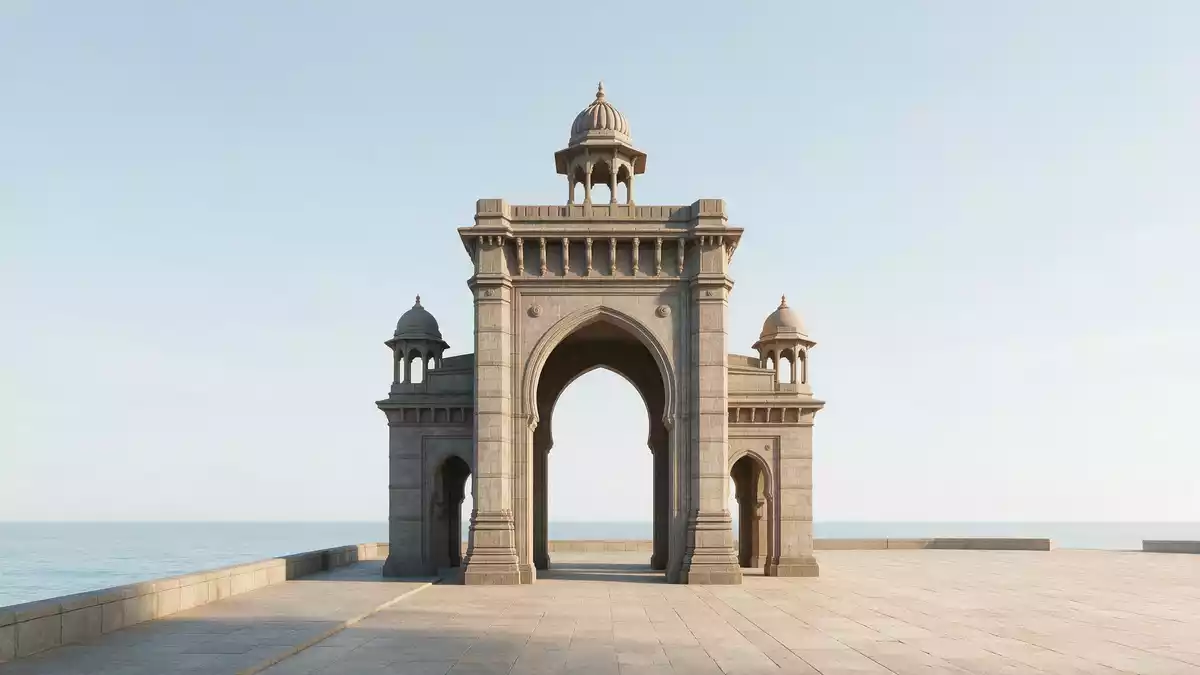
On the southern waterfront of Mumbai, Gateway of India stands as a stone arch facing the Arabian Sea and the harbour beyond. Completed in 1924 in the Indo-Saracenic style, it bridges colonial ceremony and independent India in a single, monumental gesture.
An arch between sea and city
Gateway of India rises at Apollo Bunder in the Colaba district, marking the point where Mumbai’s historic cityscape meets the open water. From the plaza around the monument, the view runs across the harbour, with vessels moving between the jetty and the wider bay.
The structure forms a ceremonial threshold rather than a defensive fortification, framing the sea through its main opening and linking the promenade with the water’s edge. Across the road, the domes and facade of the Taj Mahal Palace hotel create a dialogue between the arch and one of Mumbai’s grandest waterfront buildings, anchoring this stretch of the shoreline as a concentrated ensemble of early twentieth-century architecture.Apollo Bandar, Colaba
Indo-Saracenic design in yellow basalt
Gateway of India is built in yellow basalt over a reinforced concrete frame, a combination that gives the monument both mass and structural stability.Yellow basalt stones The yellow stone surfaces carry carved details and mouldings, while the concrete core supports the overall form, allowing the arch to stand prominently on the reclaimed waterfront site.
Designed by Scottish architect George Wittet, the monument follows the Indo-Saracenic style, blending elements drawn from Islamic and Hindu architecture with a composition shaped by British practice.George Wittet’s design The central archway is flanked by side halls, each topped with small domed forms and decorative finials, while carved stone latticework panels, known as jaali, punctuate the elevations. The profile of the monument is crowned by a larger dome above the main arch, reinforcing its role as a focal point on the skyline beside the sea.
From royal landing to symbolic departure
The origins of Gateway of India lie in the December 1911 arrival of King George V and Queen Mary at Apollo Bunder, when a temporary structure marked their landing on the way to the Delhi Durbar.1911 royal visit The foundation stone for a permanent monument was laid in 1913, and construction progressed through the early twentieth century as land at the waterfront was reclaimed and prepared for the new arch.construction started in 1913
The completed structure was formally inaugurated in 1924, becoming a ceremonial entrance for arriving dignitaries and officials travelling by sea.inaugurated in 1924 In 1948, following India’s independence, the last British troops stationed in the country departed from the pier beside Gateway of India, a moment that turned the monument’s history from one of imperial arrival to one associated with the end of colonial rule.symbolic exit of British troops
Gateway of India in the urban landscape
Gateway of India stands within South Mumbai’s historic fabric, close to important civic and commercial streets and within reach of major rail termini such as Chhatrapati Shivaji Terminus and Churchgate station.distance from railway stations The monument’s placement at the tip of the peninsula means the surrounding area opens both towards the city and out over the water, making it a natural point where urban life and maritime activity visibly meet.
The paved plaza in front of the arch provides space for gatherings and for viewing the structure from different angles, while steps and quays lead down towards the harbour, where small boats operate from the adjacent jetties.waterfront setting In this setting, Gateway of India serves as both a landmark and a reference point for exploring the Colaba area, with streets radiating inland past shops, restaurants and other notable buildings.
Visiting Gateway of India: what travellers from Western Europe should know
- Gateway of India stands at Apollo Bunder in Colaba, South Mumbai, facing the Arabian Sea and lying within reach of major railway stations such as Chhatrapati Shivaji Terminus.
- The plaza around the monument is paved, with steps leading onto the waterfront and approaches that are level over short distances but can be busy and exposed to sun.
- The official language is Hindi and the currency is the Indian rupee.
- Entry requirements depend on your nationality; UK travellers can check the FCDO travel advice at gov.uk/foreign-travel-advice, Irish travellers the Department of Foreign Affairs at ireland.ie.
Searching for Gateway of India on social platforms
These links open searches for Gateway of India on each platform.
Frequently asked questions about Gateway of India
Where is Gateway of India located in Mumbai?
Gateway of India stands at Apollo Bunder in the Colaba district of South Mumbai, on the shore of the Arabian Sea.
What can visitors expect when they come to Gateway of India?
Visitors encounter a large stone arch set on a paved waterfront plaza, with views over the harbour and easy access to nearby streets and the Taj Mahal Palace hotel.
What makes Gateway of India distinctive among Mumbai’s landmarks?
Its Indo-Saracenic design in yellow basalt, its role in the 1911 royal visit and its association with the 1948 departure of British troops give the monument a rare historical and architectural concentration.


