
Gateway of India frames Mumbai’s harbour in basalt
Published on 09/22/2026 at 13:25 | Editorial responsibility: Rafael Müller, Editor-in-Chief AD HOC NEWS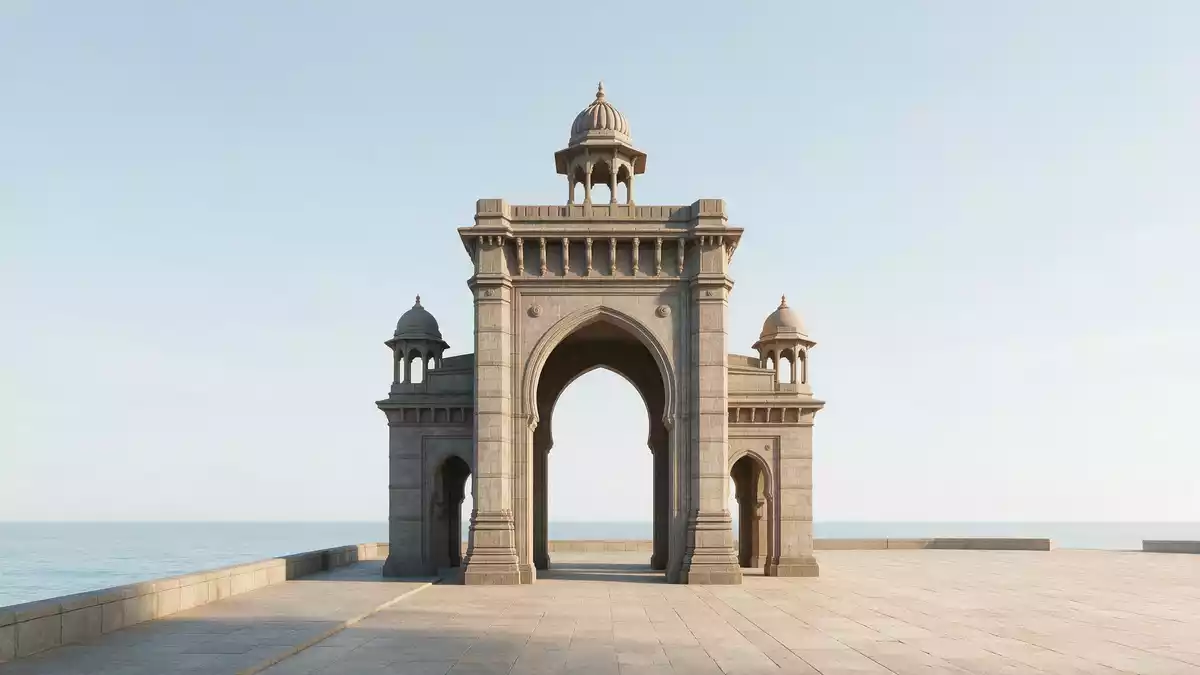
Gateway of India rises beside Mumbai’s harbour as a monumental arch of yellow basalt and reinforced concrete. Designed by Scottish architect George Wittet, it was completed in 1924 and remains closely linked with Mumbai’s waterfront.
Gateway of India and the architecture of the harbour
The monument stands at Apollo Bunder in South Mumbai, facing the Arabian Sea. Its central arch rises 26 metres, while a broad dome and projecting turrets give the structure a formal profile above the waterfront.
Wittet worked in the Indo-Saracenic style, a late-colonial architectural language combining Indian and Islamic motifs with European monumental composition. Carved stone latticework, known as jaali, appears within the design, while the yellow basalt gives the arch its warm colour.
George Wittet’s 1924 monument
The foundation stone was laid in 1913, and Wittet’s design was approved in 1914. Construction continued through the following decade, with the finished monument completed in 1924.
Gateway of India commemorates the landing of King George V and Queen Mary at Apollo Bunder on 2 December 1911. The royal visit took place before the monument was complete, so the finished arch belongs to a later moment than the event it records. Gateway of India’s history connects the waterfront with the final phase of British rule in India.
From imperial entrance to Mumbai landmark
Gateway of India was opened on 4 December 1924 by Rufus Isaacs, the Earl of Reading and Viceroy of India. Its ceremonial role placed the arch within the maritime geography of colonial Bombay, where official arrivals and departures took place beside the harbour.
On 28 February 1948, troops of the 1st Battalion of the Somerset Light Infantry marched through the gateway while leaving India. The same monument therefore carries an association with imperial arrival and with the departure of British forces. A statue of the Maratha ruler Shivaji was unveiled opposite the arch in 1961. The Indo-Saracenic design remains visible in the arch, the dome, the stone surface and the carved screens.
Visiting Gateway of India: what travellers from Western Europe should know
- Gateway of India stands at Apollo Bunder in Colaba, on Mumbai’s southern waterfront. The area faces the Arabian Sea and lies opposite the Taj Mahal Palace hotel.
- The monument is reached through the open waterfront precinct, with paved approaches around the arch and steps within its surrounding public space.
- Ferries serving Elephanta Island depart from the waterfront near Gateway of India. Elephanta’s rock-cut cave temples form a separate heritage site.
- The official language is Hindi and the currency is the Indian rupee.
- Entry requirements depend on your nationality; UK travellers can check the FCDO travel advice at gov.uk/foreign-travel-advice, Irish travellers the Department of Foreign Affairs at ireland.ie.
Searching for Gateway of India on social platforms
These links open searches for Gateway of India on each platform.
Frequently asked questions about Gateway of India
Where is Gateway of India?
Gateway of India stands at Apollo Bunder in Colaba, South Mumbai, beside the Arabian Sea. The waterfront is close to the Taj Mahal Palace hotel and ferry departures for Elephanta Island.
What can visitors expect at the monument?
The site presents a large basalt arch, a central dome, carved stone latticework and a paved waterfront setting. Its public surroundings connect the monument with Mumbai’s harbour.
What makes Gateway of India distinctive?
Its yellow-basalt construction, Indo-Saracenic design and 1924 completion combine architectural form with the history of British rule and Indian independence.


