
Gateway of India in Mumbai: an Indo-Saracenic arch by the Arabian Sea
Published on 09/21/2026 at 23:49 | Editorial responsibility: Rafael Müller, Editor-in-Chief AD HOC NEWS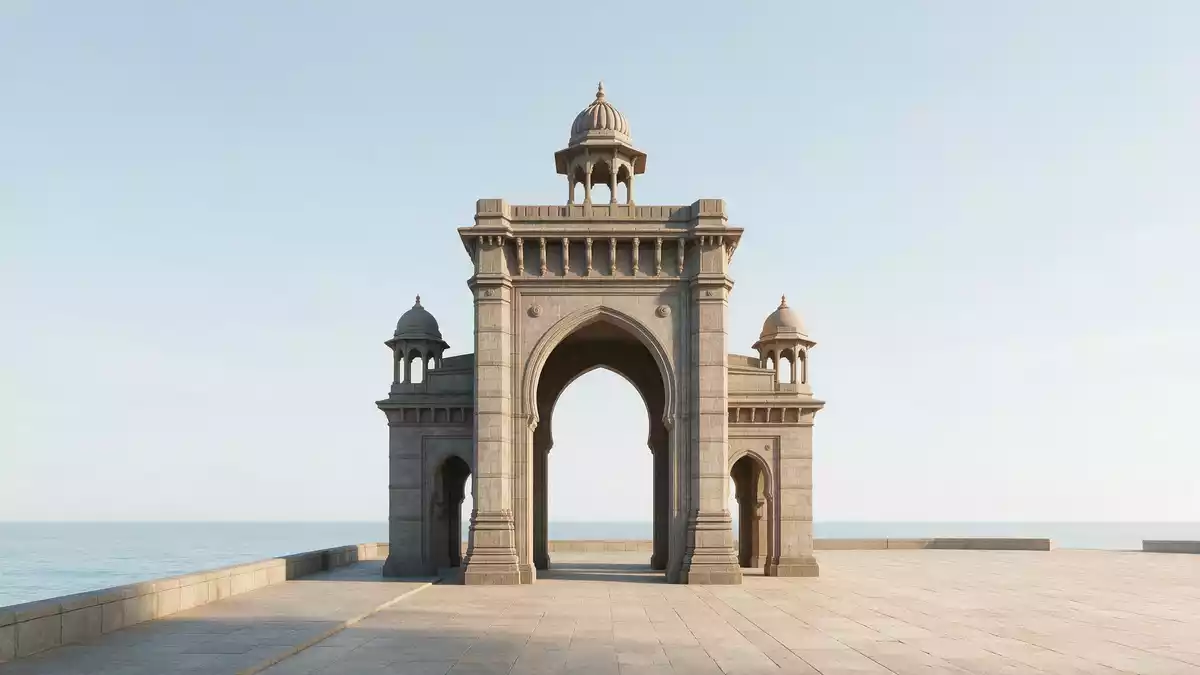
On the edge of Mumbai’s harbour, the Gateway of India rises as a monumental stone arch looking out across the Arabian Sea. Completed in 1924, it was conceived in the early twentieth century as a ceremonial entrance to the city for visitors arriving by ship, and its Indo-Saracenic design links imperial history with the waterfront that still surrounds it.Completed in 1924
An Indo-Saracenic arch on Apollo Bunder
The Gateway of India stands on Apollo Bunder, the old pier area of Mumbai, where the harbour meets the city’s southern tip.Apollo Bunder on the Arabian Sea The monument takes the form of a triumphal arch, built in yellow basalt over a reinforced concrete structure, with a central dome framed by smaller decorative elements.Yellow basalt over concrete At around 26 m (85 ft) high, the arch has a scale that matches the open harbourfront while remaining compact enough to be approached on foot from the surrounding streets.Around 26 m high
Architecturally, the Gateway of India belongs to the Indo-Saracenic tradition, a style used by British architects in India that combines Indian and Islamic decorative motifs with European composition.Indo-Saracenic style The arches echo forms seen in Gujarati and Indo-Islamic architecture, while the overall symmetry and massing follow a more European sense of order.Combination of Gothic Revival with Indian and Islamic motifs Carved stone details decorate the upper sections, giving the structure a finely worked surface that contrasts with the plain expanse of the pier and sea around it.
From royal arrival to departure point
The Gateway of India was commissioned in the context of a royal visit. King George V of the United Kingdom and Queen Mary landed at Apollo Bunder in December 1911, and the monument was planned to commemorate their arrival in India.Commemoration of the 1911 landing of King George V and Queen Mary Scottish architect George Wittet, consulting architect to the Government of Bombay, prepared the design in the years that followed, and construction began in the second decade of the twentieth century.Designed by George Wittet The foundation stone was laid in 1913, and work continued until the arch and its flanking walls were ready for formal inauguration in 1924.Construction started in March 1913 and completed in 1924
The opening ceremony took place on 4 December 1924, when the Viceroy of India, Rufus Isaacs, Earl of Reading, inaugurated the Gateway of India on behalf of the colonial administration.Inaugurated on 4 December 1924 by the Earl of Reading For years, dignitaries arriving by sea entered Mumbai by passing under the arch from the harbour towards the city streets. In 1948, following Indian independence, the gateway also marked the point where the last British troops left India, a symbolic reversal of its original ceremonial role.Departure of the last British troops in 1948
Gateway of India in the cityscape
Standing near the southern end of Mumbai, the Gateway of India forms part of a wider ensemble of waterfront and colonial-era buildings. The forecourt opens towards the harbour, while the landward side links into the streets of Colaba and the commercial districts beyond. From the arch, the line of sight across the water takes in boat jetties and the wider bay, placing the monument directly between city and sea.
The structure’s yellow basalt walls have weathered into a muted tone that sets off the carved details around the cornices and parapets.Built using yellow basalt stones The central arch frames views both outwards and back towards Mumbai’s skyline, and the surrounding platforms provide open space at the water’s edge. The Gateway of India has therefore become a fixed point where the geometry of the harbour, the pattern of streets and the memory of imperial ceremony meet in one highly recognisable structure.Eclectic Indo-Saracenic gateway
Visiting Gateway of India: what travellers from Western Europe should know
- Gateway of India stands on Mumbai’s southern waterfront at Apollo Bunder, facing the Arabian Sea and close to Colaba’s commercial streets.
- The monument is reached on foot from nearby roads; the forecourt and surrounding paving form a broad open space with steps down towards the harbour edge.
- Mumbai is served by Chhatrapati Shivaji Maharaj International Airport and by long-distance rail; onward travel to Apollo Bunder continues by city transport and local taxis.
- The official language is Hindi and the currency is the Indian rupee.
- Entry requirements depend on your nationality; UK travellers can check the FCDO travel advice at gov.uk/foreign-travel-advice, Irish travellers the Department of Foreign Affairs at ireland.ie.
Searching for Gateway of India on social platforms
These links open searches for Gateway of India on each platform.
Frequently asked questions about Gateway of India
Where is Gateway of India located in Mumbai?
Gateway of India stands on Apollo Bunder on Mumbai’s southern waterfront, facing the Arabian Sea and lying close to the Colaba district.
What should visitors expect when they reach Gateway of India?
Visitors find a large stone triumphal arch in yellow basalt, a paved forecourt and open views across the harbour, with city streets beginning just behind the monument.
What makes Gateway of India distinctive among Mumbai landmarks?
Its Indo-Saracenic design, early twentieth-century date and role as both ceremonial entrance and symbolic departure point give Gateway of India a prominent place in Mumbai’s harbourfront.


