
George Town’s layered streetscape of heritage and everyday life
Published on 09/17/2026 at 17:16 | Editorial responsibility: Rafael Müller, Editor-in-Chief AD HOC NEWS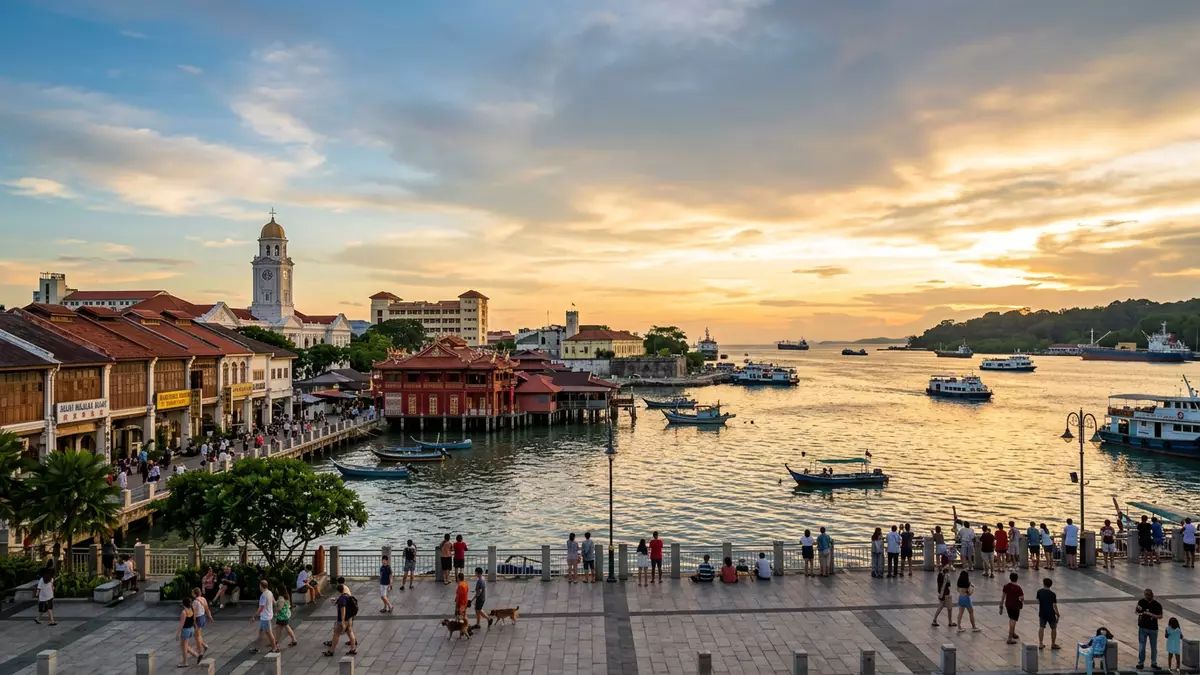
George Town on Penang Island in Malaysia is a historic port city where tight streets, shophouse terraces and religious landmarks sit within a compact urban grid shaped in the late eighteenth and nineteenth centuries. Founded in 1786 as a British trading base, its historic centre is recognised as part of the Melaka and George Town, Historic Cities of the Straits of Malacca UNESCO World Heritage property, giving this small corner of Penang an international profile anchored in solid stone, brick and timber rather than spectacle.Melaka and George Town
George Town as a historic port city
George Town occupies the north?eastern tip of Penang Island, facing the narrow strait that separates the island from mainland Peninsular Malaysia, and grew as a harbour town where ships could approach deep water close to land.leading port of Malaysia Streets laid out from the waterfront form an ordered pattern of cross?roads and lanes, with older quarters close to the shore and later urban districts spreading inland. The earliest phase of the city’s development dates to the late eighteenth century, when Captain Francis Light established a settlement here under the British East India Company, making it the first British foothold in South?East Asia.founded as an entrepôt in 1786
In the nineteenth century George Town was incorporated into the Straits Settlements together with Melaka and Singapore, linking it into a chain of colonial ports along the shipping route between the Indian Ocean and the South China Sea.Straits Settlements context The harbour faces a channel used by international shipping approaching from the north, and the city’s waterfront still shows the transition from trading godowns and wharves to more formal quays and civic buildings. Within walking distance of the shoreline stand Fort Cornwallis, with its low walls and cannon pointing towards the sea, and a series of public structures that reflect the British administrative presence, including the city hall and court buildings, all aligned with the grid rather than separated on distant hilltops.Fort Cornwallis and civic core
Shophouses and streets of a multicultural town
Within the UNESCO?inscribed area George Town is defined by continuous rows of shophouses, narrow?fronted buildings combining commercial space on the ground level and domestic rooms above, and by religious structures serving different communities.multicultural trading town The historic core covers roughly 109 ha at the island’s north?eastern cape, with streets such as Lebuh Armenian, Lebuh Chulia and Lebuh Carnarvon lined by these two? and three?storey terraces whose arcades create sheltered pedestrian walkways linked from block to block.109.38 ha core zone Many shophouses retain timber shutters, plaster mouldings and tiled floors, with rear yards opening onto lanes, forming a fine?grained pattern that is legible on foot.
The streets reflect George Town’s long role as a multicultural trading town. Within a short distance stand mosques such as Masjid Kapitan Keling, Chinese clan temples including Khoo Kongsi, Hindu temples, churches and guild halls, each expressing the architectural traditions of their communities.multicultural heritage and traditions Many of these religious buildings front directly onto everyday streets, so shrines, courtyards and prayer halls are woven into ordinary circulation rather than fenced off in separate compounds. The pattern of shopfronts, five?foot ways and side lanes makes George Town a city where exploration happens at walking pace, passing bakeries, workshops, goldsmiths, coffee shops and traders’ offices in buildings that often date to the nineteenth and early twentieth centuries.heritage buildings in protected zone
World Heritage inscription and urban fabric
George Town’s historic centre forms one half of the joint UNESCO World Heritage property “Melaka and George Town, Historic Cities of the Straits of Malacca”, inscribed on 7 July 2008 for its architectural diversity, multi?ethnic living traditions and well?preserved townscape.inscribed on 7 July 2008 The core zone occupies the tip of the island around the traditional port and commercial streets, while a larger buffer zone extends inland to protect visual corridors, residential quarters and later civic buildings.core and buffer zones Within these zones stand hundreds of buildings ranging from Chinese courtyard houses and Islamic institutions to Art Deco cinemas and early skyscrapers, with the overall scale remaining relatively low compared with many Asian port cities.
City status was granted to George Town in 1957, and the municipal area has since expanded to encompass the whole of Penang Island and nearby islets, yet the World Heritage site retains a distinct identity as the historic inner city.Central George Town city centre Walking across the protected area reveals the layering of periods: nineteenth?century streets sit beside twentieth?century commercial blocks, and post?independence additions such as apartment towers rise beyond the buffer zone, giving a clear physical contrast between fine?grained heritage quarters and more recent large?scale developments. The combination of historic buildings, active places of worship and ongoing commercial use gives George Town an urban fabric where conservation and everyday life co?exist in the same built structures rather than in separate museum districts.
Visiting George Town: what travellers from Western Europe should know
- George Town lies on the north?eastern corner of Penang Island on the Straits of Malacca, reached from mainland Peninsular Malaysia by bridges and ferries linking across the channel.
- The historic core is compact and largely level, with narrow streets, kerbs and covered walkways; many heritage buildings have internal staircases and some lanes carry mixed pedestrian and vehicle traffic.
- Within the World Heritage area, landmarks such as Fort Cornwallis, the city hall, Masjid Kapitan Keling and Chinese clan houses stand within walking distance of one another, so short urban walks connect several districts.
- The official language is Malay and the currency is the Malaysian ringgit.
- Entry requirements depend on your nationality; UK travellers can check the FCDO travel advice at gov.uk/foreign-travel-advice, Irish travellers the Department of Foreign Affairs at ireland.ie.
Searching for George Town on social platforms
These links open searches for George Town on each platform.
Frequently asked questions about George Town
Where is George Town and what kind of place is it?
George Town is the capital of the state of Penang in Malaysia, occupying the north?eastern corner of Penang Island as a historic port city on the Straits of Malacca.
What should visitors expect when walking through George Town?
Visitors encounter dense streets of shophouses, religious buildings serving different communities, harbour?side civic structures and an urban grid laid out since the late eighteenth century, all within a compact area.
What makes George Town distinctive among Malaysian cities?
George Town’s distinction lies in its UNESCO?inscribed historic centre, where British colonial urban planning, multicultural religious life and continuous rows of heritage shophouses remain integrated into an active trading town.


