
Glaciar Perito Moreno and the living ice of Patagonia
Published on 08/20/2026 at 06:56 | Editorial responsibility: Rafael Müller, Editor-in-Chief AD HOC NEWS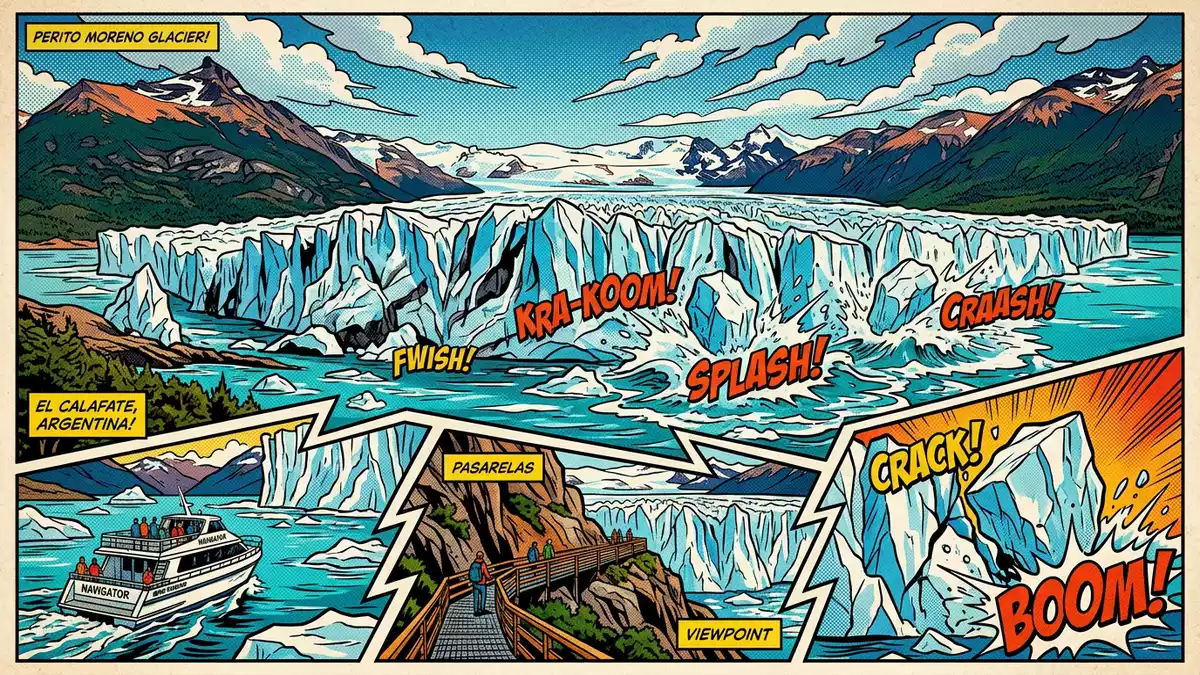
Glaciar Perito Moreno near El Calafate is one of the rare places where an Andean glacier meets a lake in a sharply defined vertical wall that seems almost architectural. Set within Los Glaciares National Park in Argentina’s Santa Cruz Province, it forms part of the Southern Patagonian Ice Field and carries the name of the nineteenth-century explorer Francisco Moreno. The glacier’s scale, its advancing front and its contact with the waters of Lake Argentino together shape a landscape where solid ice is seen as a moving body rather than a static block.
An ice river ending in a wall of blue
Glaciar Perito Moreno is a valley glacier: a river of ice flowing down from the Andean heights into the lower basin of Lake Argentino. At its terminus the glacier ends in a near-vertical face of ice that rises tens of metres above the lake, creating a long, continuous front where the colour shifts from dense white to deep blue. The visible facade stretches for several kilometres across the lake’s channel, with ice towering above the water and dropping to significant depths below the surface.the glacier’s face stretches roughly 3 miles The impression from the shore is of an enormous frozen cliff, its crest irregular and jagged, its base broken into angular blocks where pieces have calved into the lake.
The glacier belongs to the Southern Patagonian Ice Field, a large expanse of accumulated snow and ice that feeds dozens of outlet glaciers along the border between Argentina and Chile.the Southern Patagonian Icefield reaches elevations around 2,100 m From these higher plateaus, ice flows westward and eastward; Perito Moreno is one of the eastern outlets that descend towards Lake Argentino. The active front of the glacier shows clear signs of motion: crevasses run back from the edge, surfaces are buckled and folded, and the face is punctuated by cracks where ice blocks can detach into the water.
Los Glaciares National Park and a protected landscape
Glaciar Perito Moreno sits within Los Glaciares National Park, a protected area designated as a UNESCO World Heritage Site in 1981.Los Glaciares National Park has been inscribed on the World Heritage List since 1981 The park covers part of the Southern Patagonian Ice Field, surrounding lakes and Andean peaks, and protects both the glacier and its wider environment. Within this setting Perito Moreno is singled out as one of the park’s most striking sights: a large glacier that blocks a narrow channel of Lake Argentino, creating a natural ice barrier between different arms of the lake.this large glacier blocks a narrow channel formed by Lake Argentino
The glacier and the park sit in Argentina’s south-western Santa Cruz Province, in the wider region known as Patagonia.Perito Moreno Glacier lies in Los Glaciares National Park in southwest Santa Cruz Province The nearest service town is El Calafate, from which a paved road runs west towards the park. As the road approaches the glacier the landscape opens onto wide views of Lake Argentino, with its branching arms and distant Andean ridges. Forested slopes and low hills frame the approaches, while the ice front itself remains hidden until the last turns, appearing suddenly at the end of the lake arm as an almost geometric wall.
Dimensions, age and the name of Francisco Moreno
Glaciar Perito Moreno is not the largest glacier in Patagonia, yet its accessible front and well-documented dimensions give a clear sense of its scale. The glacier extends for around 30 km (19 miles) in length from the high ice field down to the lake, and its surface area is measured in the hundreds of square kilometres.the glacier is about 30 kilometres longits total area is given as 250 km² At the lake edge, the visible height of the ice wall above the water is around 70 to 78 m, with the ice reaching much deeper beneath the surface and the maximum depth of the glacier reported at about 700 m below the waterline.the glacier towers around 240 feet above the lake’s surfaceits maximum depth reaches approximately 700 m
Scientific studies place the origin of the glacier in the last Ice Age, with estimates around 18,000 years for its age as a formed ice body.the glacier began forming during the last Ice Age approximately 18,000 years agostudies estimate the glacier at about 18,000 years old Over that time glaciers such as Perito Moreno have repeatedly advanced and retreated with climatic changes, but this particular glacier has gained attention because its mass and position have remained comparatively stable. It is widely described as being in approximate equilibrium: accumulation from snowfall and ice flow is balanced by melting and calving at the front, so that the terminus does not show a clear trend of retreat. Perito Moreno’s position and dimensions therefore offer a rare contemporary example of a large glacier whose front persists close to the lake’s shore.
The name Perito Moreno honours Francisco Moreno, an Argentinian explorer and scientist born in 1852 who undertook extensive surveys of Patagonia in the nineteenth century.the glacier was named after explorer Francisco Moreno He played an important role in studies of the Andes and in defending Argentina’s position in boundary discussions with Chile at the turn of the twentieth century. The term “perito” refers to an expert or specialist, and the glacier’s name reflects his recognised status in matters relating to the Patagonian region.
Lake Argentino, ice dams and rupture events
Glaciar Perito Moreno flows into the southern sector of Lake Argentino, a large lake with multiple arms and channels extending around the Andean foothills. At a narrow point the glacier advances far enough to meet the opposite shoreline, effectively forming an ice dam between the main body of the lake and the arm known as Brazo Rico.the glacier periodically cuts off the Brazo Rico arm of Lake Argentino When this barrier is complete, water levels on one side of the dam can rise relative to the other, placing hydrostatic pressure on the ice wall.
In a repeating cycle, the ice dam eventually fails as water forces a channel through the barrier, enlarging it until a full rupture occurs and water passes from one side of the lake to the other.NASA documentation describes periodic ruptures occurring every few yearsaccounts refer to a periodic ice rupture phenomenon at Perito Moreno These rupture events are among the most documented behaviours of the glacier, illustrating the dynamic relationship between the moving ice and the lake basin. Between such events the glacier’s front and the surrounding channel remain visibly under stress, with arches, tunnels and overhangs forming and collapsing as the ice adjusts to the forces exerted by water and gravity.
The glacier in the Patagonian setting
Viewed from the walkways and viewpoints along the shore, Glaciar Perito Moreno sits in a wider Patagonian setting of mountains, water and forest. Beyond the ice front rise the higher ridges of the Andes, often carrying snowfields and the continuation of the ice cap that feeds the glacier. To the sides of the lake, lower slopes support patches of woodland characteristic of southern Argentina, with hardy trees and scrub adapted to the region’s winds and temperatures. The lake itself has a distinctive colour, influenced by fine rock flour carried by meltwater; its arms and bays extend around headlands and peninsulas, providing differing angles on the glacier and its meeting with the water.
El Calafate functions as the main service centre for this part of Santa Cruz Province, with accommodation and transport linked to visits to Los Glaciares National Park.a road journey of about 80 km separates El Calafate from the glacier The road route towards the glacier crosses Patagonian steppe before descending towards the lake shore. From the final parking areas, paths and walkways lead to viewing points opposite the ice face, set above the water and aligned with different parts of the glacier’s front.
Visiting Glaciar Perito Moreno: what travellers from Western Europe should know
- Glaciar Perito Moreno lies within Los Glaciares National Park in south-western Santa Cruz Province, Argentina, with access by road from El Calafate to the lake’s southern arm.
- The approaches to the viewpoints involve walking on prepared paths and tiered walkways, with sections of steps and railings above the lake shore opposite the glacier’s front.
- The glacier and Lake Argentino sit in a Patagonian landscape at altitude lower than the main Andean crest but still exposed to strong winds and changeable mountain weather.
- The official language is Spanish and the currency is the Argentine peso.
- Entry requirements depend on your nationality; UK travellers can check the FCDO travel advice at gov.uk/foreign-travel-advice, Irish travellers the Department of Foreign Affairs at ireland.ie.
Searching for Glaciar Perito Moreno on social platforms
These links open searches for Glaciar Perito Moreno on each platform.
Frequently asked questions about Glaciar Perito Moreno
Where is Glaciar Perito Moreno located?
Glaciar Perito Moreno is in Los Glaciares National Park in south-western Santa Cruz Province, Argentina, near the town of El Calafate on Lake Argentino.
What can visitors expect when viewing the glacier?
Visitors see a broad ice wall rising above Lake Argentino, with tiered walkways and viewpoints along the opposite shore that provide different angles on the glacier’s advancing front.
What makes Glaciar Perito Moreno distinctive among glaciers?
Glaciar Perito Moreno is notable for its stable terminus at the lake edge, its documented ice-dam ruptures and its accessible position within a UNESCO-listed Patagonian national park.


