
Glover Garden and the hillside villas above Nagasaki harbour
Published on 09/19/2026 at 20:13 | Editorial responsibility: Rafael Müller, Editor-in-Chief AD HOC NEWS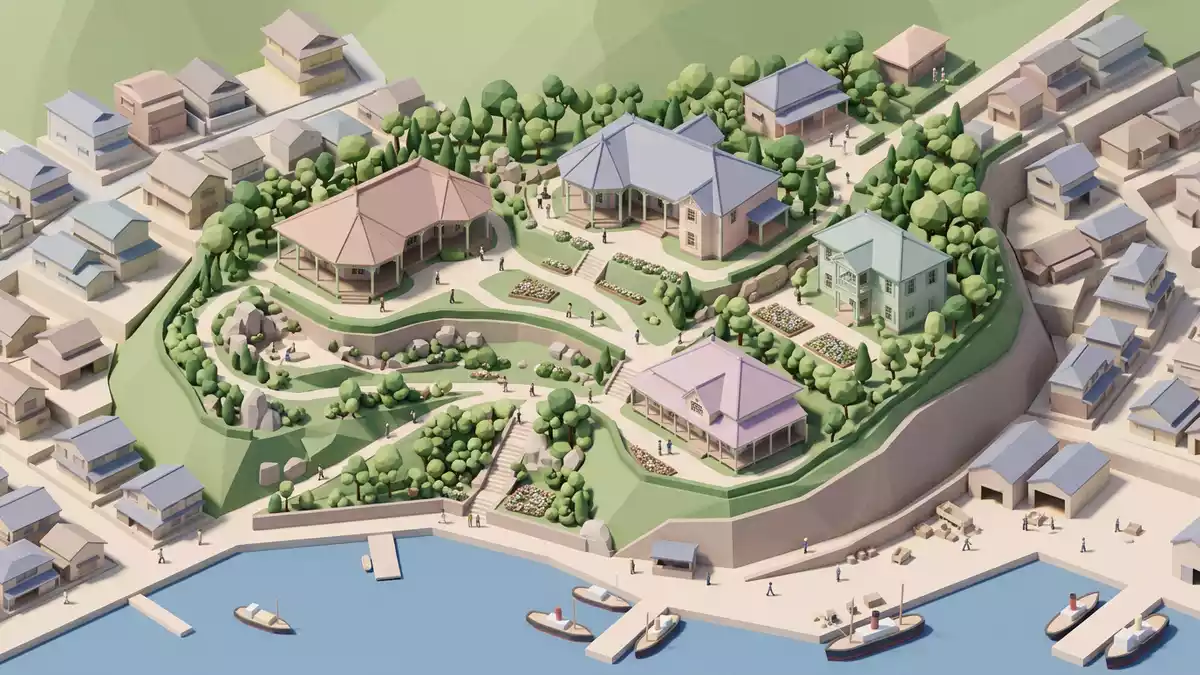
On the hillside of Minamiyamate above Nagasaki harbour, Glover Garden brings together Western-style villas, stone paths and planted terraces into a single layered landscape that looks out over the bay and shipyards. Centred on the Former Glover House, completed in 1863 for Scottish merchant Thomas Blake Glover, it forms an open-air museum of residences and gardens from Japan’s treaty-port era in the nineteenth century.
Terraced gardens above the harbour
Glover Garden occupies a hillside in the Minamiyamate district, the area that once formed part of Nagasaki’s foreign settlement and overlooked the shipping lanes leading into the port. The site sits at 8-1 Minamiyamate-machi, rising above Nagasaki harbour so that many of its paths and viewing points look down across the water and the industrial shoreline.Sitting atop Minamiyamate hill Inside the garden, stone-paved slopes, stairways and planted banks connect the various villas, with lawns, flowerbeds and small courtyards opening between the buildings.
The terraces are arranged around the Former Glover House and other Western-style residences, creating a sequence of outdoor spaces rather than a single formal axis. The paths weave between verandas, timber-framed façades and garden plots, then emerge at viewpoints where the harbour and city spread out below. Trees and shrubs soften the retaining walls and staircases, and the mix of masonry, wood and planting reflects the late nineteenth-century atmosphere of Nagasaki’s hillside residences.Glover Garden is situated on the southern slope
The Former Glover House and Meiji-era villas
The centrepiece of Glover Garden is the Former Glover House, the residence built in 1863 for Thomas Blake Glover after he established himself as a merchant in Nagasaki in the late Edo period.Thomas Glover, a Scottish merchant, built the residence in 1863 The low wooden house blends elements of British colonial-style architecture, such as broad verandas and bay-side orientation, with Japanese craftsmanship in its timber structure and tiled roof. It is recognised as Japan’s oldest surviving Western-style residence and has been incorporated into the “Sites of Japan’s Meiji Industrial Revolution”, a UNESCO World Heritage grouping that links domestic architecture to the wider story of industrialisation around Nagasaki.oldest surviving Western-style wooden building in Japan
Around the Former Glover House, the garden assembles several other Western-style villas from the late nineteenth and early twentieth centuries. These include houses associated with foreign merchant families such as the Ringer and Alt households, whose former residences in Nagasaki have been designated Important Cultural Properties of Japan and gathered on the slope.Former Ringer House and the Former Alt House Some of the buildings stand on their original foundations, while others were relocated to Minamiyamate and restored during the twentieth century to create a compact district of verandas, drawing rooms and garden plots that illustrates how Western domestic layouts were adapted in Nagasaki during the Meiji era.open-air architecture museum
Nagasaki’s foreign settlement in context
Glover Garden belongs to the historical setting of Nagasaki as one of Japan’s treaty ports in the second half of the nineteenth century. After the end of the country’s long period of seclusion, foreign merchants settled on the hill above the bay, and Nagasaki became a centre for trade, shipbuilding and contacts with Europe. Thomas Blake Glover played a notable role in this period through his involvement in shipbuilding, coal mining and industry, and his hillside residence became a visible symbol of that era of exchange.Scottish merchant who contributed to the modernization of Japan
The garden as it stands opened in 1974, when Nagasaki brought together surviving Western-style houses from the foreign settlement and arranged them within a single park on the Minamiyamate hillside.Glover Garden opened in 1974 The combination of villas, museum displays and landscaped terraces gives insight into architectural forms from the late Edo period through the Meiji era, while the views down to the harbour connect the domestic scale of the houses to the shipping and industrial activity that shaped Nagasaki’s position within Japan and beyond.
Visiting Glover Garden: what travellers from Western Europe should know
- Glover Garden stands in the Minamiyamate district of Nagasaki, on a hillside above the harbour; the nearest tram stop on line number 5 is Ouratenshudo, from which the garden can be reached on foot.
- The terrain inside the garden includes stone-paved slopes, staircases and terraces, and moving between the villas involves walking uphill and downhill along paths and steps.
- Oura Church stands close to one of the garden entrances, and the harbour and shipyards are visible from several viewing points within the grounds.
- The official language is Japanese and the currency is the yen.
- Entry requirements depend on your nationality; UK travellers can check the FCDO travel advice at gov.uk/foreign-travel-advice, Irish travellers the Department of Foreign Affairs at ireland.ie.
Searching for Glover Garden on social platforms
These links open searches for Glover Garden on each platform.
Frequently asked questions about Glover Garden
Where is Glover Garden located in Nagasaki?
Glover Garden stands on the Minamiyamate hillside above Nagasaki harbour, in the city’s former foreign settlement district.
What can visitors expect to see during a visit?
Visitors walk among Western-style villas, museum displays and planted terraces, with views down to Nagasaki harbour and examples of nineteenth-century architecture.
What makes Glover Garden distinctive among Nagasaki’s sights?
Its combination of the Former Glover House from 1863, other Meiji-era residences and a terraced hillside setting gives Glover Garden a strong connection to Nagasaki’s treaty-port history.


