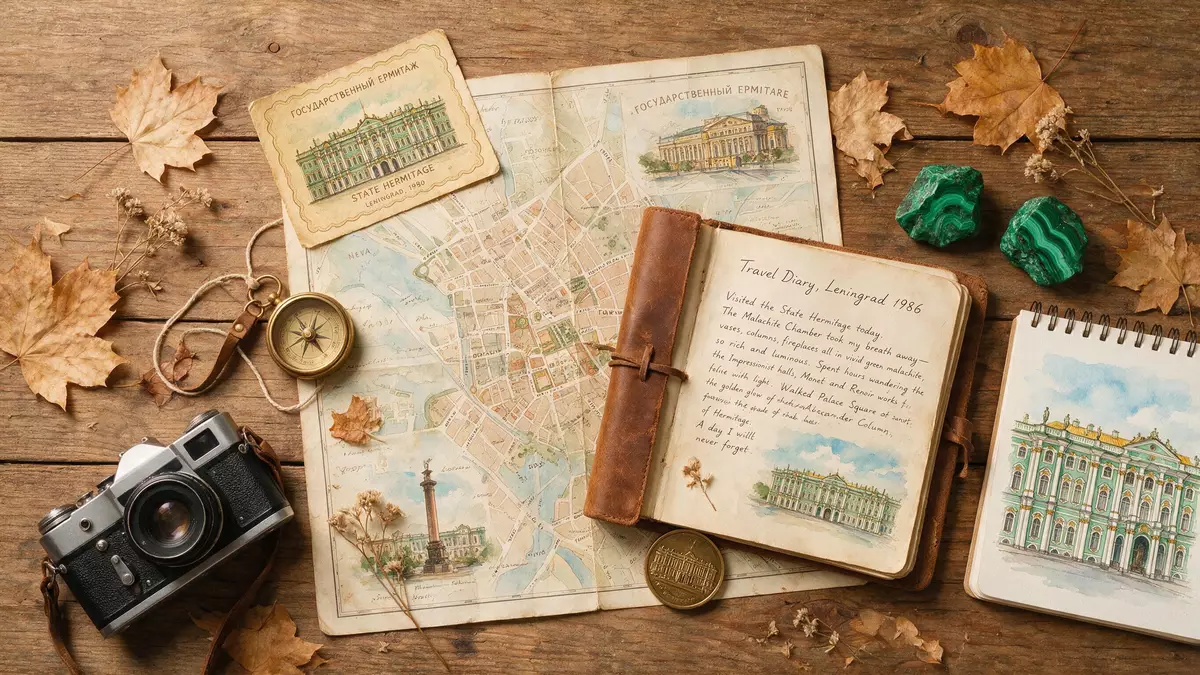
Gosudarstvennyi Ermitazh and the Winter Palace on the Neva
Published on 08/12/2026 at 14:20 | Editorial responsibility: Rafael Müller, Editor-in-Chief AD HOC NEWS
Gosudarstvennyi Ermitazh, known in English as the State Hermitage Museum, occupies the former Winter Palace on the Neva embankment in Sankt Petersburg and turns a Baroque imperial residence into a museum on an enormous scale.State Hermitage Museum The institution traces its origins to 1764, when Empress Catherine the Great began assembling a court collection that would grow into one of Russia’s major museums of art and culture.founded in 1764
A Baroque palace turned museum
The architectural heart of Gosudarstvennyi Ermitazh is the Winter Palace, a former residence of the House of Romanov that stands on Palace Square beside the Neva River in the historic centre of the city.Winter Palace residence The current version of the palace was built between 1754 and 1762 for Empress Elizabeth, with the Italian architect Francesco Bartolomeo Rastrelli shaping its long façades and rich exterior decoration in the exuberant Baroque style of mid-eighteenth-century Russia.Baroque palace by Rastrelli
The main façade runs for more than 200 m (over 650 ft) along Palace Embankment, with repeated rhythms of columns and sculptural ornament emphasising the palace’s length and height.principal façade length Behind this frontage lies a quadrangular plan with multiple staircases, halls and suites of rooms that once housed the imperial family, their state apartments and service quarters and now form part of the museum’s main complex.
From Catherine’s retreat to a vast collection
Gosudarstvennyi Ermitazh began as Catherine the Great’s private gallery, created when she acquired hundreds of paintings from the Berlin merchant Johann Ernst Gotzkowsky in 1764 and kept them in a secluded wing adjoining the Winter Palace.Catherine’s private gallery The French word “hermitage”, meaning a retreat, gave the museum its name as the collection expanded beyond the initial set of canvases into a broad survey of European painting.
During the nineteenth century the museum moved from private to public status, with Emperor Nicholas I commissioning the New Hermitage, a purpose-built gallery that opened to visitors on 5 February 1852 and made the institution one of Russia’s earliest public art museums.New Hermitage opened 1852 Over time Gosudarstvennyi Ermitazh absorbed the Winter Palace fully into its footprint, and the combined complex now holds an extensive collection that ranges from prehistoric artefacts to twentieth-century art.collection breadth
Interiors shaped by fire and redesign
Although the exterior of the Winter Palace retains Rastrelli’s Baroque composition, the interiors visitors encounter in Gosudarstvennyi Ermitazh reflect successive redesigns and a major rebuilding after the fire of 1837.fire of 1837 Nineteenth-century architects such as Giacomo Quarenghi, Ivan Starov, Carlo Rossi and Auguste Montferrand reworked many of the rooms, introducing classical motifs and new decorative schemes that created the sequence of state halls and galleries seen today.late Classical interiors
Visitors move through grand staircases and ceremonial halls before reaching more intimate galleries, each with its own character shaped by wall colours, flooring and display cases and by the mixture of paintings, sculpture and decorative arts on show. The scale of the building means that the museum’s rooms extend across several levels, and the experience of the collection is closely tied to the architecture of the former palace.
Visiting Gosudarstvennyi Ermitazh: what travellers from Western Europe should know
- Gosudarstvennyi Ermitazh stands on Palace Embankment facing the Neva River, with the main museum complex centred on Palace Square in the historic core of Sankt Petersburg.
- The Winter Palace forms part of a large ensemble of interconnected buildings, and a visit involves moving along extended corridors and climbing staircases between the suites of rooms.
- The museum complex faces the broad open space of Palace Square, with the Alexander Column in view, and its riverside frontage looks towards the opposite bank of the Neva.
- The official language is Russian and the currency is the rouble.
- Entry requirements depend on your nationality; UK travellers can check the FCDO travel advice at gov.uk/foreign-travel-advice, Irish travellers the Department of Foreign Affairs at ireland.ie.
Searching for Gosudarstvennyi Ermitazh on social platforms
These links open searches for Gosudarstvennyi Ermitazh on each platform.Frequently asked questions about Gosudarstvennyi Ermitazh
Where is Gosudarstvennyi Ermitazh located in Sankt Petersburg?
Gosudarstvennyi Ermitazh occupies the former Winter Palace and neighbouring buildings on Palace Square and Palace Embankment beside the Neva River in central Sankt Petersburg.address on Palace Embankment
What can visitors expect on a visit to Gosudarstvennyi Ermitazh?
A visit involves passing through grand staircases and state halls into galleries filled with paintings, sculpture and decorative arts, all housed within the extensive rooms of the former imperial residence.
What makes Gosudarstvennyi Ermitazh distinctive among museums?
Gosudarstvennyi Ermitazh combines Catherine the Great’s eighteenth-century court collection with the vast Baroque architecture of the Winter Palace, creating a museum where art and palace interiors are inseparable.court museum origins